Thursday, October 2, 2008

Wednesday, October 1, 2008
Counterterror: Guilt by Association
At first, Kristina Berster didn't believe that she would have to become a fugitive. But when she noticed "wanted" posters it was clear that she wouldn’t remain free for long if she stayed in West Germany. The national mood was grim by 1973, very much akin to the repression of the Nixon era, when the anti-war movement cracked and the country continued to reel from politically-motivated assassinations. By the time the informer whose testimony had originally implicated her recanted, she was out of the city, living on the edge, cut off from family and friends.
Perhaps leaving had been a mistake, she thought. But it was too late to look back.
Five years later, while she was in Montreal looking for a way into the US, a German lawyer was being convicted of "conspiracy" for assisting his clients to maintain their identities. Kurt Groenwold, who had defended Red Army Faction leaders during the intervening years, was sentenced to two years in jail because his assistant had provided support for the suspects. Defending "enemies of the state" in anything but a perfunctory manner had become grounds for a conspiracy charge.
It was the opening shot in a series of similar cases. The court had rejected Groenwold's argument that his clients had the right to determine the nature of their own defense. Such a defense, said the court, would "promote the ideas of the defendants." Those ideas were too dangerous to be heard.
The German crackdown on left-leaning lawyers was no surprise. Attorneys had already been disbarred and indicted on similar charges. This served as a major incentive for Bill Kunstler to take Kristina’s case after she was caught attempting to enter the US. Groenwold's conviction reminded him of what had happened to Kristina's first attorney. After an early attempt to disbar lawyers in 1971, the federal parliament passed amendments pointedly labeled "Lex Baader-Meinhof." They provided prosecutors with legal grounds to bar overly-aggressive lawyers, to limit the number of lawyers on a case, and to exclude defendants from their own trials if the court believed that "they willfully caused their own unfitness."
On March 11, 1975, Groenwold was excluded from the Baader-Meinhof trial. Three months later he was disbarred. He had "only been disbarred," he thought, "perhaps because of my wealthy family associations...I have been lucky for now." But criticism of the constitution or government had become a crime, and lawyers could now be jailed for objecting to prison conditions. "Always the so-called liberals and social democrats come to power and make the state bigger and more powerful," said Groenwold. "They think that if they do the work of the fascists, then the fascists will never come to power. But always, the fascists eventually come to power and then the social democrats are arrested by the very policemen they hired."
In 1978, the Bertrand Russell Tribunal concluded that constitutional rights in Germany were being seriously eroded by repressive laws, censorship, and a job ban. Perhaps those chilling effects were the price of Germany's preoccupation with order. In any case, dissent was no longer to be tolerated. The tough prescription for social crisis was pre-censorship, confiscations, blacklisting, detention, the Radical Decree, and much more.
There was also an unanticipated side effect: a new generation of terrorists. Even Andreas Baader, who had been locked up for five years by the time former SS official Hans Martin Schleyer was murdered, disapproved of such actions. On the eve of Baader’s own mysterious death from gunshot wounds, he told a chancellary official that he had never approved of, and would never approve of, terrorism in its current form of brutal actions against uninvolved citizens.
By this time, however, both the state and its enemies had gone beyond symbolic bombings and police riots. Despite protests from former Red Army supporters that terrorism merely provided an excuse for more repression, the violence of the new generation continued, capturing the imagination of some disaffected young people. Danny Cohn-Bendit, who had moved to Germany from France after the May, 1968 student uprising there, concluded that the Germany Left was trapped in a battle that was a product of German society itself.
None of this history made it into the record during the Berster trial. Yet Kristina’ situation was obviously filled with irony. Having rejected the violence that enveloped her homeland, she left Germany only to be haunted by its specter and exploited by a US intelligence community hungry for a terrorist scare. Guilt by association was a cheap shot in almost any country's court, but it certainly made good copy.
Chapter 20 of Prelude to a Revolution
Previous parts of Counterterror:
Next week: The media & the lessons
Thursday, September 25, 2008
The Final Failure of Reaganomics
 We’ve all seen the headlines: The government takes over troubled mortgage giants Fannie Mae and Freddie Mac, Lehman Brothers files for bankruptcy, Merrill Lynch is acquired by the Bank of America, and the government announces an $85 billion emergency loan to rescue insurance giant American International Group (AIG) as stock prices plummet. And that was just the beginning.
The government is currently debating a $700 billion bailout of distressed banks under a plan that initially proposed to give Treasury Secretary Henry Paulson and the Bush administration unprecedented power. We need to "remove the distressed assets from the financial system," suggests Paulson, who resigned as CEO of Goldman Sachs to become the Treasury secretary in 2006 after amassing a personal net worth of $700 million during his time at the bank.
How did all this happen? The root of the problem can be traced back to the deregulation era that began during the Reagan administration. What George H.W. Bush once called "voodoo economics" fast became the biggest redistribution of wealth since the New Deal. The central article of faith in the "Reagan Revolution" was that money rerouted from the poor to the rich would produce a burst of productivity and economic growth. Give to the corporations and the wealthy, said the "supply side" economists, and they will invest the money in new factories, research and technology, and the country will be restored to greatness.
Did the theory work? Hardly. Rather than putting their money into jobs, research or equipment, the country’s biggest businesses went on the largest merger binge in history, buying up smaller companies in a trend that spelled less competition, less productivity, and more control of the economy in fewer hands. Multi-billion dollar corporate war chests were assembled to finance takeovers of large oil and coal companies, communications giants, and prestigious financial institutions.
After a stock market meltdown in 1987, Wall Street advised the US Treasury not to meddle in financial markets. This paved the way for consolidation around large merchant banks, institutional investors, stock brokerage firms, and large insurance companies. Complex speculative instruments – derivatives, options, futures, and hedge funds – were largely unregulated, becoming vulnerable to manipulation.
Then, in 1999, the Financial Services Modernization Act – also known as the Gramm-Leach-Bliley Act – removed remaining regulatory restraints on Wall Street's powerful banking conglomerates. Repealing the Glass-Steagall Act of 1933, a New Deal reform put in place in response to corruption that had resulted in more than 5,000 bank failures in the years following the 1929 Wall Street crash, commercial banks, brokerage firms, institutional investors and insurance companies were permitted to invest in each others’ enterprises and integrate their financial operations.
In short, the current financial crisis has been building for a long time. But the alarm bells didn’t start ringing until June, 2007, when two hedge funds of the New York investment bank Bear Stearns lurched toward collapse because of their extensive investments in mortgage-backed securities. They were forced to dump assets as the trouble spread to major Wall Street firms such as Merrill Lynch, JPMorgan Chase, Citigroup, and Goldman Sachs, which had loaned the firm money.
Over the summer, German banks with bad investments in the US real-estate market were caught up in the crisis. But the most obvious sign of trouble was the Federal Reserve’s decision on August 9 to pump $24 billion into the US banking system through large purchases of securities, while the European Central Bank made a record cash injection of $130 billion into its markets to shake off credit fears. On the same day, Wall Street suffered its second-worst decline of the year as the Dow Jones dropped by nearly 400 points.
The next day, the Fed pumped another $38 billion in temporary reserves into the financial system, but the government rejected a request for Fannie Mae and Freddie Mac to take on more debt. At the end of the month, President Bush announced a plan to use the Federal Housing Administration, which insures loans for low-income borrowers, to offer government-guaranteed loans to around 80,000 homeowners in default.
On Sept. 18, 2007 the Federal Reserve started cutting interest rates, citing the credit crunch on Wall Street and in the broad economy. The nation's central bank made cuts at seven straight meetings. It also agreed to start loaning money directly to Wall Street firms, rather than only to commercial banks, and to accept troubled mortgage-backed securities as collateral. In October, profits at Citigroup dropped sharply. One large financial institution after another reported heavy losses.
At the start of 2008, the Bank of America acquired Countrywide Financial in a deal that rescued the country's biggest mortgage lender. Another sign of trouble: Bear Stearns CEO James Cayne lost his job. In February, Congress approved a $150-billion spending package to stimulate the sluggish economy. In March, on the verge of collapse and under pressure by the Federal Reserve, Bear Stears was forced to accept a buyout by investment bank JPMorgan Chase at a fire-sale price. The deal was backed by Fed loans – up to $29 billion in financing to cover potential losses. In July, the California mortgage lender IndyMac collapsed and troubles deepened for Fannie Mae and Freddie Mac.
Which brings us to September 6, 2008, when Treasury Secretary Paulson announced the takeover of Fannie and Freddie, putting the government in charge of firms that own or back more than $5 trillion in mortgages. The Treasury Department agreed to provide up to $200 billion in loans to the cash-starved firms, which are crucial sources of mortgage funding for banks and other lenders. It was a bid to reverse a prolonged housing and credit crisis. By the way, this was the same week when the McCain campaign was pushing the “lipstick on a pig” charge and the candidate himself remained certain that the “fundamentals of the economy are strong.”
Both Fannie and Freddie were placed in a government conservatorship, a move that could end up costing billions. The firms own or guarantee about half the home loans in America. The government implicitly had been guaranteeing their creditworthiness, enabling them to borrow at below-market rates. But private shareholders pocketed the profits they made lending cheap money at higher interest rates.
A week later, on Sept, 15, 2008, Lehman Brothers, burdened by $60 billion in soured real-estate holdings, filed for bankruptcy after attempts to rescue the 158-year-old firm failed. Merrill Lynch also agreed to be acquired by the Bank of America, and AIG asked for a bridge loan of billions of dollars from the Federal Reserve. The $50 billion Bank of America deal creates a bank that will rival Citigroup, the biggest US bank in terms of assets. Meanwhile, stocks fell, the Dow Jones sliding 504.48 points – the worst drop since the 9/11 attacks. Stocks also posted big losses in markets across much of the globe. The day has been labeled “Black Monday."
The next day, Sept. 16, 2008, the government agreed to an $85 billion emergency loan to rescue AIG, saying failure of the company could hurt the already delicate financial markets and the economy. That was Tuesday. On Wednesday, the Dow lost about 450 points, giving it a shortfall of more than 800 for the week. Markets around the world were also having a confidence crisis, and Russia shut down its market for a third day following its worst plunge since 1998.
Last Thursday, the Federal Reserve, working with banks in Europe, Canada and Asia, pumped as much as $180 billion into money markets to combat a seizing up of lending. Republicans blasted the Treasury Department and Fed for orchestrating the AIG bailout, and the White House for not informing them of the plan. John McCain said he would fire SEC Chair Chris Cox (which the President can’t actually do), and Barack Obama called it evidence of the failure of deregulation and Bush-McCain policies.
What’s next? Most likely, a $700 billion government bailout, unspecified limitations on executive payouts, a bipartisan board to handle implementation – and, perhaps, changes in regulation of the mortgage market, forcing companies to restructure individual loans rather than foreclose them. It’s not surprising that McCain, who proposed this week that his first debate with Barack Obama be postponed because of congressional negotiations on the proposed bailout, would prefer to grandstand in DC than take questions about his changing positions. A joke in Washington these days is that the crisis seems to be turning former deregulators into socialists – at least as far as business risks are concerns.
Vermont’s junior US Senator, Bernie Sanders, who has never been shy about his socialist leanings, wants to go further. He is proposing a surtax on the very wealthy, stronger oversight of financial institutions, and an end to deregulation policies. He also argues that huge businesses like Bank of America should be broken up so no company in the future could bring the economy down with it. In the meantime, he calls for an immediate economic stimulus package that would put people to work rebuilding infrastructure, and increasing energy efficiency and sustainable energy.
“The people who can best afford to pay and the people who have benefited most from Bush's economic policies are the people who should provide the funds for the bailout,” Sanders says. “It would be immoral to ask the middle class, the people whose standard of living has declined under Bush, to pay for this bail out while the rich, once again, avoid their responsibilities.”
Sanders’ plan includes:
* A five-year, 10 percent surtax on income over $1 million a year for couples and over $500,000 for single taxpayers to raise more than $300 billion in revenue
* Ensuring that assets purchased from banks are realistically discounted so companies aren’t rewarded for their risky behavior and taxpayers can recover the amount paid for them
* Equity stakes in the bailed-out companies so that the assumption of risk is rewarded when companies' stock goes up
* A major economic recovery package which puts people to work at decent wages rebuilding infrastructure and moving the country from fossil fuels to energy efficiency and sustainable energy
* Reinstalling the regulatory firewalls that were torn down in 1999, including re-regulating the energy markets and possibly abolishing various financial instruments that have created an enormous shadow banking system at the heart of the financial services meltdown
Finally, and most radically, Sanders calls for ending the danger posed by companies that are "too big to fail," breaking them up if necessary. “We should not be trying to solve the current financial crisis by creating even larger, more powerful institutions,” he argues.
It’s not likely that most of this plan will be embraced by Congress. But the crisis is certainly forcing the country to take a serious look at Reagan’s old claim that “government is the problem.” Even President Bush, in his remarks to the country on Sept. 24, admitted that “democratic capitalism” – which he still considers “the best system ever devised” – needs serious help. With the economy’s “fundamentals” clearly in jeopardy and the disaster wrought by deregulation and corporate excess finally exposed, government intervention has become the only way out.
Thursday, September 18, 2008
VT Candidate Pledges to Prosecute Bush
Charlotte Dennett, who entered the race for Vermont Attorney General this week, readily admits that it will be an uphill battle. But the Vermont Progressive Party’s candidate does have one thing going for her – an issue with the potential to mobilize voters upset about the Iraq War. At her first press conference, sitting next to renowned prosecutor and author Vincent Bugliosi, she pledged to prosecute George W. Bush for murder if elected and appoint Bugliosi as a special prosecutor to take on the job. (See video clips below)
Bugliosi had come to Vermont specifically to back Dennett’s bid against incumbent Attorney General William Sorrell, who has held the job since 1997. “There is no better state to bring this forward,” Dennett said, pointing to the fact that Vermont has lost more soldiers per capita than any other state during the war and that voters at 36 Town Meetings have called for Bush’s impeachment.
“No man is above the law,” Bugliosi argued, explaining that a state Attorney General can prosecute Bush for conspiracy to commit murder after he leaves office. The key is to establish “overt acts” that prove there was a conspiracy to mislead the country into war, he said. Bugliosi pointed specifically to Bush’s frequent public statements, which were broadcast nationally, and the recruitment of Vermonters to fight in Iraq. “Any Attorney General can do this,” he said.
Dennett, who has been practicing law since 1997, is also an investigative journalist. "When I read Mr. Bugliosi’s meticulously-argued case," she has explained, "it struck a chord with me as a Vermonter and an American citizen.”
Bugliosi has won 105 out of 106 felony jury trials and is best known for prosecuting Charles Manson. Yet his most recent book, The Prosecution of George W. Bush for Murder, has proven highly controversial. Mainstream media outlets have declined to review it or interview him, Bugliosi noted. Asked what explains the reaction, he speculated that the Right Wing in the US has frightened many people into silence. Thus, “the establishment has decided Bush should not be held accountable,” he said.
In recent days, there have been renewed calls to go after the president. For example, Seattle Congressman Jim McDermott has announced that he wants to see Bush impeached, whether or not he’s still in office. He has joined a call from Ohio Congressman Dennis Kucinich to launch impeachment proceedings, and has cited Bugliosi’s book as part of the reason for his decision.
Although pleased that McDermott is calling for impeachment, Bugliosi thinks congressional action doesn't go far enough. "Impeachment alone would be a joke for anyone interested in justice," he says. His recommendation is that a state official – Dennett, for example, if she is elected – should prosecute Bush for murder in the deaths of American soldiers fighting in Iraq.
On the campaign trail, Democratic Vice Presidential candidate Joe Biden recently said that an Obama/Biden Administration would pursue criminal charges against Bush over the treatment of captured terrorists held at the US Naval Base at Guantanamo Bay. “If there has been a basis upon which you can pursue someone for a criminal violation, they will be pursued,” Biden pledged at a Florida campaign stop.
Earlier this year, Barack Obama took a similar position, stating that he would look at whether Bush violated laws. But fearing that such a position could undermine their chances of victory, Biden subsequently softened his position, telling the Philadelphia Daily News that he didn’t want the start of an Obama/Biden term to look like a “witch hunt.”
At this point, Dennett’s chances of victory aren’t strong. Although Vermont Progressives have elected representatives to the state legislature, no candidate has yet come close to winning a statewide race. Anthony Pollina, the Progressive standard bearer who ran for governor in 2000 and received 24.8 percent of the vote in a 2002 race for Lt. Governor, decided this summer to run for governor as an Independent in hopes of broadening his base.
Sorrell, a Democrat, has enjoyed bi-partisan support, and received enough write-in votes in Vermont’s recent primary to appear on the November ballot as both the Democratic and Republican candidate. Nevertheless, a strong turnout for Dennett would send the message that the idea of prosecuting Bush is something to seriously consider.
In 2007, Vermont's State Senate passed a resolution calling on the US Congress to impeach Bush over his handling of the war. But House Speaker Gaye Symington, a Democrat who is currently running for governor against Republican incumbent James Douglas, argued at the time that the move wasn’t appropriate prior to a Congressional investigation. During the House proceedings, about 400 Vermonters from 102 communities showed up at the State House but the resolution was defeated. Vermont's congressional delegation has shown little interest in the idea.
The question raised by Dennett’s promise to pursue prosecution of Bush is whether anger about the war – and how the public and Congress were misled – are enough to create a competitive race against a successful incumbent. Vermonters don’t register by party, and identification as Democrats and Republicans is weaker than in most states. But it remains to be seen if the race can become an unofficial referendum. In essence, a strong turnout for Dennett would mean that Vermont voters want to take the lead in turning a former president into a criminal defendant.
Video Report on Charlotte Dennett’s Pledge
Bugliosi testifies before House Judiciary Committee
Wednesday, September 17, 2008
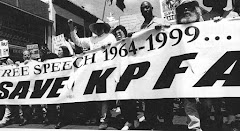
Pacifica Meltdown: The Price of Democracy
 Rob Robinson, a member of Pacifica Radio’s National Board representing WPFW in Washington, DC, has been working on programming issues for years. In 2006, he finally succeeded in getting a National Programming Policy adopted, although several key elements were sidetracked and few people have read it. In early September, at a meeting of the network’s Programming Committee, he explained again that stations are losing listeners and not meeting on-air pledge goals. The current programming schedules aren’t attracting enough people, he argued, and the audience is aging. “I’m not trying to dictate to management,” he promised, yet he stressed that some accountability is needed.
The Committee’s main business that night was to deal with a series of new proposals Robinson had put forward in his role as chair. But those on the phone were also thinking about a motion referred to them by the Pacifica National Board. Concerned about listenership, the Board was asking the Committee to consider a series of “performance requirements” for managers developed by KPFK director Grace Aaron.
The basic idea is that Program Directors, Station Managers, and the Executive Director should be working to increase listenership by 7 percent each quarter, or else have their failure to do so “kept on file” as part of performance evaluations. Some Board members had problems with the idea. “Magical thinking doesn’t work,” said KPFA Director Bonnie Simmons. “I can’t imagine people working under this system.” Others called it reckless, arbitrary, and punitive.
In the end, the motion was passed, but mainly because it would be referred to the Programming Committee for further consideration. When the Committee met, however, it wasn’t ready to deal with the issue, and Robinson said that his intention wasn’t “to implement a specific growth rate.” Still, one of his proposals was to establish “quantifiable programming goals designed to reach new listeners, convert them and get renewals.”
Another was to develop “objective measures to evaluate programs and schedules.” Revenue isn’t the only way to measure a show’s success, he said, but there should be “incentives” to free up space and develop new programs. Since the 16-member Committee didn’t have a quorum, it was clear from the start that no decisions would be made. But that would have been unlikely anyway, since there was disagreement about most of Robinson’s ideas. George Reiter, a director representing KPFT in Houston, saw the proposal for evaluating programs and schedules as a way to spark change, but Simmons found it troubling and advised asking the staff how they felt. “We shouldn’t throw lofty but impossible things at the stations,” she cautioned. KPFK Board Member Sherna Gluck looked for common ground, suggesting that people needed to be reminded that the current national policy hasn’t been implemented.
Robinson also urged that resources be allocated to reach larger audiences “by helping current shows and developing new programs.” WBAI Board members Lisa Davis and Cathy Davis were uncomfortable with that, noting that cutbacks at their station are being considered and the staff there should determine the needs. Next, Robinson suggested that money be “reallocated” to produce “quality news programs, documentaries, and specials,” noting that most stations don’t carry the network’s “Headline News” service and too often rely on soft-edged “talking head” interviews. Several people objected strongly to his analysis and defended their local news operations. The real problem, several people asserted, is training.
When Robinson proposed “national access to local airwaves,” the chorus of objections was almost unanimous, even when he stressed collaboration and local initiatives. Simmons and Lisa Davis opposed the suggestion that stations “must carry” any program. “Mandating builds in failure,” Simmons argued. The consensus was that the National Programming Coordinator should suggest some local shows for national distribution, but stations shouldn’t be forced to air them.
Another idea was to consolidate and coordinate the network’s news operations. After discussing the uniqueness of local news, as well as Free Speech Radio News and the DC News Bureau, the group agreed that better communication would help but the proposal itself should be dropped.
Finally, Robinson urged more aggressive digital distribution of programs. Cathy Davis agreed but added that it should be handled “station by station,” while Simmons argued that the real issue is “getting people to focus” on the network’s best shows.
In the end, while there seemed to be agreement that improving programming would eventually increase revenue, the Committee remained stymied on how to do it. The overall thrust was that stations and their staffs are best equipped to make any needed changes, and forcing the issue won’t help. Robinson’s assertions that Pacifica currently has no standards, that station schedules haven’t significantly changed for years, and that listeners are rejecting them failed to persuade.
The stalemate over programming reflects a more general problem, the difficulty in making any substantive changes with a management and governance structure that imposes a complex deliberative process, and requires input from literally hundreds of people prior to any action. Complaints about this often bring the response, “Democracy is messy.” But there’s more to it. If a group of people – for example, a local Board faction, or a group of unpaid staff members – or the management at one or two stations objects to something, they can usually block it by demanding consultation, threatening to protest, or simply ignoring the idea. One obvious result is that there has been no new ongoing national programming in a decade, since the launch of Democracy Now! Less obvious, but equally troubling, is the failure to adopt network-wide policies in key areas.
Pacifica has about a dozen national committees dealing with finances, governance, personnel, audits, programming, the internal election process, affiliates, allegations of racism and sexism, and so on. It also has a Coordinating Committee, which is supposed to keep the process moving. But many committees have trouble consistently achieving quorum, resulting in a work backlog, or are divided along various factional lines. The one committee that has been explicitly avoided in the 2002 bylaws is an “executive committee,” which could allow some decisions to be made when other parts of the system break down. Yet, some directors clearly have more influence than others.
On Sept. 7, when 11 members of the National Board convened in hopes of moving forward with a “strategic recovery plan” to deal with Pacifica’s current financial problems, nothing could be done because the other 11 Board members didn’t show up. This approach – preventing a decision through non-participation – is relatively common. It could be argued that such a response represents democracy in action – the withdrawal of consent – but the immediate result is inaction.
The meeting demonstrated the dynamics of the Board split. Those attending included two directors each from KPFK, KPFT and WPFW, three from WBAI (the winners in a highly contested election that led to a lawsuit), one director representing affiliate stations, and one from KPFA. All but two just joined the Board this year. The absent members included the other affiliate director, one from WBAI, plus the remaining three KPFA delegates (including the Board chair), and the remaining six directors from the other three stations, including the chairs of the Coordinating and Finance committees. Three in that group were elected by station staffs, and a majority have served on the Board for two years or more. In other words, the turnout suggests that the Board’s leadership, and most directors representing KPFA and staff, are at odds with a new insurgent group.
The bylaws impose some rules that have been difficult to follow. For example, the National Board is supposed to meet in person four times a year in specific months and a prescribed rotation between station areas. But this requirement has frequently been sidestepped, and the most recent quarterly meeting was postponed, then cancelled. Two attempts to change this meeting requirement have failed, due in part to other strict amendment requirements, and another attempt is currently underway. But another section of the bylaws says that amendments can only be put forward once every 12 months, so if several are proposed they all must be handled at the same time – unless the Board decides otherwise by a two-thirds vote.
At the moment, at least five possible amendments are in the pipeline. In addition to the one allowing the Board to reduce the number of in-person meetings (if two-thirds of the Board deems it necessary due to “emergency conditions”), proposals include allowing amendments at any time during a given year; a new category of “monthly” Board meetings that can be held by telephone, video conferencing or other means; allowing earlier election of Affiliates Directors, so that they can be seated along with others in January; and, possibly, elimination of bylaws language that describes the duties of election supervisors.
The election supervisor amendment is being considered in response to concerns that classifying national and local election supervisors as contractors despite the inclusion of their qualifications and specific job descriptions may violate California employment law. The solution being considered is to strike anything that describes job requirements or duties.
If the Board decides to move forward, any proposed changes – also according to the Bylaws – will have to be posted on the Foundation’s website and announced two times daily on all five sister stations for 60 days before each Local Station Board (LSB), as well as the Pacifica National Board (PNB), votes. All the voting must occur during the same month.
Fortunately, Pacifica isn’t electing new local board members this year. That will happen in 2009 and 2010, using a process that takes up to nine months and can cost $200,000. But each station will vote in January on who should represent it on the PNB, and after that, the National Board will have to reconstitute itself, holding new elections for officers and committee membership. That process can take up to two months, further slowing down the Board’s work.
In the midst of all this, Pacifica will have to fill some key management vacancies – Executive Director and Human Resources Director, and KPFA will continue to struggle with whom to appoint as permanent General Manager in the midst of an emerging local revolt. In addition, the PNB will be looking at a new job description for its Chief Financial Officer.
Last Spring, at the urging of Executive Director Nicole Sawaya, the Board decided that national financial staff should report to her. But Sawaya is leaving, and the Personnel Committee has meanwhile voted not to incorporate that reporting requirement into the new job description, while giving the CFO responsibility for investing Pacifica’s funds and managing its banking relationships. Thus, the situation may return to where it was before.
None of these problems are insurmountable. But the current financial crunch won’t make things easier, and, as if things weren’t tough enough, Hurricane Ike forced KPFT off the air on September 12. According to Sawaya and GM Duane Bradley, the staff is all right and power will soon be restored, but the transmitter site was burglarized. This is the longest period that the Houston station has been off the air since it was bombed about 38 years ago.
When the next ED is chosen, she or he is very likely to have a smaller national staff, and thus less ability to coordinate resources or advance new initiatives. There will be union negotiations at stations, a new Pacifica election season, and lingering complaints and lawsuits to resolve. At WBAI the cash crunch is severe enough that the PNB may be forced to either further tap Pacifica’s line of credit, let the station fail, or consider the unthinkable – sale of a station.
A decade ago, when the rumor that a station might be sold began to circulate, it added fuel to an already smoldering revolt. This time, if the option of selling an “asset” is publicly voiced by those in charge, the response could be different. The confederal structure put in place after the “Save Pacifica” movement makes change difficult, but also stresses that individual stations have a right to chart their own paths. The Local Board and management at KPFA, Pacifica’s flagship station, don’t always see eye to eye, but they do agree that the current crisis could put the station at risk. That makes it unlikely that KPFA’s stability will be further leveraged to save a sister station.
In a Sept. 12 open letter to KPFA supporters, a group of managers underlined the seriousness of the situation as the station prepares to begin a delayed on-air fund drive on Sept. 18. “Given the Pacifica Network's current financial condition,” they write, “if we don't raise the money we need soon, KPFA could have to close its doors.”
Yes, democracy is messy. But cleaning up this mess, with a divided Board and a fragile national structure, may well require sacrifices that put Pacifica’s version to the ultimate test.
To find out more, read Part One and Two of this series:
Part Two: Budgeting for Triage
The Pacifica National Board met in Washington, DC, Sept. 19-21.To access archived recordings, go to http://www.kpftx.org/. See agenda below. Sources for these articles include meetings of the Pacifica National Board, National Finance Committee, Coordinating Committee, and Personnel Committee, LSB minutes, and members of the Pacifica community who provided information on condition of anonymity.
PNB meeting, Sept. 19 - 21, 2008: Preliminary Agenda
Friday, Sept. 19
10:00 AM - Executive Session, with legal update
12:00 - Lunch
1:00 PM - Open Session
Welcoming Remarks; roll call, approval of agenda/minutes
Executive Director's state of the network address
Updates: General & Specific
2:00 PM - By-law revisions
3:00 PM - Executive Session; solutions, strategies
4:00 PM - break
5:00 PM - Open Session - Host station presentation
5:45 PM - Public comment
7:00 PM - Reception
Saturday, Sept.20
9:00 AM Sharp – All Day Session: Finances/Budgets
Presentation and approval of 7 budgets; personnel issues; implications for re-organization; National Office staffing issues/ transition
Sunday, Sept.21
8:00 AM - PNB Public Session
Audit Committee report & presentation of new firm; report out on work; ED report
10:30 Public comment
11:30 Committee reports


 Posts
Posts