Sunday, September 11, 2016

Casualties of 9/11: Truth and Freedom

When the powerful feel they are under an effective attack and can find a convincing pretext, they rarely hesitate to use virtually any tactic to recapture hearts and minds.
***********
Part One

By Greg Guma

Late in the last century, those in charge of the "new world order" faced a mounting challenge to their planetary management. Whether it began with the disruption of a World Trade Organization summit in Seattle in late 1999, with the Zapatista rebellion -- launched on the very day the North American Free Trade Agreement took effect in 1994, or with the numerous local uprisings in bloom around the world, the message was obvious: The corporate-dominated Pax Americana promoted with the end of the Cold War was not "the end of history" or anything else. Superpower rivalry might be a thing of the past, but that did not mean the US would have an open-ended term as global CEO.
   By early 2001, the struggle had entered a new stage. Uprisings challenging privatization, low wages, structural adjustment, and other "globalization" policies were mounting throughout Central and South America. When leaders from the Western Hemisphere gathered in Quebec City to iron out details for a Free Trade Area of the Americas (FTAA), massive protests on the street combined with widespread dissent inside the summit to derail the negotiations. Meanwhile, back in the US, doubts grew that President-select George W. Bush would soon succeed in winning "fast track" -- recently renamed "trade promotion authority."
     Unable to continue ignoring demands for change, the establishment was forced to respond. In June, at a G8 Summit of industrialized nations in Genoa, Italy, leaders professed concern -- or at least shed crocodile tears -- about poverty, debt, and environmental threats. Even Bush, still shopping for a mandate in the wake of his contested election, urged rich nations to give more grants to poorer ones. 
     At the same time, however, Bush, British Prime Minister Tony Blair, and other nervous cheerleaders for one world under free market capitalism went on the offense. Blair called the protesters who converged in Genoa "an anarchist traveling circus." Bush added that their anti-globalization crusade was actually hurting the poor. The predictable clash between activists and police also escalated to a new level: a direct assault on the Italian city's Independent Media Center, and the movement's first fatality. 
     Still, both responses -- the carrot and the stick -- betrayed a growing apprehension in the corridors of power. Well-laid plans were being placed in jeopardy. Regional cracks were also deepening, especially once Bush took office. In the first six months of his term, Europe broke with the US on missile defense, trade rules, the "war on drugs" in Colombia, and global warming. After shooting down a US spy plane -- and getting away with it -- China signed a treaty of friendship with Russia, including agreement on military policies that directly challenged the new administration. In the UN, the US was ejected from the Human Rights Commission. Global trade deals were going nowhere and NATO's future was up for discussion again.
     As summer waned, events suggested that the next months would be critical. In late September, for example, the anti-globalization movement was planning to converge again, this time on Washington, DC for meetings of the International Monetary Fund and World Bank. But as history illustrates, when the powerful feel they are under an effective attack and can find a convincing pretext, they rarely hesitate to use virtually any tactic, from disinformation and agents provocateur to repression and premeditated violence, in order to recapture hearts and minds. 

Tomorrow: Nexus of Infamy
This article is adapted from Greg Guma’s 2003 book, Uneasy Empire: Repression, Globalization and What We Can Do. 

Friday, March 25, 2016

TV Time: Nixon and the Early Magic of the Tube

Although television had been around for decades, sets weren’t widely available until after World War II. At that point at least 70 new stations immediately went on the air. But the Federal Communications Commission quickly realized that the 11 available TV channels on the VHF band wouldn’t meet the expected demand and therefore put a four year freeze on new station licenses until it could sort things out. As a result, TV remained an infant medium until the FCC authorized dozens of ultra-high frequency (UHF) channels and lifted the freeze in 1952. 

By then, 15 million TV sets were in use and manufacturers were rushing to get more inexpensive models into as many private homes as possible.

The impacts were rapid, widespread and profound, breaking down social barriers, giving children an early glimpse of the adult world, demystifying relations between the sexes, and changing entertainment habits. But TV also posed a serious economic threat to radio and put hundreds of movie theaters out of business.

Combining visuals and sound, it was a highly effective way to shape public opinion with persuasive messages, misleading images, and outright propaganda. One person who exploited this potential early was Richard Nixon, by 1952 an ambitious and opportunistic anti-communist Senator embroiled in a fund-raising scandal after receiving the Republican nomination for Vice-President.

The GOP’s standard bearer, General Dwight Eisenhower, demanded that the political striver later known as Tricky Dick offer a public explanation over TV. He had been assured by his advisors that Nixon wouldn’t garner much support through such an appeal. But Nixon’s September 23 chat with the American people instead worked to his advantage, giving him an opportunity to reshape his persona and communicate his values.

Taking a page from radio evangelist Father Coughlin (see “When Radio Mattered”), Nixon was one of the first people to make political use of television to appeal directly to the public. Accused of accepting $18,000 in illegal campaign contributions, he gave a live address to the nation in which he revealed the results of an independent audit, provided a financial rundown of his assets and debts, openly solicited support, and cleverly protested that his wife wore a "respectable Republican cloth coat" rather than a fur. The one contribution he did acknowledge came from a Texas traveling salesman who gave his family a Cocker Spaniel. His daughter named the dog Checkers.

"The kids, like all kids, love the dog,” Nixon announced defiantly, “and I just want to say this right now, that regardless of what they say about it, we're gonna keep it." Simulcast on radio, the speech was a huge success, and Nixon, whom many expected to be dropped from the ticket, gained enough sympathy to remain Eisenhower’s running mate and ride the war hero’s coattails into the White House.

Under harsh TV lights, in black and white, his wife sitting uncomfortably in the background, Nixon projected the image of a hard-working, responsible and efficient realist, unafraid of opposition -- in fact, reconciled to it -- aggressive and clear-headed. At the very least he came across as committed, though the exact nature of the commitment was unclear. The style was self-important, even awkward. But it worked. He looked and sounded like a “man of the people,” an average guy, a believer in hard work and homespun values. 

Nixon instinctively understood that television is a showcase for values, which are even more important than the content itself. He knew that more than ideas or facts, how things appeared determined the support one could generate through mass media, especially television. It was basic advertising logic; making the sale depended on the product’s attractiveness, enhanced by the seller’s ability to sustain attention, build rapport and promote interest.

As a sales pitch, Nixon’s “Checkers” speech offered viewers a sincere and slightly offended candidate, an average middle class family man valiantly holding up under the stress of attacks by mean-spirited forces, someone the viewers could trust or perhaps even admire. Nixon made the sale that night and became one of the first public figures to reinvent himself through the new medium.

***

I was five at the time of Nixon’s first rehabilitation – remarkably, he managed the feat several more times during his tumultuous public life, plus once after his death -- and watched “Checkers” with my parents. They were loyal Republicans who collected “I like Ike” buttons, volunteered for local candidates, and warmly embraced the American Dream. Words like pacifism weren’t in their vocabulary, and the notion that something might be amiss with capitalism and the prevailing political system never came up. Despite any setbacks – the wartime draft that delayed dad’s legal career by five years, for instance, or the gangster-dominated textile unions that made things tough for my grandfather, who was part-owner of a clothing factory – as far as my folks were concerned the system worked well enough.

At that point I wasn’t paying much attention to politics. Nixon was just some guy on the tube, marginally interesting simply because he was there, somewhat sympathetic because he sounded so earnest, and yet, in the end, considerably less riveting than the average animal act on Ed Sullivan’s weekly revue. As a child of the emerging electronic age, what really grabbed me was TV’s seemingly endless supply of fantasies and personalities – Ernie Kovaks’ weird visual tricks and Jackie Gleason’s oversized hamming, Milton Berle’s egotistical swagger, the overdressed cowboy virtue of Hopalong Cassidy and outlandish mishaps of Lucy and Desi, Jack Webb’s “just the facts” deadpan, and Howdy Doody’s freckle-faced puppet enthusiasm. When the Lone Ranger and Tonto brought simple justice to TV’s squeaky clean Old West, I’d strap on my miniature gun belt and ride along.

One of the first shows that made an impression was called Winky Dink and You, a combination of animation and live action that may have been the first attempt at interactive video. To get involved, your parents had to buy a "Magic Screen" – AKA sheet of sticky acetate -- and a set of crayons from the producers. At several points in each episode, narrator Jack Barry would explain that Winky, a cartoon hero with a star-shaped head, needed help to get out of some fix. If you had the equipment, you could solve his problem by drawing a few lines. 

The show was a clever innovation by Barry and Dan Enright, who had been partners on radio and made an early jump to TV. Later, the duo would produce quiz shows classics like Tic Tac Dough, Concentration and Twenty One, the latter leading to a media scandal when it was discovered that some contestants got the questions in advance.

Years earlier, Barry and Enright had come up with a hit kids radio show called Juvenile Jury, originally aired on WOR radio in New York. Once Mutual Broadcasting took it national in 1946, Juvenile Jury became the first commercially sponsored network series and later, on NBC, one of the first programs to make the transition to TV. 

The premise was disarmingly simple: Barry, a quick-witted bachelor with an easy smile, would question and spar with a panel of five kids on topics submitted by the studio audience, selected viewers, or, on the TV version, other kids who described their “problems” in person. In that innocent time, questions like “should an eleven-year-old girl wear lipstick” or “who should administer a spanking, mom or dad” made for perfect family viewing. Putting the youngsters at ease before the broadcast, Barry could provoke spontaneous, often funny reactions.

In 1953, around the time that philosopher Alan Watts was beginning a sophisticated, philosophical talk show on KPFA in Berkeley, recruiters for the unabashedly lowbrow Juvenile Jury came to my elementary school in New York City looking for kids who were comfortable in public and had practical, easy-to-solve “problems.” A few weeks later I made my television debut.

As Barry introduced the five young jurists, each sitting behind a microphone-equipped tape dispenser (CIA take note), I waited nervously in the wings. It was one thing to talk about myself in private, and quite another to do it in front of an audience and cameras on live TV. But my desire for attention trumped my fears. I was six years old and ready for my close up.

After introducing the jury, five “adorable” children between four and ten years old, and a brief pitch by the Scotch girl, a perky blonde holding a tape dispenser and wearing a plaid kilt, Barry got down to business. First, he fielded a question from a member of the home audience. The answers were less important than the comic possibilities provided by kids trying to sound like adults. 

Barry had hosted the show for more than six years by this time and knew how to maintain the right tone, letting each kid have a say, conducting relaxed discussions, accepting their suggestions with mock seriousness, and summing up with a wholesome lesson. Most of the time, the jury’s verdict was some variation on themes like “be yourself” or “wait a while.”

Next, he explained that a regular feature of the show was to “let our younger listeners present their problems in person.” This was my cue. As Barry announced my name, I stepped out through the huge tape dispenser into glaring studio light and took my place on the witness stand. It was like Alice going through the looking glass. I was no longer just passively watching what happened on the other side but actually becoming part of an alternative, electronic world.

During the audition, I’d presented a simple problem. I am an excellent golfer, I complained, but my father won’t let me play with him on the adult course. At six, of course, my expertise was limited to the putt-putt variety, but that’s what made it funny. To enhance the comic possibilities, the producers decided to have me appear with a pint-sized golf bag and clubs slung across my shoulder. The plan was that Barry would ask me to demonstrate my swing.

So, there I was on live TV, talking with someone famous whom I’d been watching and hearing for years, amusing the studio audience and magically connecting with thousands of people in their homes across the country. It was like a drug that made you instantly high and incredibly self-confident. At that moment, an obsession with mass communication took hold.

When the cue came, I pulled out a club and took my stance, oblivious to the lights and cameras, completely into the experience. Up to that point it felt like a public audition to enter dad’s adult world. But the show was really about comedy, kids saying and doing amusing things, a primitive form of reality TV, and it was my turn to do the amusing.

I took a swing and almost whacked Jack Barry.

The audience roared. Seeing the dapper MC almost get his head used as a golf ball by a kid was apparently even funnier than the usual “mouths of babes” platitudes. Once again, live TV had delivered something spontaneous – and borderline dangerous. For an instant I was worried. After all, I’d almost beaned the master of ceremonies. But it quickly became obvious that the audience reaction was positive, and Jack wasn’t too upset, so I relaxed and enjoyed the attention. Completely by accident I’d turned my simple demonstration into a moment of physical comedy. 

I’d missed the host but hit the target and my life would never be the same.

NEXT: Managing Pacifica - How the Journey Began

To table of contents: Planet Pacifica 

Tuesday, March 15, 2016

From Dialogue to Division: When Radio Mattered

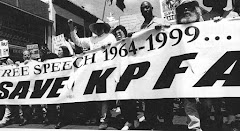
Lew Hill, founder of Pacifica Radio, was the son of an Oklahoma millionaire. Attending Stanford University, he studied Kierkegaard and Gandhi, became a conscientious objector, and conceived the idea for a pacifist-controlled radio station while working at a remote, church-funded Civilian Public Service camp in Coleville, California, one of many set up for those refusing to fight in World War II. KPFA, the first Pacifica station, went on the air in April 1949, initially reaching relatively few people in the San Francisco Bay Area on the FM dial.

These were the boomer years, a time of anticommunist fever, later renamed the McCarthy era after the unscrupulous Wisconsin Senator who claimed in 1950 that 205 Communists infested the State Department (and that was just his warm up act), a time when Hollywood screenwriters were jailed for refusing to discuss their political activities with red-hunting congressmen. In fact, during KPFA’s first months on the air, union leader Harry Bridges was imprisoned for lying about his ties with the Communist Party, and a dozen California Communist leaders were convicted for violating the Smith Act, which made it a crime to advocate the overthrow of the government. 

But for Hill and other early Pacificans the purpose of the new station was dialogue not revolution, and the Pacifist ideology that had inspired its birth played a marginal role as it struggled to establish itself in Berkeley’s then relatively insular university community.

By this point, commercial broadcasting had been around for almost thirty years. Lee DeForest, the controversial “father of radio,” who spent millions in court trying to validate his patents, conducted the crucial tests on trains and boats, and finally began distributing news and opera in 1916 from an experimental radio station located in the High Bridge section of New York City. He later moved his transmitter to San Francisco and installed it in the wings of the California Theatre to broadcast orchestra performances, then took his fledgling station to Berkeley, where it lasted less than a year.

American Telephone & Telegraph was another early entrant, transmitting signals across the Potomac River for the US Navy, while the Marconi companies used a low-powered vacuum-tube transmitter to send audio from Aldine in New Jersey to David Sarnoff aboard the Bunker Hill off the coast of New York. Thirteen years later Sarnoff would become president of the Radio Corporation of America.

The early experimenting ended abruptly on April 6, 1917, when the United States entered World War I and all stations not needed for the war effort were shut down. It remained illegal for the general public to hear radio transmissions until the fighting ended. During this period, the industry was placed under government control and the Navy Department tried to convert it into a permanent public monopoly, quietly purchasing Federal Telegraph and Marconi stations. When the US Congress found out about that after the war, the Navy was ordered to return the stations to private owners. 

Government pressure also led to the sale of the British-managed Marconi stations to General Electric, already a big US electrical firm and poised to dominate international radio communications. It soon formed a new company for that precise purpose. GE’s patriotically named Radio Corporation of America, soon known worldwide as RCA, made its debut on July 2, 1921 with the broadcast of a heavyweight boxing championship, Jack Dempsey’s defeat of Georges Carpentier in Hoboken. Within a year, RCA was building a national consumer market fueled by advertising.

For a while most programming contained no commercials and many entertainers performed for free. But the next decade featured a battle for dominance by some of the largest companies in the United States that eventually turned radio into a vehicle for superficial comedy, big bands, and often unprincipled advertisers. In 1931, the father of radio publicly voiced his disgust, describing commercial broadcasting as a “national disgrace.” But DeForest was also conservative Republican and fervent anticommunist who called Franklin Roosevelt the “first fascist president,” lobbied Congress against “socialized medicine” and federally subsidized housing, and, in 1953, cancelled his subscription to The Nation magazine on the grounds that it was “lousy with treason.” In any case, the public flocking to radio didn’t much care what its cranky “father” thought.

By 1941, more than 13 million radios a year were being sold – that is, until the Japanese attacked Pearl Harbor in December and a World War II ban on non-essential electronic manufacturing drastically reduced production. After the war, of course, the industry grew like a teenager on steroids; Manufacturing exploded, automakers installed millions of sets, and the number of AM stations doubled to 2000 in less than three years. By 1949, radio’s advertising income reached $200 million, over 90 percent of all US households had receivers, and a poll reported that two thirds of the American people regarded the medium as their primary source of news.

From the start, the US government resisted proposals designed to require balance and accuracy on the air, even though prominent figures recognized the danger of monopoly and the power of propaganda. In 1922, no less than the president of GE warned Europe about the downside of radio, urging nations to stop hurling insults at each other "in furious language." Five years later, the League of Nations passed a resolution opposing "obviously inaccurate, highly exaggerated, or deliberately distorted" news, urging the press not to undermine international peace. By the early 30s, the International Federation of Journalists had established a tribunal to deal with broadcasting that promoted hate and violence. Still, the prevailing argument in the US was that only private-sector ownership could protect the so-called "free marketplace of ideas.”

Fundamentalist Christians took early advantage of the opening, jumping into broadcasting even before federal regulation could be developed. By 1925, more than 10 percent of all stations were licensed to religious organizations. Starting with radio evangelism, these media radicals subsequently perfected the use of each new technology to influence opinion, win elections, and hammer home their theology. One of the first was Aimee Semple McPherson, who pioneered the approach on a powerful Los Angeles' radio station. Broadcasting from her temple, McPherson styled herself a modern-day Joan of Arc in a titanic struggle against communism.

Her crusade reached the boiling point in 1934 during the insurgent Democratic gubernatorial campaign of Upton Sinclair. The socialist author of The Jungle and other novels about the excesses of capitalism had pledged to "end poverty in California," but the evangelist, in an alliance with Republican leaders, Hollywood propagandists and political consultants, redefined the race in apocalyptic terms. "Someone has cast in the poison herb," McPherson bellowed on the Sunday before Election Day, "and if we eat thereof we shall all perish and the glory of our nation as it has stood through the years shall perish with us." 

Sinclair, at first the front runner in an era of mass unemployment and hard times, became the target of the nation’s first full-fledged "media campaign" and ultimately lost by 200,000 votes. McPherson had effectively seized on growing fears of revolution, convincing her flock – many of them poor – that the real enemy was satanic communism and its Democratic messenger.

First appearing on CBS stations in 1930, Father Charles Coughlin built a similarly ardent following with his volatile mixture of populism and nationalism. When CBS management insisted that he stop railing against “international bankers,” the evangelist appealed directly to his listeners, who sent more than a million letters of protest to the network. CBS responded by replacing all paid religious broadcasts with Church of the Air, a show that offered free, rotating air time to speakers from the three “major” faiths. 

This became a standard media approach with religious groups. But it didn’t deter Coughlin, who created his own network and turned even more political, eventually drifting toward fascism. Along the way – until he lost favor in World War II -- he suggested that “Christians suffer more at the hands of the Reds than Jews do in the Third Reich” and that Nazi Germany had to protect itself from Jewish communists who were influencing radio, journalism and finance. Attempts to censor him were often decried as “Jewish terrorism.”

For Lew Hill, interest in launching a radio station dated back to his time at the Coleville Public Service Camp in California, but was further stimulated by a stint announcing on the air at WINX in Washington DC toward the end of the war. Working there also brought him together with Joy Cole, a kindred spirit from an old American family who shared his anti-war sentiments and desire to create a better world. They married in 1944. But Lew couldn’t abide the restrictions and distortions that had become commonplace in commercial radio by this time, and his qualms ultimately became intolerable in May 1945, when he was handed a story about “the people at Tule Lake.”

He knew what that euphemistic phrase really meant. Tule Lake was the site of one of the most infamous internment camps for Japanese Americans during the war, a so-called "segregation camp" in northern California that warehoused more than 18,000 people for several years. In all, about 120,000 US citizens of Japanese ancestry were taken from their homes and imprisoned in remote detention centers. The Tule Lake camp had just closed but Lew, who knew about it from working as a war resister 300 miles away, refused to read what he considered a misleading report and turned in his resignation.

A year later, shortly after the Hills moved to San Francisco, he submitted his proposal for a radio station to the Federal Communications Commission and wrote an initial fundraising prospectus. The basic idea was that people who were committed to nonviolence could reach beyond the choir, beyond ivory tower intellectuals and pacifist war resisters, and reach the “average man” by bonding with the community through a station. “Pacifica Foundation has been organized to begin this job,” his description proclaimed. In what became the single most important document in Pacifica history, he outlined the purposes of the new educational foundation in a series of bold, idealistic statements that remained central to its self-image for the next six decades.

At the core, Lew Hill’s vision was that KPFA would “engage in any activity that shall contribute to a lasting understanding between nations and between individuals of all nations, races, creeds and color.” It would “gather and disseminate information on the causes of conflict between any and all such groups,” he wrote, “and promote the study of political and economic problems, and the causes of religious, philosophical and racial antagonisms.” 

And how would this happen? Through dialogue – diverse groups openly communicating with each other on the air. The objective, he explained, wasn’t to discover and convey indisputable truths but rather to nurture an open exchange of ideas that could help people come to know each other as human beings, dialogue that demonstrated the possibility of peace in practice.

By the time I became CEO more than half a century later Pacifica had evolved into something different: progressive radio, a source of “alternative” news and left-wing viewpoints, a platform for local constituencies, identity politics, and too often “politically correct” wisdom, as well as the site of angry and endless internal bickering over process, ideology, air-time and assigning blame that effectively prevented what had become a national network from making an impact on public discourse or, as Lew Hill more modestly hoped, creating constructive connections between people.

Despite altruistic intentions, there was ambiguity from the start. The goals, at least when Lew put them in writing, tended to shift with his audience. For instance, in pitches to the Ford Foundation and a 1952 book, Voluntary Listener Sponsorship: A Report to Educational Broadcasters on the Experiment at KPFA, he dropped words like “pacifism” and “peace” and replaced them with “personal freedom” and “imagination.” Rather than bonding with the community by discussing the local and familiar, he proposed that the station offer “serious cultural broadcasting” in order to secure the support of two percent of the area’s total FM audience. This two percent formula became central to his theory of sustainable listener “sponsorship” through voluntary subscriptions. For the first five years, however, not nearly enough listeners sent in money and the station depended mainly on wealthy benefactors and major foundations.

As Matthew Lazar explained years later in Pacifica Radio: The Rise of an Alternative Network, early Pacifica announcers would boast often that, as an advertisement-free station, KPFA didn’t need to appease commercial influences. “But this freedom did not protect Lew Hill and his band of utopians from the strict ideological requirements of the liberal corporate state,” Lazar wrote. “Nor did it inure Pacifica from the influence of the class able and willing to pay for commercial-free radio.”

Neither was the Bay Area radio experiment protected from the impact of television, which would soon transform communication and human consciousness itself.

NEXT IN THE SERIES: Rise of the Tube

To table of contents: Planet Pacifica 

Tuesday, February 23, 2016

Fragile Paradise: Those Lead-laced Blues

In 1978, ten years after I first arrived in Vermont, Nixon was gone, Jimmy Carter was president, and I returned to Bennington to see how things had played out. When I tried to contact school superintendent George Sleeman, however, he didn't want to meet. But I knew that he, along with Town Manager Lou Sarelas and assorted police and social workers, were scheduled to hold a Vandalism Task Force meeting that day at the Mt. Anthony Country Club. The place was for sale and the meals were cheap.

Meanwhile, I received kid-glove treatment from high school principal Don Banchik, a firm but open disciplinarian 21 years into his act. He’d solved most of the school's problems, he claimed, by instituting overlapping sessions to ease overcrowding and eliminating department heads. He and two assistants planned the whole curriculum now. Banchik dealt severely with vandals and drug users who "experimented" on school grounds. To prove it he showed me some dope and a collection of pipes in his desk.

"I do understand the euphoric feeling in a social sense," he explained, "but in school marijuana does inhibit learning. I know Jon doesn't agree with me. Right, Jon?" Jon, his faculty supervisor, looked up but wouldn't say.

Did the school have a Ms. subscription now? I wondered. "No, but there are a lot of magazines we don't have," he replied. I reminded Banchik that Ms. had offered the school a free subscription. He shrugged it off and talked instead about his new health curriculum. He wanted me to know that sex and drug education weren’t being neglected.

And what was the secret of this principal's success? "I'm very accessible at all times," he explained. "I'm in the hall, in classes, at all events, constantly exposed." I was already intimidated.

"I'm winning the confidence of the faculty," he went on. "We could even get a bond vote through for a new middle school now." That told me some things hadn’t changed. The project had been on the drawing board for 10 years, since the local parochial school closed and Mt. Anthony became overcrowded. When I ran for a seat on the school board in 1972, overcrowding was my campaign issue. I'd called my line the Open Door Party. My slogan was “Open the doors and let the kids out.”

By the time I arrived at the country club, Town Manager Lou Sarelas was eating lunch with Sleeman and the gang. Known as Suitcase Lou – because he’d held so many manager jobs that he supposedly never unpacked his bags – his agenda that day was to push through a neighborhood crime prevention program and a revolving fund to reward vandal-stoppers. "I see the protective arm joining forces with neighbors, people with CB radios, and organizations like the Lions," he explained.

The Vandalism Task Force was especially sensitized by a recent attack, the weekend trashing of the junior high school library and main offices. Vandals also had wrecked local gardens, town signs, the high school, even the local graveyard. Bennington was witnessing a weekly demolition roulette. Yet when the Task Force was formed not one student wanted to join.

Poisoned pot, bad water, teen criminals – the ingredients for a major psychic illness were all here. George Sleeman wasn't about to confide in me, not after a critical article I'd written on his powerful family before becoming Suitcase Greg. But maybe Suitcase Lou would have some answers, I thought. A flat tire on his town car after the meeting provided me with a perfect excuse to give him a lift to the office.

Beginning the interview, I asked about the lead in Bennington’s water. It had been discovered over a year earlier during state Health Department tests of industrial lead levels at Globe-Union. "We've added a combination of sodium bicarbonate and sodium hydroxide, which forms a coating on the lead pipes," he explained. But people claimed the water tasted worse than ever. "It does affect the taste," he admitted, "especially when we add chlorine. But it's mostly imagination."

Lou fancied himself a long-range planner, and therefore was willing to admit that water was indeed a limiting factor in Bennington. Aside from the health hazards, he mentioned the increased demand created by development. Yet he supported the major new projects in the works and pooh-poohed the paranoia of local merchants.

Before exiting he referred cryptically to narrow-minded people who were blocking change. I probed for names. Could it be Reggie Perrott, the reactionary selectman who ran a local bar well-known for its brawls? Perrott had recently confessed to income tax fraud, yet remained on the board afterward. "Reggie's a fine, upstanding citizen," said Lou.

Then what about Frank Velkas? He was the guy who blew the whistle on Bennington's water pollution, a psychoanalyst without clients whom Banner reporter Tim Powers had described to me as "certifiable."

"Velkas has very accurate information," Lou warranted."What bothers me about him is his methods." Since he obviously wasn't going to name the narrow-minded, I gave up amiably. Yet his line on water problems left a bad taste. Maybe I had those lead-laced blues. My next stop just had to be C. Frank Velkas.

"I'm gonna bury them," he told me over the phone before we met. Tough rhetoric, but I wasn't certain who "they" were. Celestin Frank Velkas turned out to be rational – at first – and armed with hard data. When he couldn't get action from local and state officials about lead levels running up to 10 times the federal standard, and after the Center for Disease Control called it "a major public health hazard," he’d gone to the top: the Environmental Protection Agency. Eventually, the town received money to distribute lead-free water and agreed to replace some of the corroding pipes.

Velkas was offered an EPA National Merit award but turned it down. As far as he was concerned, the problem hadn't been solved. "Sodium hydroxide, what's that used for?" he asked. "When you start mixing chemicals strange things happen. No studies have been done on the effects of mixing water with lead, chlorine and these chemicals. After they started treating the water, you know what happened?" I didn't. "All the goldfish in Knapp's Pet Shop rolled over and died. There's an animal test for you. The town is doing just what Globe-Union is doing, and the damage continues while they fiddle around. We're in an era of contamination, and the culprits are pillars of the community."

His verdict was brutal. "They would rather see people go down the tubes than do anything about it." But what was he going to do? His lawsuit had been rejected. "What's the use of filing suits when the system won't respond," he snapped, wavering between indignation and despair.

When we began the interview he’d assured me that "I'm gonna resolve the issue here." By the end he was playing public enemy, closely watched by government agents. And when I finally reached my car to leave he stood in the road to block my departure. Now he was pessimistic.

"It's too late to help this generation," Velkas warned. "To some extent we're all brain-damaged. Even you."

With that diagnosis I headed out of town, eager to avoid further contamination. Yet even with my foot on the accelerator, I could barely hold an anxiety attack in check. I was prepared to believe almost anything – even lead-induced craziness – about this place now. That might even explain the town's vandalism.

Bennington had gone modern, but the name of the game wasn't progress – unless that means reckless demolition, thoughtless expansion, and benign neglect. The kids apparently knew that things were out of joint, and their main mode of expression was a coarse comment on local leadership. They were mad and rightly so. The law was on the drug warpath, there was nothing doing downtown, and the high school had long ago ceased to be a good place to hang out, talk or roughhouse.

I slipped into fourth gear, speeding past the fenced-in school and Veterans Center, out onto terminal beltline, and beyond the flood-plain mall site. The road whipped into the foothills between blasted rock. Once upon a time this place had been my idea of paradise. I'd loved it and never wanted to leave. But faced with Lead City in the flesh, I decided to keep wandering in the wilderness.


Check out other chapters of Dangerous Words, or continue to the next part of the story: Prelude to a Revolution …

Tuesday, January 19, 2016

The Casting of the President

We can do better than Donald Trump. We all know it. But I'm not talking about his politics. I'm talking about his performance and entertainment value. After all, he's just a reality TV star who has played the corporate version of Judge Judy. Before that it was all bit parts and walk-ons, mainly self-promotion for his gaudy real estate empire.
    No wonder his presidential campaign feels like a political sitcom featuring Biff Tannen, the Back to the Future bully to whom Trump is often compared. The plot, gags and catch phrases are already wearing thin, as if Veep morphed into Breaking Bad.
    But seriously (not), if we want an entertainer-in-chief, at least let's get first-rate talent. Personally, I'm for Bernie Sanders. Not showy, but believable and increasingly entertaining (and right on the issues). But if being believable and entertaining are what make you electable these days, actors and other performers may have an edge. We’ve already had one actor in the role, Ronald Reagan, who knew how to sustain his appeal and sell almost anything – from Borax to Star Wars.
    For a while we also had an actor in the 2008 race, Fred Thompson. He had even played a real president, although it was Ulysses Grant in Bury My Heart at Wounded Knee. But Thompson's real problems were that he couldn’t find a decent script and seemed uncommitted to the part.
     What about someone who has played a fictional president? That could provide experience imagining and handling a crisis, especially one that hasn't happened yet. Feels like some sort of advantage. Remember when  Bill Pullman saved us from an alien invasion in Independence Day, or when Harrison Ford faced off terrorists in Air Force One? Those were terrifying times, they boldly took charge, and everything worked out. Or how about John Travolta? He played a charming, fictional Bill Clinton and he can fly a plane. 
    For a while Martin Sheen seemed destined for the role. First, in The Dead Zone, he played a presidential candidate whom Christopher Walken foresaw blowing up the planet. Years later he returned as the longest running president in TV history, keeping America witty, safe and fast-talking on The West Wing. Clearly, he had learned from “experience.”
     Other qualified prospects, all of whom have played the President at some point, include Sam Waterston, James Earl Jones, Jimmy Smits, Alan Alda, Morgan Freeman, Tom Selleck, William Petersen, Dennis Haysbert, Tim Robbins, Michael Douglas, Rip Torn, Robert Duval, Michael Keaton, James Brolin, Billy Bob Thornton, two Quaid brothers, both Jeff and Beau Bridges, and even Kris Kristofferson.
    Want a comedian, someone far more entertaining than Trump? You can't do better than Chris Rock, a stand up president in Head of State. Imagine his State of the Union speech.
    A female alternative to Hillary? The supply of tested candidates is growing. Julianne Moore almost crashed the glass ceiling as Sarah Palin in HBO's Game Change. But let's not forget Geena Davis, who kicked ass on Commander in Chief – and won a Golden Globe for Best Actress. Glenn Close, Patty Duke, Patricia Wettig … they all have recent presidential experience, plus acting chops. 
     We must also seriously consider Meryl Streep, who nailed an Oscar as Margaret Thatcher in The Iron Lady -- with a flawed script. Sure, Thatcher was a British head-of-state, but Streep is pure American, born in New Jersey. 
     Some names on this list are past their box office dates. But it's just a starting lineup. Look at it this way: In addition to serving as commander-in-chief, the president must now deliver a sustained public performance on the biggest stage of all. Whoever gets the job will be in our living rooms almost every day for at least four years. That's something to consider. The role calls for believability, authenticity, a bit of star quality, and a talent for conveying both compassion and righteous outrage, plus a talent for improvisation and an instinct for public taste. Oh yes, also good judgement and such...
     Anyway, restricting the field to amateurs -- governors, senators and other so-called political "insiders" -- clearly isn't working out. The best they can deliver is awkward guest shots on SNL and The Daily Show. What do they know about building a fan base, staying in character, and looking comfortable on TV? Isn't it time to for someone who can really handle the role?