Showing posts with label Pacifica Radio. Show all posts

Tuesday, March 15, 2016

From Dialogue to Division: When Radio Mattered

Lew Hill, founder of Pacifica Radio, was the son of an Oklahoma millionaire. Attending Stanford University, he studied Kierkegaard and Gandhi, became a conscientious objector, and conceived the idea for a pacifist-controlled radio station while working at a remote, church-funded Civilian Public Service camp in Coleville, California, one of many set up for those refusing to fight in World War II. KPFA, the first Pacifica station, went on the air in April 1949, initially reaching relatively few people in the San Francisco Bay Area on the FM dial.

These were the boomer years, a time of anticommunist fever, later renamed the McCarthy era after the unscrupulous Wisconsin Senator who claimed in 1950 that 205 Communists infested the State Department (and that was just his warm up act), a time when Hollywood screenwriters were jailed for refusing to discuss their political activities with red-hunting congressmen. In fact, during KPFA’s first months on the air, union leader Harry Bridges was imprisoned for lying about his ties with the Communist Party, and a dozen California Communist leaders were convicted for violating the Smith Act, which made it a crime to advocate the overthrow of the government. 

But for Hill and other early Pacificans the purpose of the new station was dialogue not revolution, and the Pacifist ideology that had inspired its birth played a marginal role as it struggled to establish itself in Berkeley’s then relatively insular university community.

By this point, commercial broadcasting had been around for almost thirty years. Lee DeForest, the controversial “father of radio,” who spent millions in court trying to validate his patents, conducted the crucial tests on trains and boats, and finally began distributing news and opera in 1916 from an experimental radio station located in the High Bridge section of New York City. He later moved his transmitter to San Francisco and installed it in the wings of the California Theatre to broadcast orchestra performances, then took his fledgling station to Berkeley, where it lasted less than a year.

American Telephone & Telegraph was another early entrant, transmitting signals across the Potomac River for the US Navy, while the Marconi companies used a low-powered vacuum-tube transmitter to send audio from Aldine in New Jersey to David Sarnoff aboard the Bunker Hill off the coast of New York. Thirteen years later Sarnoff would become president of the Radio Corporation of America.

The early experimenting ended abruptly on April 6, 1917, when the United States entered World War I and all stations not needed for the war effort were shut down. It remained illegal for the general public to hear radio transmissions until the fighting ended. During this period, the industry was placed under government control and the Navy Department tried to convert it into a permanent public monopoly, quietly purchasing Federal Telegraph and Marconi stations. When the US Congress found out about that after the war, the Navy was ordered to return the stations to private owners. 

Government pressure also led to the sale of the British-managed Marconi stations to General Electric, already a big US electrical firm and poised to dominate international radio communications. It soon formed a new company for that precise purpose. GE’s patriotically named Radio Corporation of America, soon known worldwide as RCA, made its debut on July 2, 1921 with the broadcast of a heavyweight boxing championship, Jack Dempsey’s defeat of Georges Carpentier in Hoboken. Within a year, RCA was building a national consumer market fueled by advertising.

For a while most programming contained no commercials and many entertainers performed for free. But the next decade featured a battle for dominance by some of the largest companies in the United States that eventually turned radio into a vehicle for superficial comedy, big bands, and often unprincipled advertisers. In 1931, the father of radio publicly voiced his disgust, describing commercial broadcasting as a “national disgrace.” But DeForest was also conservative Republican and fervent anticommunist who called Franklin Roosevelt the “first fascist president,” lobbied Congress against “socialized medicine” and federally subsidized housing, and, in 1953, cancelled his subscription to The Nation magazine on the grounds that it was “lousy with treason.” In any case, the public flocking to radio didn’t much care what its cranky “father” thought.

By 1941, more than 13 million radios a year were being sold – that is, until the Japanese attacked Pearl Harbor in December and a World War II ban on non-essential electronic manufacturing drastically reduced production. After the war, of course, the industry grew like a teenager on steroids; Manufacturing exploded, automakers installed millions of sets, and the number of AM stations doubled to 2000 in less than three years. By 1949, radio’s advertising income reached $200 million, over 90 percent of all US households had receivers, and a poll reported that two thirds of the American people regarded the medium as their primary source of news.

From the start, the US government resisted proposals designed to require balance and accuracy on the air, even though prominent figures recognized the danger of monopoly and the power of propaganda. In 1922, no less than the president of GE warned Europe about the downside of radio, urging nations to stop hurling insults at each other "in furious language." Five years later, the League of Nations passed a resolution opposing "obviously inaccurate, highly exaggerated, or deliberately distorted" news, urging the press not to undermine international peace. By the early 30s, the International Federation of Journalists had established a tribunal to deal with broadcasting that promoted hate and violence. Still, the prevailing argument in the US was that only private-sector ownership could protect the so-called "free marketplace of ideas.”

Fundamentalist Christians took early advantage of the opening, jumping into broadcasting even before federal regulation could be developed. By 1925, more than 10 percent of all stations were licensed to religious organizations. Starting with radio evangelism, these media radicals subsequently perfected the use of each new technology to influence opinion, win elections, and hammer home their theology. One of the first was Aimee Semple McPherson, who pioneered the approach on a powerful Los Angeles' radio station. Broadcasting from her temple, McPherson styled herself a modern-day Joan of Arc in a titanic struggle against communism.

Her crusade reached the boiling point in 1934 during the insurgent Democratic gubernatorial campaign of Upton Sinclair. The socialist author of The Jungle and other novels about the excesses of capitalism had pledged to "end poverty in California," but the evangelist, in an alliance with Republican leaders, Hollywood propagandists and political consultants, redefined the race in apocalyptic terms. "Someone has cast in the poison herb," McPherson bellowed on the Sunday before Election Day, "and if we eat thereof we shall all perish and the glory of our nation as it has stood through the years shall perish with us." 

Sinclair, at first the front runner in an era of mass unemployment and hard times, became the target of the nation’s first full-fledged "media campaign" and ultimately lost by 200,000 votes. McPherson had effectively seized on growing fears of revolution, convincing her flock – many of them poor – that the real enemy was satanic communism and its Democratic messenger.

First appearing on CBS stations in 1930, Father Charles Coughlin built a similarly ardent following with his volatile mixture of populism and nationalism. When CBS management insisted that he stop railing against “international bankers,” the evangelist appealed directly to his listeners, who sent more than a million letters of protest to the network. CBS responded by replacing all paid religious broadcasts with Church of the Air, a show that offered free, rotating air time to speakers from the three “major” faiths. 

This became a standard media approach with religious groups. But it didn’t deter Coughlin, who created his own network and turned even more political, eventually drifting toward fascism. Along the way – until he lost favor in World War II -- he suggested that “Christians suffer more at the hands of the Reds than Jews do in the Third Reich” and that Nazi Germany had to protect itself from Jewish communists who were influencing radio, journalism and finance. Attempts to censor him were often decried as “Jewish terrorism.”

For Lew Hill, interest in launching a radio station dated back to his time at the Coleville Public Service Camp in California, but was further stimulated by a stint announcing on the air at WINX in Washington DC toward the end of the war. Working there also brought him together with Joy Cole, a kindred spirit from an old American family who shared his anti-war sentiments and desire to create a better world. They married in 1944. But Lew couldn’t abide the restrictions and distortions that had become commonplace in commercial radio by this time, and his qualms ultimately became intolerable in May 1945, when he was handed a story about “the people at Tule Lake.”

He knew what that euphemistic phrase really meant. Tule Lake was the site of one of the most infamous internment camps for Japanese Americans during the war, a so-called "segregation camp" in northern California that warehoused more than 18,000 people for several years. In all, about 120,000 US citizens of Japanese ancestry were taken from their homes and imprisoned in remote detention centers. The Tule Lake camp had just closed but Lew, who knew about it from working as a war resister 300 miles away, refused to read what he considered a misleading report and turned in his resignation.

A year later, shortly after the Hills moved to San Francisco, he submitted his proposal for a radio station to the Federal Communications Commission and wrote an initial fundraising prospectus. The basic idea was that people who were committed to nonviolence could reach beyond the choir, beyond ivory tower intellectuals and pacifist war resisters, and reach the “average man” by bonding with the community through a station. “Pacifica Foundation has been organized to begin this job,” his description proclaimed. In what became the single most important document in Pacifica history, he outlined the purposes of the new educational foundation in a series of bold, idealistic statements that remained central to its self-image for the next six decades.

At the core, Lew Hill’s vision was that KPFA would “engage in any activity that shall contribute to a lasting understanding between nations and between individuals of all nations, races, creeds and color.” It would “gather and disseminate information on the causes of conflict between any and all such groups,” he wrote, “and promote the study of political and economic problems, and the causes of religious, philosophical and racial antagonisms.” 

And how would this happen? Through dialogue – diverse groups openly communicating with each other on the air. The objective, he explained, wasn’t to discover and convey indisputable truths but rather to nurture an open exchange of ideas that could help people come to know each other as human beings, dialogue that demonstrated the possibility of peace in practice.

By the time I became CEO more than half a century later Pacifica had evolved into something different: progressive radio, a source of “alternative” news and left-wing viewpoints, a platform for local constituencies, identity politics, and too often “politically correct” wisdom, as well as the site of angry and endless internal bickering over process, ideology, air-time and assigning blame that effectively prevented what had become a national network from making an impact on public discourse or, as Lew Hill more modestly hoped, creating constructive connections between people.

Despite altruistic intentions, there was ambiguity from the start. The goals, at least when Lew put them in writing, tended to shift with his audience. For instance, in pitches to the Ford Foundation and a 1952 book, Voluntary Listener Sponsorship: A Report to Educational Broadcasters on the Experiment at KPFA, he dropped words like “pacifism” and “peace” and replaced them with “personal freedom” and “imagination.” Rather than bonding with the community by discussing the local and familiar, he proposed that the station offer “serious cultural broadcasting” in order to secure the support of two percent of the area’s total FM audience. This two percent formula became central to his theory of sustainable listener “sponsorship” through voluntary subscriptions. For the first five years, however, not nearly enough listeners sent in money and the station depended mainly on wealthy benefactors and major foundations.

As Matthew Lazar explained years later in Pacifica Radio: The Rise of an Alternative Network, early Pacifica announcers would boast often that, as an advertisement-free station, KPFA didn’t need to appease commercial influences. “But this freedom did not protect Lew Hill and his band of utopians from the strict ideological requirements of the liberal corporate state,” Lazar wrote. “Nor did it inure Pacifica from the influence of the class able and willing to pay for commercial-free radio.”

Neither was the Bay Area radio experiment protected from the impact of television, which would soon transform communication and human consciousness itself.

NEXT IN THE SERIES: Rise of the Tube

To table of contents: Planet Pacifica 

Friday, March 20, 2015

Managing Pacifica: How It Began

(Originally posted on March 20, 2008)

Shortly after I landed a post-college media job – reporter for a daily newspaper in southern Vermont – an angry reader complained about my bias in a letter to the editor. “I strongly doubt that he could cover the proceedings of a dog show without incorporating a message,” the critic charged. Clearly, I wasn’t amusing this member of my audience.

But by then I didn’t care. In fact, the attack was encouraging. I wasn’t going for laughs or trying to satisfy expectations. Between age six and twenty-two my goals had shifted – from pleasing people to challenging their assumptions, and from merely entertaining to also informing.

Reporting should convey more than just facts, I thought. Current events ought to add up to something, and journalists are kidding themselves if they believe that they can divorce their personal viewpoints and conclusions from what appears on the page or goes out over the airwaves. As I told the headhunters who thought I might have the right stuff to handle Pacifica Radio, what I'd tried to do over the years was “mass market some radical ideas” and provide a counter-narrative to the diet of misleading infotainment people were being force fed every day. They thought it might be a good fit.

The chance to work at Pacifica came my way by accident. More than a decade earlier I’d met an activist librarian on a plane by striking up a conversation about Z, a left-wing magazine she was reading. Even before 9/11, you rarely saw people on airplanes engrossed in “alternative” publications. At the time I was editing Toward Freedom, a smaller but respected magazine that had covered international affairs from a “progressive perspective” since the early 1950s. We hit it off, and she provided an invaluable stream of news, ideas and leads for articles over the next decade. But she was also a loyal yet disgruntled listener to a Pacifica station, and when the top job became available, she let me know.

At first it didn’t feel right. The ideal candidate for Executive Director, said the job announcement, should have at least 10 years of relevant job experience, including non-profit management, and preferably two years as General Manager of a noncommercial broadcasting station. I’d run non-profits and had experience editing and publishing newspapers and magazines. In the late 1970s I’d been a stringer for Pacifica and Vermont Public Radio. But my only recent radio work was a two-year stint co-hosting a university radio morning show – before being cancelled and banned from the premises. As it turned out, being banned was a plus.

Dan Coughlin, the previous Executive Director, had resigned months earlier after three years on the job. After growing up in England, he had covered crime for Interpress Service in New York before moving over to Pacifica in 1996 by way of Democracy Now!, an election series that became a network hit and made Amy Goodman a household name in progressive circles. After producing DN! for two years, he took over Pacifica Network News – just in time to become embroiled in a fight for the organization’s future.

Even before Pacifica evolved into a national network with five owned stations and dozens of affiliates, there were internal battles. But until the 1990s the fact that each station handled its own programming kept most of the fighting local. At that point, rumors began to circulate that “central” management and the national board wanted to seize control of content to increase listenership and shift the funding model from reliance on listener donations toward foundations.

In 1999, when the board amended the bylaws to make itself self-appointing, ostensibly to comply with a CPB requirement, Pacifica’s community-based culture began to actively resist what was soon labeled an attempt to “hijack” and “mainstream” the organization. For Coughlin, the question became: Should PNN, a daily newscast aired on more than 60 stations, cover the deepening crisis?

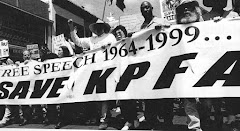
Early that year, after KPFA Station Manager Nicole Sawaya and popular correspondent Larry Bensky were abruptly fired, staff began to defy a long-standing policy of not airing internal grievances. Going on the air, some charged that Pacifica was a top-heavy bureaucracy hungry for mainstream legitimacy, preoccupied with ratings, and unaccountable to the community. There was even evidence that the board might consider selling stations. Listeners could read about major developments -- arrests inside KPFA, a staff lockout, street protests -- in the Los Angeles Times, Washington Post and other corporate outlets. But Pacifica’s news operations were under orders to keep the struggle off the air. For a while Coughlin went along.

In late October, however, when 16 affiliate stations declared “A Day without Pacifica” and boycotted its programs, he decided to break PNN’s silence, airing a report on the protest and what was called, in a monument of understatement, a labor-management dispute. “This summer, more than 100 persons were arrested, and thousands took to the streets at the oldest listener-sponsored station in the country to protest Pacifica staffing decisions,” the item announced. “The 16 Pacifica stations from 11 states called for the network to adopt new open, accountable governance and to continue to support community-based journalism, which they said had made Pacifica great.”

The report lasted only 37 seconds. Yet, when Coughlin returned to work after a long weekend, a terse e-mail from ED Lynne Chadwick was waiting. “You’re no longer news director,” she announced. A day later, he was reassigned without notice to a murky “Task Force on Programming and Governance.” Although he remained on staff for another year, his removal from PNN confirmed the suspicions of dissidents that censorship had replaced free speech and editorial independence at Pacifica.

Two years later, in 2002, after a titanic struggle and multiple lawsuits produced a new board and a decidedly decentralist structure, he returned – this time as Pacifica’s first “post-revolution” chief executive.

Unfortunately, he inherited a mess – millions in debt, missing records, an aging audience, and a legacy of distrust. Yet he somehow managed, with the help of loyal listeners and a strong financial team, to bring the organization back to relative stability. What remained unclear was why and how, despite a major save, he had gone from Golden Boy in 2002 to object of scorn three years later. The accusations included shady payouts, lax oversight, and “contempt” for the new bylaws and democratic structure. A protest was staged outside the main office in Berkeley during his last day on the job. Just how did all that happen?

The deeper I looked the more convoluted and intractable the problems appeared: Charges and counter-charges of secrecy, waste, racism, sexism, harassment and violence, turf battles over local fiefdoms, manipulation, and alleged fraud. It seemed like a fratricidal war with no end in sight. A friend who worked in community radio, hearing that I was up for the top job, mildly defined the main issue as an “actual and perceived lack of transparency.” But he also mentioned poor fundraising and development, ineffective mediation of personnel problems, and legendary racial battles over the control and “color” of programming.

It reminded me of how easily reality can be blurred by misinformation. That July, Jeff Ruch, the director of Public Employees for Environmental Responsibility, had issued a relevant assessment of a much larger and even more dysfunctional organization. "The federal government,” he concluded, “is suffering from a severe disinformation syndrome." Could this be what was afflicting Pacifica? Theories presented as facts, information massaged to promote a specific spin, cherry-picked evidence. Whether intentional or not, Pacifica’s convoluted politics and history seemed to have created, as Bob Woodward put it his book that summer about Watergate secret source Deep Throat, “an entire world of doubt."

Who could unravel this mess, no less get the larger community to look beyond its debilitating bitterness and distrust? Probably not a middle-aged activist editor from one of the smallest, whitest states in the country. But I wasn’t too concerned, since it didn’t look remotely possible that I would get the job. It was flattering to be interviewed, but I essentially saw the invitation to Houston to meet Pacifica's leaders as little more than an opportunity to offer an informed outsider’s assessment.

NEXT: 9/11 Theories and Pacifica’s Fear Factor