Saturday, March 21, 2015

State of the News Media

Part One: A Crisis of Fact

The technology of journalism has advanced more in the last decade than in the 100 years before. Yet more and more, print and electronic media fill airtime and space with “advertorials” and questionable “news” -- some of it fake -- produced by public relations firms and even governments. The race for higher circulation and audience shares has placed a premium on titillation and superficiality, producing to an ill-informed electorate. Journalistic professionalism and credibility are in free fall, and truth has been seriously devalued.
      Compounding the problem, corporate ownership and bottom line thinking appear to mean that fewer responsible and trained journalists will be available in the future, especially to cover developments in foreign countries. US television networks employ at least a third fewer correspondents than they did 20 years ago. Radio newsroom staffs shrank by 44 percent between 1994 and 2001. Foreign coverage by broadcast and cable networks has shrunk at least 70 percent since the 1980s. Sad to say, but professionalism in reporting may be going the way of shortwave radios, fax machines, and the single-lens reflex camera.
     The uncomfortable truth is that the First Amendment doesn't guarantee that democracy will be fair, that people will be well or truthfully informed, or that the press will be competent.
     Society is experiencing what has been called a crisis of fact, leaving people with little to trust or believe. As a result, more and more they consume only information that reinforces their opinions. And, according to Alexander Cockburn, journalists aren’t helping. The first law of the profession today, he says, is “to confirm existing prejudice, rather than contradict it.”
     We live in an age defined by fraud and scandal – questionable elections, corrupt religious leaders, fabricated accounting that devastates the savings of thousands, doped-up athletes, and plagiarized and phony news. Even scholars have been caught plagiarizing parts of their books. It’s become so common that there is a new peer-reviewed academic journal: Plagiary: Cross Disciplinary Studies in Plagiarism, Fabrication, and Falsification. One the fastest growing educational Web businesses investigates whether student terms papers have been plagiarized. So far, investigators have found that at least 30 percent of the papers submitted for verification have been plagiarized, at least in part.
Publications frequently use something they call “photo illustration” – basically the fabrication of images using digital tools. It may sound harmless, but given the power of images it has the potential of warping public perception in the service of biased or inaccurate stories.
     Local TV, the primary source of news about civic life for most people, covers less and less political news. A survey of the 2006 election season by the University of Wisconsin concluded that “local television news viewers got considerably more information about campaigns from paid political advertisements than from actual news coverage.”
     Given all this, how do the young get their news in the Internet age? The truth is the many don’t bother. But most younger people who want to know what’s happening don’t turn to print newspapers, or even radio and TV. They scan online versions of papers, check the sites of research organizations, and surf political blogs – many of them operated by academics and think tanks that have figured out how to appeal to a popular audience by mixing commentary with breaking news, analysis, and research.
     According to the blog search engine Technorati, 120,000 web logs are created each day, and the total number is close to 100 million. Most of these blogs are primarily devoted to diary accounts, opinions, theories, and so one. But a new type of website has also emerged – the Carefully-Researched Weblog, or CROG. These include, for example, the site on Middle East affairs maintained by Juan Cole and a health policy Crog on the Daily Kos written by someone calling himself Dr. Steve B. Many people also use Google’s popular “alert” function. If you want to know about a specific topic, Google will send you a daily message with links to the latest information from writers, bloggers, and sites. Still, the best information on the Internet continues to come from Websites run by print organizations.
     However, the emergence of “citizen journalism” and the “new media” have led to the notion that professional journalists are no longer as necessary. Everyone can be a journalist, we hear, and this will promote a conversation among equals. The idea is that citizen journalists can assemble, edit, even create of their own news; that the more options we have -- and the less control traditional media has over what is relevant -- they better offer we will be.
     But this presumes that professionalism doesn’t matter, and that standards aren’t that important in providing information. At this point, unfortunately, the “new media” acknowledge few rules. And to be frank, professional journalism isn’t so simple. For example, knowing the difference between news, opinion and commentary is a serious challenge. Journalists work hard to develop skills like how to conduct fair and constructive interviews, how to find relevant and complete – not merely convenient – information, how to see various sides of an issue, and how to convey what they find out clearly and accurately. Without such skills, the public is vulnerable to distortions, biased reports, and blatant falsehoods.
     According to a 2006 State of the News Media report by the Project for Excellence in Journalism, only five percent of blog postings included “what would be considered journalistic reporting.” And the origins of the vast majority of blog stories can be traced back to newspapers. Who will do the reporting if they fade away?
     For all its benefits, the “blogosphere” is also accelerating social fragmentation. Many blogs and Websites attract only like-minded people, creating a self-segregated news and information environment that serves the interests of extremists and ideologues on both the “left” and “right.” It’s not so different from the partisanship that characterized the press in the early 19th Century. Truth and facts are becoming debatable notions. This makes it far more difficult for people to reach agreement or even have a civil discussion, and easier for demagogues to ignore reality for the sake of pushing initiatives based on convenience or ideology.
     In The Elements of Journalism, authors Bill Kovach and Tom Rosenthal write, “In the end, the discipline of verification is what separates journalism from entertainment, propaganda, fiction, or art.” Thus far, the blogosphere is weak on checking what it presents as fact.

Originally posted on March 21, 2008. Material in this four-part series was first presented in January 2008 at a KPFT strategic planning retreat.

Next: Will Newspapers Survive?

Friday, March 20, 2015

Managing Pacifica: How It Began

(Originally posted on March 20, 2008)

Shortly after I landed a post-college media job – reporter for a daily newspaper in southern Vermont – an angry reader complained about my bias in a letter to the editor. “I strongly doubt that he could cover the proceedings of a dog show without incorporating a message,” the critic charged. Clearly, I wasn’t amusing this member of my audience.

But by then I didn’t care. In fact, the attack was encouraging. I wasn’t going for laughs or trying to satisfy expectations. Between age six and twenty-two my goals had shifted – from pleasing people to challenging their assumptions, and from merely entertaining to also informing.

Reporting should convey more than just facts, I thought. Current events ought to add up to something, and journalists are kidding themselves if they believe that they can divorce their personal viewpoints and conclusions from what appears on the page or goes out over the airwaves. As I told the headhunters who thought I might have the right stuff to handle Pacifica Radio, what I'd tried to do over the years was “mass market some radical ideas” and provide a counter-narrative to the diet of misleading infotainment people were being force fed every day. They thought it might be a good fit.

The chance to work at Pacifica came my way by accident. More than a decade earlier I’d met an activist librarian on a plane by striking up a conversation about Z, a left-wing magazine she was reading. Even before 9/11, you rarely saw people on airplanes engrossed in “alternative” publications. At the time I was editing Toward Freedom, a smaller but respected magazine that had covered international affairs from a “progressive perspective” since the early 1950s. We hit it off, and she provided an invaluable stream of news, ideas and leads for articles over the next decade. But she was also a loyal yet disgruntled listener to a Pacifica station, and when the top job became available, she let me know.

At first it didn’t feel right. The ideal candidate for Executive Director, said the job announcement, should have at least 10 years of relevant job experience, including non-profit management, and preferably two years as General Manager of a noncommercial broadcasting station. I’d run non-profits and had experience editing and publishing newspapers and magazines. In the late 1970s I’d been a stringer for Pacifica and Vermont Public Radio. But my only recent radio work was a two-year stint co-hosting a university radio morning show – before being cancelled and banned from the premises. As it turned out, being banned was a plus.

Dan Coughlin, the previous Executive Director, had resigned months earlier after three years on the job. After growing up in England, he had covered crime for Interpress Service in New York before moving over to Pacifica in 1996 by way of Democracy Now!, an election series that became a network hit and made Amy Goodman a household name in progressive circles. After producing DN! for two years, he took over Pacifica Network News – just in time to become embroiled in a fight for the organization’s future.

Even before Pacifica evolved into a national network with five owned stations and dozens of affiliates, there were internal battles. But until the 1990s the fact that each station handled its own programming kept most of the fighting local. At that point, rumors began to circulate that “central” management and the national board wanted to seize control of content to increase listenership and shift the funding model from reliance on listener donations toward foundations.

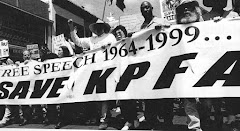
In 1999, when the board amended the bylaws to make itself self-appointing, ostensibly to comply with a CPB requirement, Pacifica’s community-based culture began to actively resist what was soon labeled an attempt to “hijack” and “mainstream” the organization. For Coughlin, the question became: Should PNN, a daily newscast aired on more than 60 stations, cover the deepening crisis?

Early that year, after KPFA Station Manager Nicole Sawaya and popular correspondent Larry Bensky were abruptly fired, staff began to defy a long-standing policy of not airing internal grievances. Going on the air, some charged that Pacifica was a top-heavy bureaucracy hungry for mainstream legitimacy, preoccupied with ratings, and unaccountable to the community. There was even evidence that the board might consider selling stations. Listeners could read about major developments -- arrests inside KPFA, a staff lockout, street protests -- in the Los Angeles Times, Washington Post and other corporate outlets. But Pacifica’s news operations were under orders to keep the struggle off the air. For a while Coughlin went along.

In late October, however, when 16 affiliate stations declared “A Day without Pacifica” and boycotted its programs, he decided to break PNN’s silence, airing a report on the protest and what was called, in a monument of understatement, a labor-management dispute. “This summer, more than 100 persons were arrested, and thousands took to the streets at the oldest listener-sponsored station in the country to protest Pacifica staffing decisions,” the item announced. “The 16 Pacifica stations from 11 states called for the network to adopt new open, accountable governance and to continue to support community-based journalism, which they said had made Pacifica great.”

The report lasted only 37 seconds. Yet, when Coughlin returned to work after a long weekend, a terse e-mail from ED Lynne Chadwick was waiting. “You’re no longer news director,” she announced. A day later, he was reassigned without notice to a murky “Task Force on Programming and Governance.” Although he remained on staff for another year, his removal from PNN confirmed the suspicions of dissidents that censorship had replaced free speech and editorial independence at Pacifica.

Two years later, in 2002, after a titanic struggle and multiple lawsuits produced a new board and a decidedly decentralist structure, he returned – this time as Pacifica’s first “post-revolution” chief executive.

Unfortunately, he inherited a mess – millions in debt, missing records, an aging audience, and a legacy of distrust. Yet he somehow managed, with the help of loyal listeners and a strong financial team, to bring the organization back to relative stability. What remained unclear was why and how, despite a major save, he had gone from Golden Boy in 2002 to object of scorn three years later. The accusations included shady payouts, lax oversight, and “contempt” for the new bylaws and democratic structure. A protest was staged outside the main office in Berkeley during his last day on the job. Just how did all that happen?

The deeper I looked the more convoluted and intractable the problems appeared: Charges and counter-charges of secrecy, waste, racism, sexism, harassment and violence, turf battles over local fiefdoms, manipulation, and alleged fraud. It seemed like a fratricidal war with no end in sight. A friend who worked in community radio, hearing that I was up for the top job, mildly defined the main issue as an “actual and perceived lack of transparency.” But he also mentioned poor fundraising and development, ineffective mediation of personnel problems, and legendary racial battles over the control and “color” of programming.

It reminded me of how easily reality can be blurred by misinformation. That July, Jeff Ruch, the director of Public Employees for Environmental Responsibility, had issued a relevant assessment of a much larger and even more dysfunctional organization. "The federal government,” he concluded, “is suffering from a severe disinformation syndrome." Could this be what was afflicting Pacifica? Theories presented as facts, information massaged to promote a specific spin, cherry-picked evidence. Whether intentional or not, Pacifica’s convoluted politics and history seemed to have created, as Bob Woodward put it his book that summer about Watergate secret source Deep Throat, “an entire world of doubt."

Who could unravel this mess, no less get the larger community to look beyond its debilitating bitterness and distrust? Probably not a middle-aged activist editor from one of the smallest, whitest states in the country. But I wasn’t too concerned, since it didn’t look remotely possible that I would get the job. It was flattering to be interviewed, but I essentially saw the invitation to Houston to meet Pacifica's leaders as little more than an opportunity to offer an informed outsider’s assessment.

NEXT: 9/11 Theories and Pacifica’s Fear Factor

Tuesday, March 10, 2015

Join the Campaign for Preservation & Change

To find out more,
Visit the Campaign's Blog
 
Here is a list of ten specific proposals offered by our campaign and defended during the recent election. Some were also supported by other candidates, or even adopted as their ideas. Imitation is a form of flattery and, in this case, a sign of how we influenced the debate. For example, Mayor Weinberger has established a group to preserve some BC land, asked for a delay of South End zoning change, and currently claims there will be no "fast-track" projects. We'll see. Meanwhile, here is a recap of the agenda for preservation and change presented by the campaign:

- Establish a public interest partnership to preserve BC/Diocese property

 
- Retain current zoning for the South End Enterprise Zone

- Restore NPA funding at $5,000 each, along with the authority to select staff

- Consider proposals like rent stabilization and a higher minimum wage to address affordability

- Join the federal lawsuit to challenge F-35 basing

- Accelerate marijuana legalization through local research and action

- Begin the process of reforming commission representation to provide more equality and accountability

- Establish standards for public-private partnerships that emphasize responsible growth and protection from gentrification

- Coordinate all stakeholders to assemble capital and retain local ownership of Burlington Telecom


- Tougher negotiations with UVM to house more students on campus, beginning with juniors


Sunday, March 8, 2015

The Green Mountain Way: Why It Works

From The Vermont Way
Since the 1970s Vermont has been a testing ground for groundbreaking politics. But the many ex-urbanite professionals and members of the counterculture who helped to make that possible were building on a solid foundation. Active dissent began before the American Revolution, as early settlers organized to declare themselves free of British rule and exploitation by land speculators. It continued with the re-election of Matthew Lyon to Congress in defiance of the Alien and Sedition Acts, resistance to an embargo of Britain and the War of 1812, rejection of Masonic secrecy and Town Meeting defeat of the Green Mountain Parkway during the New Deal. This pattern reflects a libertarian streak that has resisted the pull of modern liberalism.

For more: The Vermont Way

Despite relative isolation before the arrival of railroads, telephones, highways and instantaneous global communication, Vermonters have also expressed an egalitarian belief in equality and tolerance that made it fertile ground for revival-era religious experiments and persistent leadership in the fight to end slavery. Although the state was sometimes slow to respond, as with the decision to extend voting rights to women or when handling early union activism, the tradition re-asserted itself in Gov. Ernest Gibson’s expansion of social services in the 1940s, the peaceful assimilation of immigrants and the landmark legislative decision in 2009 to make same-sex marriage the state law.

Public concern has frequently extended beyond the protection and defense of state residents and resources. Ecological consciousness, rooted in Vermont’s rural character and a practical understanding of interdependence, has made it an advocate for reducing pollution, conserving limited resources, protecting endangered habitats, and closing the Yankee Nuclear plant.  Skepticism about wasteful military spending and the logic of war, combined with the symbolic power of Town Meeting, has helped it to spur national reconsideration of the nation’s nuclear weapons stockpiles and intentions.

Today Vermont is as identified with liberal social causes and political mavericks like Bernie Sanders as it once was with “rock-ribbed” conservative thinking. But beneath the different labels is a consistent approach to governance and the way it is discussed. Despite a centralized administrative structure, Vermont has emphasized accountability more than most -- through the retention of short terms of office, a citizen legislature, and the tradition of local control.

Friday, March 6, 2015

Community & Consciousness

Part 35 of Prisoners of the Real

We can't go back. The only route is through the current crisis and on to the next stage of human evolution. But we can only get there if we know where we want to go.

First and foremost, the impulses toward centralization, rationalization, absolutism, and hierarchy must be rejected as means toward personal liberation and global harmony. This is especially difficult at a time when the need for global control is so strongly asserted and threatens to erase the vision of free communities. Complicating matters further is the confusion between the concept of true community and the State. The more a group of people allows itself to be represented from outside, the less community life is left in it.

Community is the joint and active management of what we hold in common, a primary aspiration of all human beings. Survival itself depends on the use of community structures and institutions to promote genuine freedom and spontaneous social action.

Second, we must recognize that community isn't a rigid idea but instead a living form, shaped by daily experience. It must satisfy the demands of real situations rather than abstractions. Like any realization, community is not reached once and for all time. Every moment presents new challenges and calls for original answers. For the individual, community building requires the inner disposition to pursue a life in common, despite the prospect of adverse circumstances and anxiety, tribulations, and toil. What sustains it is spirit, trust and love.

Community begins when its members see their common purpose and relation to the whole, a living togetherness that is the essence of sister and brotherhood. In that sense, few true communities currently exist in our "post-modern" world. Most of our cities have no real centers, and we devote little time to defining what holds us together. That work has mostly been turned over to elected representatives and appointed bureaucrats. Their "rational collectives" leave little space for warmth or friendship in the press of political and economic reality. Visions of togetherness are usually viewed as romantic fantasy, conceivable at all only in terms of their concrete effects.

Dionysian collectives, in contrast, are the seeds of an organic commonwealth that place true solidarity at the center of social experience. Every act of true friendship, every moment of selfless aid in our rationalized "post-industrial" world, brings social transformation a step nearer. This is true community building, and it occurs whenever autonomous actions create dynamic unity.

The Dionysian path is known by many names – metaphysical reconstruction, holistic epistemology, deep ecology, and new age claptrap, among others. Critics rightly note that attacks on rationalism and "instrumental reason" often extend too far, ending in rejection of all forms of purposeful activity and a retreat into the mystical haze of nature worship and “magical thinking.” Wary of the cult of technique, cultural revolutionaries sometimes confuse technology with practice and reject all human inventiveness as wanton dominance. In truth, however, it is possible to make peace with nature even while acknowledging the separation created by our consciousness. As Christopher Lasch explained, "Nature sets limits to human freedom, but it does not define freedom."

Ecological and systems thinking provide a theoretical foundation for the Dionysian approach. The former encompasses the realization that structures that may appear rigid in nature are actually manifestations of processes in continual flux; the latter has moved beyond analysis of complex machines to an understanding of relationships and integration in living systems. After 2000 years of reducing the world to smaller and smaller building blocks, science has finally turned its attention to principles of organization. Every organism is an integrated whole, a living system. Families and communities exhibit the same characteristics of wholeness as cells and ecosystems.

Yet the metaphysical reconstruction implied by a turn to the Dionysian principle also involves reconciliation of two realms of experience that have long been viewed as separate and irreconcilable – the political and spiritual. Marx's claim that religion is the "opiate of the people" has been as debilitating as the notion that enlightenment is a purely personal pursuit, fundamentally incompatible with the "dirty" world of social action.

The keys to a synthesis have been found in ecological consciousness and the post-modern politics of Gaia. Together they form a new cultural paradigm – planetary consciousness. With roots in myth, Gaia re-emerged as hypothesis, out of research on the auto-regulation of the Earth as a living system. According to James Lovelock, originator of the hypothesis, "the entire range of living matter on Earth, from whales to viruses, can be regarded as a single entity." Studying the nature of Earth's atmosphere, he and other researchers discovered that it is not merely a biological product but instead an active system designed to maintain a chosen environment within the biosphere.

Since this initial research Gaia has developed as a theoretical and artistic context, embraced by social critics, articulated in music, and developed as an eco-social organizing principle. There is talk also of a Gaian mode of consciousness, one acknowledging that science has a myth-making quality. Closely linked to ecological concepts, Gaian consciousness recognizes that opposites can – in fact, must – coexist.

This emerging form of spirituality is politically consistent with certain strains of Green thinking, in particular deep ecology, holistic feminism, community-based populism, and bio-regionalism. All of these incorporate a subtle awareness of the oneness of life, the interdependence of its limitless manifestations, and its cyclical processes of change and transformation. The sense that we are connected to the cosmos as a whole is a spiritual revelation that ties together the disparate expressions of this new consciousness.

In The Spiritual Dimension of Green Politics, Charlene Spretnak argued persuasively that Green concepts of inter-relatedness and sustainability open the way toward what she called post-modern spirituality. Human beings, she wrote, are social and interconnected, and the boundaries between us are more illusory than we normally think. Taking account of the nature reverence buried within most religious traditions, she concluded that a spiritual grounding can not only answer a deep hunger in modern experience, but also mesh comfortably with the Green tendrils that have sprouted around the world. Like others who are attempting to describe the next stage of humanity's journey, she found herself in a region where cosmic consciousness and political analysis meet.

William Irwin Thompson defined the current transition as a shift from the cultural ecology of the Atlantic, with its capitalist, industrial approach, to a new Pacific ecology that is more communal and balanced. On the spiritual level, this translates as a move from obedience to symbiosis. Working with a series of paradoxes, he noted that "Good at one level of order becomes evil at another.... In the age of mental understanding of doctrine (the current Atlantic era), obedience to law is evil, for it aborts the development of the mind. In an age of universal compassion (the new Pacific era), understanding of doctrine becomes evil, for it simply sanctifies murder in religious warfare."

The key to a new age, says Thompson, is the acceptance of difference, "the consciousness of the unique that contributes to the understanding of the universal." The main danger, on the other hand, is what he has labeled "collectivization through terror," the stamping out of differences. Just as mono-crop agriculture does violence to nature, a mono-crop society – essentially the extreme of an industrial mentality – would be deadly to human nature. Even Green politics, which may yet develop an ecology of consciousness, could instead become a fundamentalist ideology, rejecting flexibility and promoting a Luddite contempt for innovation.

"The real secret of freedom," Thompson once wrote, "seems to lie in the ability to deal with ambiguity, the capacity to tolerate noise and yet hear within its wild, randomizing abandon the possibilities of innovation and transformation."

Next: The Eclipse of Free Expression

To read other chapters, go to
Prisoners of the Real: An Odyssey