Saturday, March 22, 2014

Pacifica Radio’s Progressive Meltdown Continues

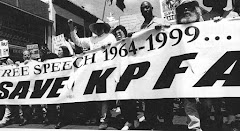
The Pacifica Foundation, a community radio network that includes WBAI-FM in New York, has dismissed its executive director, the latest tumultuous step for an organization that has been plagued by financial problems and acrimonious turnover among its management.

Summer Reese, who was named executive director in November after doing the job on an interim basis for more than a year, was fired by Pacifica’s national board on Thursday. In a brief statement on Friday, the board confirmed the move and thanked Ms. Reese “for her service to date,” but gave no explanation.

Ms. Reese’s dismissal is the latest in a series of changes in recent years that have destabilized Pacifica and its five stations. In August, WBAI, which operates a powerful signal at 99.5 FM but is millions of dollars in debt, laid off 19 of its 29 employees, including the entire news staff. The station, which is supported almost entirely by listener donations, has since been through two program directors and struggled publicly with its fund-raising.
- New York Times, March 18, 2014

"According to a media release Monday morning, Reese and a small group of supporters removed a padlock installed at Pacifica’s offices the previous day and “informed staffers that business would continue as usual.” (Tracy) Rosenberg claims the firing was illegal because of the three-year contract held by Reese, adding that she has “no doubt” that the board was planning to fire Reese for political reasons.
- Paul DeRienzo
The forces currently aligned with Summer Reese, including Gary Null, and with Bernard White, Lydia Brazon and Dan Siegel were already engaged in a long-term struggle by the time I arrived in January 2006. Many of the players still remain the same, and "takeover" rumors are currently being circulated by both factions. 

Contract issues were also involved in my departure, although I ultimately chose to leave rather than extend what was becoming a stalemate. Essentially the same leadership that retook control of the PNB and dismissed Reese urged my early departure and the selection of Nicole Sawaya (without interviewing any other candidates). Not a great transition, as it turned out, and entirely avoidable.

That said, no one faction is exclusively responsible for the network's decline. But snap dismissals are no better than bolt cutters in solving Pacifica's real problem - a crippling deficit of trust. In light of recent developments, I thought these 2010 reflections might be relevant...

A lot has happened since I left my job as Pacifica Radio’s Executive Director at the end of 2007. Almost a decade after she was abruptly fired former KPFA General Manager Nicole Sawaya returned as my replacement with enthusiastic support from the Board and community – but resigned twice over the next year. As the network approached its 60th anniversary it faced the most serious organizational and financial crisis in years. On-air fund drives, which bring in over 80 percent of the network’s income, weren’t meeting their goals, most stations had meager cash reserves, and WBAI was a half a million behind its target and mired in an internal power struggle that had been building for several years.

According to Casey Peters, Pacifica’s National Election Supervisor in 2007, a “vacuum of power” developed after my departure. “With obvious instability at the top,” he wrote in his final report, “the election campaigns descended into chaos.” When he tried to meet with Sawaya to discuss the process, she declined and told him “she opposed Pacifica Bylaws provisions for elected boards.”

The problems intensified further when Sawaya resigned and corporate counsel Dan Siegel stepped in. “He applied intimidation regarding the still-pending certification of KPFA results,” Peters claimed, “telling me that I would be fired if I did not do so promptly. The problem was that criteria for certification had not been met due to irregularities in the campaign.” Peters came to believe that Siegel was attempting to control the outcome of the vote. On March 13, 2008, as Peters was about to fly to New York for the WBAI vote count he received a message from Chief Financial Officer Lonnie Hicks. The word was that Siegel didn’t want him counting votes in New York. Furthermore, he was being fired.

A few days later, according to Peters’ account, Siegel entered his home without notice and startled his wife. “His intent was to confiscate election equipment and materials,” Peters wrote. “Siegel had apparently been drinking, and sat in a rented SUV flashing his headlights into our bedroom. Marilyn called the police to stop the harassment. We seriously considered pressing trespass and assault charges, but felt any publicity about the incident would not look good for the Pacifica Foundation.” Nevertheless, after the elections a lawsuit was filed by one faction at WBAI against the network and its representatives.

In Spring 2008, a fight over financial control between Hicks and Sawaya, who had been wooed back after her first resignation, resulted in a Board decision to give her the right to directly supervise the national financial staff, something I’d sought without success. Unfortunately, after a three month absence she faced a rapidly worsening picture. Frustrated by a costly organizational structure that often blocked change, she openly called it “unsustainable.”

One of her first big decisions, made with Hicks’ agreement, was to cut the budget for Free Speech Radio News by 25 percent. What seemed to shock some people wasn’t so much the cutback (about $11,000 per month) but the fact that it was done without prior discussion. Sawaya explained that the financial crunch required strong and immediate action. The Board decided to let it stand.

The next surprises came in July, just as budgets for the next fiscal year were being developed. The National Board had voted to convene in person that month, but the national office didn’t follow up and the meeting had to be cancelled. Afterward, without explanation, Hicks disappeared from work. No announcement was issued, but news leaked out that he was on “paid leave to deal with family matters.” Later, rumors circulated that an investigation of his activities was being pursued – and also that he might sue. Sawaya meanwhile assumed responsibility for budget development, pushing for staff reductions and other budget cuts.

In the end, she left first, while Hicks returned to work in late 2008. He was ultimately terminated in early 2009, and replaced by an old nemesis, former National Finance Committee Chair LaVarn Williams. As predicted, he filed a lawsuit, alleging that he was dismissed because he was African American and a whistleblower. Clearly, Hicks had a sense of irony, considering his frequent warnings about escalating legal costs, the fact that a majority of Pacifica's National Board and staff – including his replacement – were people of color, and that he fought as hard as anyone to hold back information from the board and membership when he was in control.

Sawaya announced her second resignation in early August 2008, but asked those who knew not to say anything for a month. At meetings, she meanwhile tried to convince the Board and National Finance Committee that Pacifica should act like a network and “centralize” various functions, especially accounting and reporting. Directors listened but nothing changed.

As the national political conventions approached she turned her attention to Pacifica’s coverage. A radio journalist, Sawaya considered it a high priority. Still, people were surprised by her decision to leave the national office and personally cover the presidential race at a time when the main management issue was resolving its financial crisis. What they didn’t know was that she had already resigned.

Before she left for Denver, another confrontation intensified the situation. A volunteer programmer, allegedly “banned” from KPFA in Berkeley, showed up unexpectedly. The General Manager wasn’t around, but the Business Manager felt that something needed to be done. Calling the National Office next door, she asked for advice from the new Human Resources Director, Dominga Estrada, who advised her to call the police. According to witnesses, when the cops arrived excessive force was used. Sawaya was there and attempted to block videotaping of the event.

This deepened the existing divide at the station. Management defended its decision but said it wasn’t responsible for the overreaction of the police. Dozens of volunteers, and some on the staff, saw it as another example of a management out of step with Pacifica’s values and mission. A letter of no confidence in GM Lemlem Rijio was signed by dozens of people.

Soon afterward HR director Estrada left for a new job elsewhere and the National Board began to openly discuss what was called a “national office collapse.” The term actually referred to one of several options for how to address the overall problems. One alternative was to struggle on as is, a decision that would create a large budget deficit. Another was to cut some national positions and the salaries of others. The third and most radical option was to lay off almost everyone, retaining only enough staff to pay the bills and keep governance and the national office functioning.

The Board also had to decide what to do about the leadership vacuum. Some hoped to quickly recruit a new Executive Director. But the process would take months, and proposals to re-expand the CFO’s authority and apply strict performance standards to managers were likely to get in the way.

Even if a new chief executive could be found – and the Board overcame its divisions – there were elephants in the room. Pacifica’s leaders were far from agreement on how to resolve its financial crisis, and, even more difficult, restructure its programming and management to reverse the long-term decline in listenership and income.

By early 2009, as blogs and discussion forums speculated about receivership, bankruptcy, and breaking up the network, the balance of power shifted again. In New York and on the national board, the controversial Justice and Unity Coalition lost control. A new national chair, Grace Aaron of Los Angeles, stepped in as Interim ED. As the crisis deepened, she took dramatic action.

WBAI was facing eviction. It was $128,000 behind on the rent for its Wall Street office and studio space by April, and owed another $75,000 in back payments for its coveted transmitter atop the Empire State Building. It was losing at least $500,000 a year, required repeated short-term bailouts, and owed the national office almost $1 million in back payments for central services. WBAI had weathered storms and struggles before. But this time the troubles not only could bring down the station but also threaten the future of Pacifica itself.

To reduce the rent, Tony Riddle, the station’s fifth General Manager in seven years, renegotiated a long-term lease with Silverstein Properties – without getting Aaron’s approval. Under the new terms, WBAI had to pay $60,000 in May, another $75,000 in June, and $45,000 by July 25. If the station or Pacifica missed a payment, the consequence would be immediate eviction. It turned out to be one of Riddle’s last acts as GM.

In early May, Aaron removed him, but created a new “at home” job for Riddle as National Development Director. It was apparently a consolation prize for not making a stink. The new CFO, LaVarn Williams, was appointed Acting GM of the station. Almost immediately, Program Director Bernard White was removed. Aaron had already ordered the locks changed on the transmitter site. While some WBAI boosters cheered the changes as long overdue, others took to the streets, decrying a racist world view among opportunistic liberals.

In June, Aaron removed another GM, Ron Pinchback of WPFW in Washington, DC. The station had also lost listeners and fallen short on fundraising in recent years. Yet critics saw racial motives: like White and Hicks, Pinchback was African-American, suggesting to some that the changes were really a purge of top Black managers. The fact that most replacements were also Black was overlooked.

“WBAI was predominantly white in the 1960s and 1970s,” noted JUC leader Lederer. “And there has always been a rear guard of white listeners and programmers who want to go back.” JUC members and other Bernard White backers threatened to boycott and possibly sue unless this latest “national coup” was reversed. The station’s “race” war wasn’t over yet.

When Amy Goodman expressed “dismay” about White’s removal in a letter to Pacifica management, Williams replied that he and previous GMs were responsible for a “failure model” that jeopardized both “your program and the whole foundation.” Despite the popularity of Democracy Now!, Amy’s influence had become limited over the years, mainly governed by a mutually lucrative contract to air the show and assist with fundraising. Thus, barring a successful lawsuit, which could take years to resolve, or an LSB election that returned the JUC to power, Bernard White had seen his final days at Pacifica.

By 2010, Pacifica finally settled on a new Executive Director, Florida feminist radio host Arlene Engelhardt. The intensity of conflict was down a bit, but revenues from on-air fundraising continued to decline. KPFA’s GM Rijio was forced out and only KPFT in Houston had permanent management.

Upset about staff cutbacks, Kellia Ramares, long-time journalist and board operator at KPFA, delivered her own swan song at a Pacifica National Board meeting in July. After more than a decade with the network, including an arrest in the newsroom during the bad old “hijack” days, she announced that she was leaving. “Pacifica hires an election supervisor while they cannot keep a news tech at quarter-time hours?” she asked rhetorically. “Is this the business of elections or radio? To those who say that I should not criticize this expenditure, because ‘we must democratize Pacifica,’ I quote Confucius: “You cannot teach philosophy to a hungry man.”

The critique went deeper still. In an article for the Atlantic Free Press, Ramares added, “I now question the entire alleged movement that calls itself progressive.” She urged others similarly disillusioned to ask whether “progressivism is a philosophy that helps its adherents live healthy, secure, decent lives in the material world of today, or is it just pie-in-the-sky propaganda that institutions such as Pacifica use to get well-meaning people to give it money.”

Acknowledging that all media were taking an economic hit, she nevertheless had concluded that “citizen journalism, available across the political spectrum, but a special darling of the left because of its free speech nature and alleged purity of purpose, is destroying the ability of journalists to make a living. Paid journalists can’t compete with free. Is it progressive to expect, or even to demand, to receive free work in a society that demands that we pay for our food, clothing, housing and health care? Is it progressive to give donations to an institution for its infrastructure, but not to care about whether the workers in that institution can pay their bills?”

“Can we do well while we do good,” she concluded, “or is progressivism just a fancy name we give our struggle and poverty in order to make our marginalization seem noble?”

When rumors fly through Planet Pacifica or attacks get especially nasty, people often blame provocateurs and charge that the government is out to get radio’s voice of the people. There is some basis for this suspicion. The FBI had Pacifica in its sights as early as 1958, and took a special interest in 1962 when former Special Agent Jack Levine gave KPFA an interview. Levine exposed the Bureau as a threat to democracy and a tool of J. Edgar Hoover, its vain and obsessed director. According to Mathew Lasar, who reviewed Freedom of Information Act files, the Bureau poked, prodded, and harassed the organization for years, even planting agents disguised as private citizens.

In recent times, however, charges of counter-intelligence operations directed against the organization have been speculative at best, and occasionally excursions into free-range paranoia. As Executive Director, I was frequently asked to investigate such suspicions but found no solid evidence of a government operation. And even if a disinformation campaign was being pursued, it would be overkill. The Pacifica community is capable of destabilizing itself without a federal assist. Outside forces aren’t responsible for the bylaws or listener activist distrust of staff, the slow response to the digital age, disputes about the mission, programming gridlock, financial decline, or misbehavior by board members and volunteers.

Part of the problem is the version of democracy put in place in 2002. At this point, the five stations had about a million regular listeners (declining since then). Of this total, about 10 percent make financial or volunteer contributions, qualifying them to participate in local elections. Of that total, little more than 10 percent actually return ballots in the elections. In recent years it has sometimes been difficult to reach that bylaw-mandated threshold.

Due to instant runoff voting, it takes at most about 300 votes for someone to be elected to a station board. In other words, Local Station Board members draw their right to govern from less than one percent of the listeners. And in order to win, candidates often resort to negative appeals, especially charges that the process is corrupt and Pacifica isn’t democratic enough. In general, the elections have tended to perpetuate an atmosphere of confrontation and suspicion.

Board meetings also pose problems. They frequently feature rude outbursts and other disrespectful behavior. Roberts Rules are often abused, becoming weapons of obstruction rather than tools to promote rational discussion. Members use e-mails to spread rumors and promote debates of marginal relevance. In many cases, factional alliances manipulate the rules. Productivity suffers and questionable behavior opens the organization to legal liability. All this has had the effect of alienating potential supporters or future board members.

Touring the stations back in 2006, I repeatedly asked whether Pacifica was trying to operate a radio network or create a government. The reason was that it looked like the latter. Some even wanted quasi-judicial bodies – like the Committee to Investigate Allegations of Racism and Sexism formed in 2006 – and the equivalent of a Freedom of Information Act, as if Pacific was a National Security State. Anyone who questioned the “bold experiment” was considered out of step, possibly even a reactionary.

More than three years after I left, despite financial crisis, major staff turnover and a forceful exercise of executive power, progress remains elusive. Change is in the air, but the outcome is uncertain. Another round of contentious Board elections is underway, and whatever the results, they will likely either slow down the pace or again alter the direction.

Thursday, March 6, 2014

Prisoners of the Real

An intellectual odyssey – from Pythagoras to planetary consciousness – and a new vision of  freedom and cooperation

One: The Creative Also Destroys 

Ye instruments, forsooth, but jeer at me,
your wheels and cogs mere things of wonder;
when at the door, you were my keys to be,
yet, deftly wrought, your bits can move no wards asunder.

-- Goethe's Faust

In the alternative universe where fact and fantasy fuse — that intergalactic space of “science” and “speculative” fiction — super-heroes, alchemists and misguided or “mad” inventors search for occult formulae through which the secrets of matter and spirit can be unveiled. Faith and reason meet within a cosmic flash and, for a moment, they see a source of limitless power.

Long before paperback novels and films turned this universe into an industry, magicians of an earlier age attempted to unravel the mysteries of space and time through number systems, using experience and experiment to juxtapose "sacred" numbers with chemical and material correlates. Number theory also fascinated many founders of modern science; for Descartes there was "universal mathematics," for Liebnitz the key was "universal calculus."

More than two thousand years before that, however, Pythagorean philosophy launched this quest by synthesizing the use of numbers in several religious traditions. The Babylonians had based their system on the number 60, with a god for each number. In the Old Testament 40 was a holy cipher. In Jericho the number seven was powerful, referring both to the seven deadly sins and the seven spirits of God. In Chinese mythology odd numbers represented white, day, sun and fire, while even numbers signified black, night, earth and water.

With such precedents, in about 550 BCE Pythagoras used his knowledge of numbers, along with related beliefs about music, magic and astrology, to construct a knowledge system that eventually served as the basis for "solar" systems of thought. With his discourses, numbers began to expand humanity's grasp of the actual, imposing order on matter.

According to legend, the "first philosopher" had noticed a relationship between the sizes of four anvils and the notes they produced when struck. From this revelation he developed a philosophy based on the numbers one through four. Creation begins with the One – pure unity, he concluded, and then expands to the holy four. In turn, they beget the sacred number ten. For Pythagoras, all life sprang from this formula. Using the four basic numbers he proceeded to build his great triangle: 
*
* *
* * *
* * * * 
During the renaissance rational scientists finally made the Pythagorean system accessible to reason. The number one, they argued, represented the source of all numbers -- pure reason; two was man and three was woman. Four, the product of equals (2 + 2) was justice and cosmic creation, leading to the "mother of all" -- ten (1 + 2 + 3 + 4). Elements of Pythagoras' theory can be traced to Plato, and from there to Descartes. Subsequent practitioners further concretized the mystical basis of the system; Copernicus' correction of Ptolemy's mistake, about 2000 years after the formation of Pythagoras' "secret brotherhood," committed Western civilization to a one-sided expansion of "solar" knowledge in which the cosmos was given over to rational explanation.

Despite the trend a few mathematicians did manage to maintain their belief in the mystical basis of number theory. Liebnitz, for example, accepted the universe as an expression of perfect reason and proposed the "universal calculus" that eventually developed into symbolic logic. His intention was to replace the decimal system's repeating sequences of one through ten with a binary system in which only one and two were used. Yet this notion, which ultimately led to the 20th century's computer revolution, was linked to his recognition that the binary system reflected another form of knowledge, a "lunar" system known as the I Ching. Although Liebnitz' attempt to express all knowledge through mathematical symbolism might well be classified as a simplistic error of rationalism, his insight into the revelatory power of the I Ching was nothing less than inspired.

A series of 64 oracles, the I Ching is said to have been written by King Wen about a millennium before Christ. Its subconscious, or lunar insights – sometimes used as a spur for meditation or a form of fortune telling – are derived from a dialectic of light and darkness, the primal thesis and antithesis known as Yin and Yang. Yin is the dark, night side of mind, the opposite of the bright, white and orderly Yang. The 64 oracles have a simple mathematical basis, the total number of possible combinations of Yang (represented by unbroken lines) and Yin (broken lines). The symbols of the hexagrams are paired opposites: heaven and earth, thunder and wind, water and fire, mountain and lake.

When I began this project many years ago I consulted the oracle in a moment of intuitive expectation. The idea was that the answer to any question is – and has always been – known to the asker. The coincidence of thrown coins, or even a page randomly opened, records this subconscious knowledge, and can eventually be understood through meditation. Jung called this principle synchronicity, the meaningful coincidence of two or more events:

"Synchronicity designates the parallelism of time and meaning between psychic and psychophysical events, which scientific knowledge has so far been unable to reduce to a common principle."


In this case, the Wilhelm-Baynes translation of the I Ching fell open at the commentary on the first hexagram, six unbroken lines called Ch'ien, or The Creative. This hexagram represents primal power, light-giving and strong, the power of time and duration, motion with time as its basis.

In the human world, The Creative represents the action of the leader, the ruler or manager, who awakens and develops the higher nature of his or her fellows. The Creative "sees with great clarity causes and effects" and attempts "conservation," which the translators define as the continuous actualization and differentiation of form. The qualities of such leaders are potentiality of success, power to further, perseverance, and sublimity; in this context "sublime" means "head" and success implies that the Creative lends "form" to archetypes of ideas.

According to the oracle, The Creative brings peace and security to the world by creating order: "The course of The Creative alters and shapes beings until each attains its true, specific nature, then keeps them in conformity with the Great Harmony." The leader is personified by the dragon, Chinese symbol of the electrically charged, dynamic, arousing force, a thunderstorm which is active in summer and withdraws into earth in winter. The oracle explains that the leader chooses a specialty and exerts influence on his environment without conscious effort.

Ch'ien seemed an ideal definition of the manager, bringing order to the environment, shaping the actions of others through creative activity that can lead to harmony. The Creative strives upward – toward heaven, giving support to the idea that managers and other leaders are natural ascensionists. Psychically oriented toward brightness, flying, climbing, pointing and moving upward, ascensionists are also often particularly concerned with hierarchic order. In sum, the I Ching defines the creative nature of humanity, organizing the universe of ideas.

My reading, however, wasn’t complete; there were also the "lines" which reflect the changes in individual situations. Lines that "move" reveal the direction of subsequent events, and sometimes offer warnings. Reading the lines related to The Creative, "nine at the top" caught my attention. In any hexagram, this line concerns the effect produced by the beginning line; in this case, it provides the warning that the "arrogant dragon will have cause to repent."

Several interpretations are possible. When a person attempts to move too high he or she loses touch with humanity and becomes isolated. Extremes also lead to confusion. Arrogance leads one to press forward, moving outward and upward without understanding how to draw back – inward and downward.

Put another way, an "arrogant dragon" knows existence but not annihilation; such a leader "meets with misfortune." Although the hexagram deals with creative powers, suggesting that an excess of strength isn’t necessarily harmful, this line illustrates the final effect of the leader's situation. If one's character is strong and inner preparations have been made, the end may simply be a transition. Yet the line also implies remorse, "since there is no possible way out."

"Nine at the top" is a succinct description of leaders in a world of manipulative tools that they create to order reality, a world of efficient production that culminates in techniques of death, a world of predictability, assimilation, and alienation. Over the last century, The Creative has certainly become a destroyer. More than once, order had led humanity to the brink of annihilation in a cycle suggested by the lunar system.
***
Next:Deconstructing Leadership

Friday, February 7, 2014

Rational Collectives: The Rise of Impersonal Rule

Modern bureaucracies have far more influence than anything officially conferred on them by elected officials. They may respond to the demands of certain special interests, or occasionally even to the personal pressure of one powerful person. But most often they follow strict "operational" laws and obedience to their rules turns systems of transmission into systems of decision.
     Philosopher Jacques Ellul argues that bureaucratic law rests on three basic principles:

     1. Continuity and Stability: The idea is that personnel comes and goes, but "administration" remains basically the same. Beyond any changes there is a constant structure, a continuity of tradition that sustains administrative power.
     2. Specialization and Rationalization: Bureaucracy exists in order to function, to make the existing political-economic system advance as a whole. It doesn't promote any particular truths and can't often consider the needs of specific individuals. It obeys a single basic rule – efficiency. There is no central leadership. Each person is actively restricted to making his or her own unit function, preferably without crisis or work stoppage.  There's little interest in or incentive for knowing the whole.
     3. Anonymity and Secrecy: Leaders give only general instructions, usually not concrete and therefore not requiring specific actions. Ultimately, decisions become independent of individual responsibility.     
Congressional Maze/GG
     These three "laws" are expressions of a single overriding idea: bureaucracy obeys no rule except necessity. Freedom of choice isn't a high priority for "organization men." In a bureaucratic society the charismatic leader becomes largely ephemeral. His main tool for coercing action, if he has the basic power and will, is to re-staff the organization with his or her own people, a strategy used with limited success by Nixon and implemented effectively since Reagan in the US.

     In Nixon's case, the tactic also became a factor in his ultimate ouster. Like most politicians, he lacked much technical competence. Despite his preoccupation with strong-arm tactics, bugging “enemies,” and recording himself, he couldn't gain and maintain control of information. In the end, it undid him. What Nixon might have tried instead was to refine the methods in order to make government bureaucracy more effective and contribute to its "progressive autonomy."
     One move in that direction was revenue sharing, which shifted control over federal funds filtered to the local level. Categorical grants to diverse groups, many of them essentially unfamiliar to the central bureaucracy, were less manageable than "block grants" to state and local governments. But revenue sharing didn't really decentralize decision-making. Instead, decisions were turned over to politicians and their appointees, who were forced by their own lack of information to depend on the bureaucrats who managed the information.
     Elections create the impression that political channels are open to every citizen. This is the essence of the "political illusion," a belief that meaningful participation is possible in a bureaucratic state – that bureaucracy can be controlled democracy. Electronic and print media perpetuate this illusion, reinforcing conformity while emphasizing the political spectacle.
     Even investigations of scandals like Watergate and Iran-Contra have promoted an illusion that decisions rest in public hands. At the time most people assume that their opinions about official malfeasance, expressed in opinion polls and letters, represent input in a democratic process. But the officials under scrutiny are just part of a public spectacle, behind which the true structure of the State bureaucracy remains obscure and out of control. Distracted by the flow of daily "facts," dissociated bits of data that reveal little of the "hidden agenda," people are discouraged from looking deeper.
     Legislatures and parliaments no longer do much more than endorse decisions that have been vetted and negotiated by experts and pressure groups. The experts themselves are mostly "organization men," citizens of the expanding State.
     Pressure groups have also expanded their reach. Huge non-government organizations and labor unions have swallowed smaller independent associations. The remaining rivals struggle to claim status as representatives of prime constituencies. At the same time, transnational corporations gobble up each other, building empires that make the trusts of the 19th century look quaint. Newer conglomerates cross industrial lines and often include hundreds of product lines, across every phase of the production process.
     Like good bureaucrats, the managers of multinationals claim that the need to grow is based on efficiency, which will profit the corporation and "benefit society as a whole." Bigness is essential and necessary, they say, to research, develop and market new products and technologies. Despite the persuasive evidence challenging this view, the idea that bigger is better – more efficient, not to mention more healthy and sustainable remains a widely held and generally unexamined belief.

Conglomerates are efficient in at least two areas: generating profits and satisfying the short-term security and self-esteem needs of some employees. The corporate approach stresses minimal satisfaction and attractive fringe benefits for "loyal" workers, high payoffs for key executives, and profitable investments for stockholders. Everyone wins, goes the corporate wisdom – except the consumer and society.
     These huge systems are the vanguard of a new form of organization – rational collectives. In this case, the term collective doesn't mean equal division of assets but rather refers to an organizational mentality marked by bureaucratic order, the impersonal rule of efficiency and the "market," and, despite the interchangeability of people and smaller businesses, extreme rigidity.
     This preference for the collective, at the expense of the individual, has affected not only corporations and the legislative branch of governments but also the legal system. In the US, the Supreme Court has gradually expanded the realm of collective rights, building on the "equality" standard that began to emerge in the 1950s, while narrowing the scope of individual rights. Although equal protection under the law is often stressed, individual rights to privacy, speech, and personal security have been undermined in a series of decisions. The Court has nudged the country toward a flat compartment-less society, perhaps less arbitrary in how people are classified but more arbitrary in the way all people are treated.
     Taken together, government, business, interest groups and the courts are promoting a process of progressive collectivization. At one time "organized" society may have provided solutions to specific crises. By the early 20th century, however, social rigidification was already well advanced. In the latter half of the last century control moved to the national, then the global level.
     In 1902, Lincoln Steffens, the muckraking journalist, said that the "shame of the cities" was crooked politicians and businessmen who attempted to manage the American people. The solution of his era was federal action to rescue the states. But the answer became the problem.
     Planners nevertheless look toward escalation. If the remedy for local failure is federal control, they assume, the answer to the disputes of nation-states must be some form of World Order.

This is Part 23 of Prisoners of the Real 

To read other chapters, go to Prisoners of the Real: An Odyssey

Thursday, February 6, 2014

Weekend in Sochi: An Alpha House Hangover

                                   THURSDAY, FEBRUARY 6, 2014
   In theaters...
    Also available...

PREVIOUSLY
MONDAY, FEBRUARY 3, 2014

WEDNESDAY, JANUARY 29, 2014
TUESDAY, JANUARY 28, 2014

FRIDAY, JANUARY 24, 2014
THURSDAY, JANUARY 23, 2014


Monday, February 3, 2014

Chaos in the Competition Zone

Olympic Excess from Lake Placid to Sochi

What’s it like these days in Sochi, the Black Sea resort about to host the Winter Olympics? That depends on who you ask, or if you live there. Sochi is widely known as “Putin’s town,” and, in the run-up to the Games, it has become a boomtown where gleaming residential and office complexes dot a city filled with Stalin-Gothic architecture. 

Construction in Sochi
But for the average Sochi resident the Games are largely an inconvenience – in danger of becoming a disaster. Long power and water outages and colossal traffic jams have been caused by Olympic construction. Some residents have been evicted, especially if their homes were in the path of a planned venue. There have also been multiple violations of labor law, along with widespread corruption in the course of Olympic construction, including illegal permission for the building of large private homes and shopping malls unrelated to the Games.  And that doesn’t cover the security threats or overkill response.

Yet this is not the first Olympic community to be shortchanged, disrupted, and abused. Take the 1980 Winter Games, which happened shortly after the US and USSR began their face off in Afghanistan. In fact, the Lake Placid Games could easily have become a $150 million disaster movie. But like most of the media gathering in Sochi, ABC, the network with the exclusive US rights to cover the 1980 Winter Olympics, ignored much of the news unfolding outside the official sites. For example, the fact that thousands of spectators missed events they paid premium prices to attend, or were left out in the cold after the athletes were done.

On opening night, to keep from freezing spectators and New York state troopers broke into the VIP lounge near the luge run. The next morning then-Gov. Hugh Carey said that no one would be prosecuted.

By the first weekend, amidst US hopes that the US hockey team would prevail in a finals battle with the Soviets, and that speed skater Eric Heiden might win as many as five gold medals, Olympic officials were on the verge of banning more visitors – for their own protection. “I don’t want to endanger people,” admitted Rev. Bernard Fell, president of the Lake Placid Olympic Organizing Committee (LPOOC).

A tiny upstate New York community, one that had fought hard for the right to host these Games, was instead hosting a regional emergency. And it took even more unpleasant turns over the first few days. Fights broke out over bus rides; to get on an “official” bus you needed the right color ID. People fumed as half-empty vans left them at roadside. Attending as a journalist I watched entire families hitchhike through the snow.

One crowd, catching sight of a van downtown, was refused entry when they tried to board. Surrounding the vehicle, they ended up rocking it angrily. After that a new order went out from the top: drivers should not travel on Main Street in Lake Placid during midday.

In some accounts the sense was conveyed that thousands were stranded on the streets, many on the verge of severe frostbite. But only about ten frostbite cases were reported during Week One, and a mere 4,000 people were kept waiting in the freezing cold at Mt. van Hoevenberg after bobsled and luge events. Some accounts claimed it was 15,000. One driver explained that the real problem was the LPOOC. “They had six years and still couldn’t get it straight,” he said. “After one ski jump there were thousands of people waiting. They sent three buses.”

Gov. Carey authorized a Department of Transportation contract with Greyhound for added services just in time. But then over 30 Canadian drivers expectedly walked off their jobs. They just locked their buses and left. And if any remaining drivers needed some wiper fluid, forget it. Not even local gas stations had any left after the first day of bad weather.

Relations between bus drivers and State Police deteriorated along with the transportation system. When 15 troopers asked to hitch a ride on an “official” van, approval was denied by the LPOOC’s director of operations. With two hours drivers were being ticketed for minor infractions. About 40 drivers got tickets over the next few days.

If the Winter Games were proving nothing else they were confirming widespread suspicions that although the US could certainly put a man on the moon, it had no idea how to run a mass transit system.

1980 US Hockey Team
By the second week war stories about LPOOC incompetence had become a new fad – almost as popular as mixing politics with sports. There was little hope that the US would attend the upcoming Summer Games in Moscow. President Carter, who didn’t attend the opening ceremonies in upstate New York, was taking a hard line on withdrawal of Soviet troops from Afghanistan. But what about the 1984 Winter Games, scheduled for Sarajevo? After Tito’s death there was no telling what political earthquakes might rock Yugoslavia by then.

“Sarajevo is next.” So said a button circulating in what Olympic officials took to calling the “competition zone.” Maybe so, but “next” could mean anything from another boycott to World War III.

A political subtext emerged in the competition for medals: the US was the underdog, perhaps no longer number one. In fact, the USSR and East Germany were establishing a dominance close to devastating. In the first week each country won 16 medals. The only US wins at that point were men’s and women’s speed skating, including three medals for Heiden.

The Competition Zone was a new concept, a temporary nation, and a virtual police state with its own hierarchy, built to accommodate 1,400 athletes and up to 30,000 spectators a day, plus a media crew of thousands more.

At the low end of the ladder were the ticketholders, enthusiasts who paid $60 per event only to wait hours for a bus. Next were the holders of temporary passes, people like bus drivers and lower-level staff. Some of them had been told they could attend indoor events. But once the Games began the offer was withdrawn.

Athletes had obvious status and value. Yet many were nevertheless lodged in claustrophobic cubicles at the Olympic Village. Their rooms were actually cells for a future youth prison; the bars would be added once the Games were over. Saunas and other recreation facilities would be ripped out. Sometimes even athletes were victims of the transportation system. Take the Soviet team that missed an awards ceremony when they weren’t picked up on time.

Even in the press contingent there were levels of privilege. But most journalists and photographers did find a comfortable home in the Press Center, a converted high school where free drinks flowed and huge TV screens captured the action. Texas Instruments produced summary printouts within minutes of every event. A reporter would have to be blind and illiterate not to fill a newscast or column.

By midday the gym would fill up with writers, who eventually went to work on typewriters provided by Olympia. Upper levels classrooms housed various wire service offices, temporary corporate lounges and Olympic administrative suites. Where were the students? At the Coca-Cola Olympic School learning about metrics, sports medicine and athletic competition.  The 200 students displaced for the Games also studied Olympic history and heard lectures from veterans of past competitions.

“It’s an ideal solution,” crowed Project Coordinator Don Morrison, who normally ran the local elementary school. “We don’t make it as rigidly formal as our regular classes.” That turned out to be an understatement. Students mainly attended events and exhibits, while their less-fortunate peers worked as part of the “Olympic family” in jobs ranging for ticket-handling to food service.

No sacrifice seemed too great. Residents of Lake Placid and surrounding towns had their lives seriously disrupted, and saw staggering price hikes and traffic snarls in which a trip to the grocery could take hours. Store owners initially expected to clean up during the mass confusion by hiking their prices. But customers balked at the systematic scalping and sales ended up being more modest than projected.

A new awareness gradually crept into local consciousness. Residents began to feel they were really hostages in their home towns, captives of the LPOOC, a new, un-elected and almost criminally incompetent government.

When the planning for the 1980 Winter Games began, organizers called it “the Olympics in perspective.” This was supposed to be the time when the needs of athletes finally came first. But that promise evaporated once the Games were politicized by the start of Cold War II. When Secretary of State Cyrus Vance urged the International Olympic Committee to move or cancel the Summer Games – only four days before the opening ceremonies – sports lovers rightly began to fear that the competition itself would ultimately be eclipsed. Subsequent events confirmed those fears.

In the end, the LPOOC could not even deliver on its most basic pledge. The 1980 Games were not just out of perspective, they were buried in an avalanche of corporate huckstering, opportunistic politics, and logistical confusion. Should anything different be expected in Sochi?

Greg Guma has been a writer, editor, historian, activist and progressive manager for over four decades. His latest book, Dons of Time, is a sci-fi look at the control of history as power.