Thursday, October 22, 2015

We're All Socialists Sometimes

Like most western democracies, for many decades the US government has been operating with some socialist programs – within an undeniably capitalist economic system. But what are we really talking about? We clearly don’t have the state running the economy. It can barely manage itself. But we have adopted programs designed to increase economic equality – and sometimes programs that have done the opposite. 
In other words, we’ve had redistribution of wealth. As Bernie Sander has been arguing in his presidential campaign, during the last few decades it’s largely been redistribution toward the top.
What do socialists believe? Most would probably agree that capitalism unfairly concentrates power and wealth, creating an unequal society. Basically, a no brainer so far. Where they disagree is about how much and what type of government intervention will work. A few advocate complete nationalization of production. But more prefer some state control of capital within a market economy, while democratic socialists often talk about selective nationalization of key elements in a mixed economy, along with tax-funded social programs. On the other hand, libertarian socialists don’t favor state control and prefer direct collective ownership – workers coops, workers councils, basically workplace democracy.
Libertarian socialists, like libertarians in general, weren’t happy about the 2008-2009 financial bailouts. Democratic socialists, in contrast, felt they didn’t go far enough. And most capitalists? Well, many decried the situation but went along. Some even chirped that “we are all socialists now” – at least as far as losses are concerned.
The truth is, Americans have been adopting socialist ideas – although not living in a socialist society – for many years, and the sky hasn’t fallen. But this doesn’t matter to the politicians and talking heads who hawk “out of control” government and a hostile takeover of the country. 
The attempt to stir up fears about socialism, and link it to xenophobia and un-American activity, is a cheap but tried-and-true political ploy. That's probably why it appeals to Donald Trump. It’s also the latest incarnation of an ongoing culture war based on resentment, ignorance, and selfishness. The subtext is that we are not equal, that being "truly American" includes a very narrow set of values, and that the government shouldn’t be a force for equality. How Sanders defines the issue -- and handles the topic from here on -- may determine whether voters decide he's electable or ultimately just a protest candidate. 
But let’s give a conservative the last word. During the 2008 presidential campaign, George Will put it this way: “Ninety-five percent of what the government does is redistribute wealth. It operates on the principle of concentrated benefits and dispersed costs. Case in point: we have sugar subsidies. Costs the American people billions of dollars but they don’t notice it it’s in such small increments. But the few sugar growers get very rich out of this. Now we have socialism for the strong – that is the well-represented and organized in Washington like the sugar growers. But it’s socialism none the less and it’s not new.”

Sunday, October 11, 2015

Jeb's Dark Alliances: Bush, Batista & the Contras

Over the years various researchers and investigations have suggested, even asserted at times, that as Vice President George Bush, along with some of his national security advisers, maintained close ties with a secret air-re-supply operation in El Salvador during the Reagan years. In October 1986, a week after the Nicaraguan government shot down a plane carrying supplies for the Contras, front page press reports actually announced that the operation led to both the CIA and Bush.


When it was revealed that Contra resupply project Chief Felix Rodriguez met several times with Bush and a key aide, the VP claimed they didn't discuss Nicaragua. That actually worked! But here's where it gets really interesting: the trail also led to the vice president’s son, Jeb. According to the Manchester Guardian, Jeb Bush “long acted as a liaison man with the fiercely pro-Contra, anti-Cuban and Nicaraguan settlers in Miami.”

Yes, this is the Republican "establishment choice" for 2016.


When the Iran-contra scandal began to break in October 1986, mainstream sources like CBS Evening News and the Miami Herald quoted unnamed officials as saying that Jeb Bush had served as his father’s chief point of contact with the contra rebels. Jeb’s denials were narrow. He didn't deny being his father’s liaison to the contras, only the idea that he had participated "directly" in the illegal contra resupply effort directed from the White House.

And yet, like Keyser Soze, such stories just vanished. George Bush, by then heir apparent to Reagan, was insulated from probing questions as he campaigned for president for the next two years. The one person who connected the CIA, NSA and the mercenary forces on the ground. Instead of being investigated he became president.

Robert Parry, an Associated Press reporter who investigated the Reagan-Bush administration’s secret support for the Contras, confirms Jeb Bush’s association with Contra supporters operating out of Miami. More recently, he recalled that one Nicaraguan businessman with close ties to both Jeb and the Contras told Parry that Jeb Bush was involved with a pro-Contra mercenary named Tom Posey, who was organizing groups of military advisers and weapons shipments. In 1988, Posey was indicted along with several other individuals on charges of violating the Neutrality Act and firearms laws. The charges were dismissed in 1989 when a federal judge ruled that the US was not "at peace" with Nicaragua.

Jeb was also integral in securing a number of “pardons” of Cubans involved in terrorist acts. A prominent example was his intervention to help release Cuban terrorist Orlando Bosch from prison and grant him US residency. A notorious figure, Bosch was convicted of firing a rocket at a Polish ship en route to Cuba and was implicated in many other acts of terrorism, including the 1976 mid-air bombing of a Cubana Airlines plane, which killed 73 civilians.

The Cubana Airlines bombing and several other major acts of terrorism by Cuban right-wingers occurred while George H.W. Bush was CIA director and was working closely with anti-communist Cuban exiles employed by the CIA, including Rodriguez, a close associate of Bosch’s alleged co-conspirator in the Cubana bombing Luis Posada Carriles.

Bosch’s release, often called a pardon by media, was the result of pressure by hardline Cubans in Miami -- with Jeb Bush as their point man. In July 2002, while he was Florida’s governor, Bush nominated Raoul Cantero, grandson of Cuba's deposed dictator Batista, as a Florida supreme court judge despite his lack of experience. Cantero had previously represented Bosch and acted as his spokesman, once describing Bosch on Miami radio as a "great Cuban patriot.”

Cuba Confidential: Love and Vengeance in Miami and Havana recounts that in 1984 Jeb “began a close association with Camilo Padreda, a former intelligence agent under the Batista dictatorship, overthrown by Fidel Castro. Jeb was then the chairman of the Dade county Republican party and Padreda its finance chairman.” Later, Padreda was convicted of defrauding the housing and urban development department of millions of dollars.

With baggage like this, it's hard to imagine Bush making it through the race -- or just the primaries -- without opening up his shady past. And as for improving relations with Cuba, at least Trump would just want his name on a casino.

Thursday, October 1, 2015

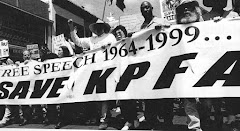
Pacifica Radio: What Went Wrong?

In late 2008, faced with layoffs, a crash crunch, lawsuits, and a long-term decline in listenership, the National Board of Pacifica Radio, the original listener-supported network, decided to seek a $1 million dollar loan, reportedly using station assets as collateral.

In response, Ricco Ross, chair of Los Angeles station KPFK-FM’s Local Board wrote to Chief Financial Officer Lonnie Hicks and the National Board, calling for greater transparency and consultation in such decision making, and asking sister stations in Berkeley, New York, Houston, and Washington, DC to stand with KPFK against the action.

The letter concluded: "This appropriation of station assets without notice and consultation sets a precedent that endangers every station in Pacifica." A motion passed by the KPFK LSB called for the National Board “to require a repair and repayment plan as a condition for its approval of any collateralized loan agreement." Almost a third of the loan would go toward payment of a smaller loan obtained the previous summer.

Since August, the organization’s Executive Director and Human Resources Director had resigned, staff was reduced at most stations, and many national staff positions were cut. On the other hand, CFO Hicks returned to work in October after a three month leave of absence. A new ED job description was written, but the search had yet to begin. Meanwhile, discussion forums speculated about receivership, bankruptcy, and breaking up the network. National Board Members and most managers remained silent.

At KPFA, the resignation of Business Manager Lois Withers was announced. According to an editorial posting on Pacificana, a KPFA-based online forum, “While Ms. Withers is known by many as capable and responsible in her position as Business Manager, the more recent memory of her tenure was marred by her role in escalating a simple volunteer matter into a disproportionate action of calling the Berkeley Police into the KPFA building and exacting violence on volunteer programmer, Nadra Foster. The original charges? Using the phones, and printing paper.”

A dispute also brewed over the KPFA Local Station Board’s decision to hold its November monthly meeting outside of the local signal area, along with postponement of the next meeting until January 2009. In New York, a lawsuit over the 2007 station board elections at WBAI had yet to be settled. Other lawsuits against stations and the network drove up legal costs. In Washington, DC, questions were being asked about the financial results of a 30th anniversary gala for WPFW.

Nevertheless, compared with recent news about station collapse and a phantom foundation set up to salvage what's left after bankruptcy and investigations, those were the good old days.

Such developments bring to mind my last in-person words to the PNB as Executive Director, delivered at a quarterly meeting in Los Angeles on July 27, 2007. I’d just come to an agreement with the Board on the terms of my departure; I’d offered to remain on the job until a thorough search could be done, and to help with a transition, but the Board passed on that option. Still, many of the problems and issues being discussed were addressed in that 12-minute report. It was, in abbreviated form, my basic assessment of Pacifica’s situation.

A financial crisis was likely and imminent, I said, but much could be done. Specific proposals to reform and revitalize Pacifica – many under discussion for years – were presented again. In short, the diagnosis was public and a plan was on the table. But some in governance and management weren’t persuaded, enough at least to make timely action next to impossible. Here’s what I said:

Report to the PNB, July 27, 2007

When I applied for this job, some of the Board members said that they were impressed with the fact that I’d studied the organization and its problems pretty seriously, and, in a sense, I got here by examining Pacifica as a journalist might and reflecting back to the Board what I’d found. Since then, however, there has been at times less interest in what I’ve learned by actually doing the job, and, at times, also limited enthusiasm for some of my proposals to address the problems that I’ve identified. But so it goes.

For the record, however, I’ve made several proposals and would like to reiterate them. I’ve suggested management reorganization, including more accountability of local management to national priorities and standards. There has been some controversy about that. I’ve advocated more aggressive and coordinated national programming, including a new national program and local programs carried by all sister stations, and national editorial priorities that are reflected in programming across the network. I’ve suggested that, like any other news organization, this one should have editorial priorities which change as circumstances change. Right now, I believe that those editorial priorities ought to be: ending the war on terror, health care for all, a restoration of democracy, and building ecological security. That is not to say that other issues and sub-issues are not also important. But these represent issues of great national concern, and which would – if reflected in national programming -- distinguish Pacifica as an independent radio network.

I have also argued for a serious investment, more serious than we have been able to provide so far, to technological re-tooling, including Internet channels with interactive content, more investment in new equipment, and increased distribution that empowers more listeners. I’ve suggested – and we are making some progress on this – more coordinated marketing and promotion with a serious and consolidated development and outreach budget, and training for affiliate stations. And finally, increased leadership within the independent media community, and work with other organizations on free speech campaigns.

But how has it gone? Slowly. Management organization has run up against concerns about local autonomy and, I think, a suspicion about the possibility that there could be another national power grab. Collaborative programming – we’ve made some improvements there, but there remains a sentiment that each station should control its own airwaves and that substantive changes should never be made without a long, thorough and, some would say, seemingly interminable process of consultation with many stakeholders.

Technological investment has been delayed by a tendency to create budgets from the bottom up, an approach that leaves overall issues that concern the national organization for last, and makes reductions in spending on network-wide needs the easiest solution when money is tight, as it is now. And coordinated marketing, which has been discussed with the term “branding,” has also proven difficult in an organization where no one really speaks for the organization without fear of being blindsided from within. There is not much consensus about image, except perhaps to be a passionate cheerleader for every good cause that comes along. I’m not denigrating those things, but a laundry list of causes is not a very effective way to market a radio network.

Meanwhile, Pacifica is grappling with several crucial issues: Adapting to fundamental changes in audio distribution, declining listenership and the erosion of Pacifica’s traditional revenue source, and, after five years with a new experimental structure, the need to make some serious adjustments. The current digital distribution project is an attempt to address one of these issues, and election-related bylaws changes acknowledge and address another. But declining audience and listener loyalty can only be fully addressed by looking hard at programming, and this is linked to unresolved questions about Pacifica’s mission and organizational structure.

Our CFO predicts that Pacifica is facing contraction and a cash crunch in the near future. But even if that doesn’t happen, and can be avoided in the next few months, the underlying problems remain and will resurface.

Earlier, I’ve mentioned that a re-evaluation of Pacifica’s mission is in order. This mission dates from Lew Hill’s 1946 prospectus for KPFA, arguably still the most crucial document in the organization’s history. One the key parts said that Pacifica would “engage in any activity that shall contribute to a lasting understanding between nations and between individuals of all nations, races, creeds, and colors; gather and disseminate information on the causes of conflicts between any and all such groups; and promote the study of political and economic problems, and the causes of religious, philosophical, and racial antagonisms.”

You know these words. This remains a fundamental philosophical statement for Pacifica. The idea behind these words is that peace can emerge from dialogue – that is, diverse groups openly communicating with one another. Not objective indisputable truth – none of us have that – an open exchange of ideas that helps us to know each other as human beings, dialogue that demonstrates the possibility that we can have peace in practice.

But today, too often, we have instead argument, an often angry struggle over ideology, airtime, and assigning blame that keeps Pacifica from creating constructive connections between people. On top of that we sometimes even have censorship; self-censorship actually, groupthink, avoidance of tough but necessary disagreement. So, I repeat: Pacifica’s mission needs serious study and reflection, a real long-overdue dialogue about the fundamental intentions of this organization – in this time.

The organization also needs a serious look at democracy as it is being practiced here. I hear it said that Pacifica is a “bold experiment,” a representative democracy of listeners. But to me it looks very much like a confederation, a very tentative association of communities –the stations – that view themselves as relatively sovereign, and operate under a common constitution – the bylaws – but with a weak central authority – the national office. My experience is that this structure makes it difficult to reach decisions, and to ensure that, even when decisions are made, that they’re actually carried out. It’s difficult to make even the simplest bylaw amendment, for example to increase efficiency, save money, or improve continuity.

The national organization is, by design, dependent on the stations, which view themselves as semi-independent. Without local cooperation and agreement, the central organization can’t provide essential services, and as a result, the funding of priorities like research, national infrastructure, development, and marketing is consistently neglected. In some quarters there is open hostility to the national organization, as if it’s some kind of parasite feeding off the stations. Therefore, it’s not very surprising that some managers and staff sometimes refuse to implement decisions made by the national board or national office.

In short, what I am saying, and what I have been saying for a year and a half, is that Pacifica’s confederal structure doesn’t work. For democracy to function compromise is essential. A minority that loses will only play along if it feels that the winning side is playing fair. This becomes difficult when groups adopt a stance of moral absolutism, or form factions. And we see both here. When factional disagreement becomes public and intense, the organization suffers from disunity, charges and counter-charges about the conduct of the elections, fraudulent or unethical conduct, and repeated attacks on so-called enemies. This is beginning to seriously undermine the legitimacy of the organization’s democratic process.

So, I ask you once again, as I asked when I traveled across the country: Are we running a media organization, or are we trying to build an alternative government? I hope it’s the former. ...

I don’t expect everyone to agree with my assessment of the situation, but I think it would be irresponsible if, after two years, I didn’t share with this community what I’ve learned and some of the reasons why I am leaving. Maybe I’m wrong. Maybe a new Executive Director can make this organization work just as it is. I hope so, and I’ve greatly appreciated the opportunity to help. Pacifica remains, despite everything I’ve said, a unique and important institution, and I sincerely hope it will continue to make a significant contribution to lasting understanding between nations and people in the years ahead.

FURTHER PACIFICA READING: Check out Quiet Meltdown for more on the crisis; Planet Pacifica is the inside story of my early months as CEO, combined with episodes from Pacifica’s history. AUDIO: Report to the PNB, Greg Guma, July 27, 2007.

Thursday, September 10, 2015

Debs and Sanders: Revolutionary Campaigners

To understand Bernie, consider Eugene Debs

“To me, socialism doesn’t mean state ownership of everything, by any means, it means creating a nation, and a world, in which all human beings have a decent standard of living.-- Bernie Sanders, 1990

Listen: Bernie reads Debs (from Sanders documentary)
Read more: 14 Things Sanders has said about socialism


Bernie Sanders has a plaque honoring Eugene Debs on the wall of his Senate office in Washington. It is an abiding admiration, stretching back decades. Before becoming Burlington mayor in 1981 -- but after four "third party" races for statewide office in the 1970s -- he produced and narrated a 28-minute documentary, Eugene V. Debs: Trade Unionist, Socialist, Revolutionary, 1855-1926.

For a better understanding of Sanders' philosophy and style, it helps to know a bit about the political figure he admired as a young radical in Vermont, during and after the Vietnam War.

A century ago, American politics was dominated by men who could command a public stage, telling jokes and stories with ease, making arguments and issuing indictments in long speeches. Of course, most of them relied on prepared remarks, but Eugene Debs seemed to speak from the heart. No tricks or effects, just electrifying straight talk.

Much like Bernie Sanders, Debs could inspire a crowd. He could be angry and funny, sarcastic and sentimental, sometimes poetic or even prophetic. But his target was always the same - big capitalists and their bankers, judges, politicians, editors, and even conservative unions leaders. He called on workers to join a moral struggle against "wage slavery." Industrialists were making a mockery of democracy, he charged, using their control of production to pervert the will of the majority.

For more than 30 years Debs was the most visible (and often controversial) spokesmen for a socialist vision in America. Critics said he was a menace, an apostle of anarchy and chaos. Eventually, he went to prison for his anti-war beliefs. In the end, the movement to free the presidential candidate who was simultaneously "democracy's prisoner" launched the American Civil Liberties Union and changed the terms of free speech during wartime.

In 1894, Debs first took center stage in the growing struggle between industrial capitalists and their workers. It was during one of the most dramatic and disruptive labor protests in American history -- the American Railway Union strike against the Pullman Palace Sleeping Car Company.

By 1901 he had moved from preaching about a cooperative commonwealth to openly promoting socialism as leader of the new Socialist Party of America. By then a "professional revolutionary," he ran for president every four years. The party had 150,000 members by 1912, and had elected hundreds of people as mayors, councilors, commissioners and state representatives. 

As the centerpiece of the ongoing Socialist campaign, Debs often toured the country in a Red Special railcar filled with posters, reporters and party dignitaries. At the height of the tours he gave hundreds of speeches a month, consistently mesmerizing his audiences. 

In 1912, Debs kicked off his fourth presidential campaign to a sold-out crowd in Madison Square Garden and received a half-hour standing ovation. It was the same everywhere he went.  He painted vivid word pictures of worker slaughter in mines and mills and the impending battle between "the multi-millionaire and the pauper." He touched an emotional core for anyone concerned about the new concentrations of wealth, even if they were skeptical about his socialism.

Part of the appeal was his claim to be part of the working class. Debs was largely self-educated and began working on the railroads at fourteen. From there he became a union leader. But his message also had appeal for middle class men and women (even though the latter couldn't yet vote). 

Critics saw socialism as an alien ideology, imported by immigrants. But Debs challenged that notion. He was a midwesterner, fighting capitalism in the spirit of Tom Paine and Walt Whitman. To back it up, he lived a conventional middle class life with his Kate in Terre Haute, Indiana, a small industrial city.

In the turning point presidential race of 1912, Debs argued that both Woodrow Wilson, the Democrat, and Theodore Roosevelt, running on his reform "Bull Moose" party platform, missed the main point -- that workers and owners were natural enemies with irreconcilable interests. Both were trying to ease the symptoms of injustice, but ignoring their cause.

That year Debs got almost a million votes, doubling his 1908 tally. It looked like the Socialist Party and Debs were here to stay. But then came World War I, and in its wake Debs ended up in federal prison in 1919 for speaking out against war. A year after that, as a movement built for his release, he ran for president again. Before the end of 1921, he was released by President Warren Harding.

Although Debs didn't get as far as Bernie Sanders in persuading Americans to join a political revolution and consider socialist solutions, he began the dialogue. Debs also provoked a national debate about the meaning of the First Amendment. In a post-war age of oppressive conformity, he sparked the birth of the modern civil liberties movement and convinced many people that society should better protect those who dissent, especially when they refuse to support the majority in the heat of war. 

It's easy to see why Bernie Sanders, already the longest serving Independent in US congressional history and leading US voice for democratic socialism today, still admires him. But he has some distance to go to match Debs' enduring impact and legacy.

(On this track, Bernie reads from a Debs speech in his 1970s documentary on the socialist leader.)

Wednesday, August 26, 2015

Immigration Fight at the AZ Corral

April 23, 2010

Arizona is in the grip of an anti-immigrant fever. Maricopa County Sheriff Joe Arpaio, whose popularity was built on his tough enforcement tactics and willingness to defy the federal government, is on the edge of a run for governor. But even if he doesn’t, the state has a controversial new law that requires police to determine the status of anyone if there is a "reasonable suspicion” they are in the US illegally – and arrest them if documents can’t be produced. Hiring day laborers off the street has also become a crime.

Supporters see the law as an anti-crime measure and part of a larger campaign to secure the border. Opponents call it racial profiling and claim it is unconstitutional.

Gov. Jan Brewer, the Republican who replaced Janet Napolitano when she became Obama’s Homeland Security chief, waited as long as possible before taking a position on SB 1070. Caught between a conservative primary challenge and the prospect of her state becoming the target of a Latino-led boycott, her first step was to issue a border security plan of her own. It includes increased surveillance, redirecting stimulus money to local law enforcement, and a request to President Obama for more National Guard border support.

Then, on April 23, as large crowds protested in Phoenix and Tuscon, Brewer signed the bill. Arguing that she is responding to a crisis, she linked her decision to the drug war.

Latino members of Congress had urged Gov. Jan Brewer to veto. "When you institutionalize a law like this one, you are targeting and discriminating at a wholesale level against a group of people," Rep. Raul Grijalva said. More than 50,000 people signed petitions opposing the law, about 2,500 students from high schools across Phoenix walked out of school and marched to the Capitol, and nine college students were arrested during protests for chaining themselves to the Capitol building doors to pressure the governor.

Interim County Attorney Rick Romley called it an unfunded mandate that is “tearing the community apart” and pledges that, despite the law’s thrust, he will focus on organized crime syndicates engaged in human smuggling. Obama says it is “misguided.” But Arpaio accuses opponents of just not wanting to enforce immigration laws, and state polls reveal strong public support.

Tourism and business leaders worry that the law will discourage visitors and economic development, comparing it to what happened when another Arizona governor rescinded recognition of Martin Luther King Day as a holiday in 1987. At least $300 million in income was lost and the NFL pulled the Super Bowl from Phoenix. Eventually, voters approved the state holiday.

Despite the social and economic dangers, Arizona’s two US Senators, Jon Kyl and John McCain, don’t just support the move. They’ve unveiled their own 10-point plan, including 3,000 National Guardsmen to be deployed to the state's border, 24/7 monitoring by unmanned aerial vehicles, permanent addition of 3,000 Custom and Border Protection agents, and completion of 700 miles of fencing.

The Arizona legislation "is exactly why the federal government must act on immigration reform," argues state Democratic leader Jorge Luis Garcia. "We cannot have states creating a jigsaw puzzle of immigration laws. This bill opens the doors to racial profiling with the provision that allows an officer to ask for citizenship papers from someone who only looks illegal."

When Napolitano was governor, she vetoed similar bills. She was relatively tough on immigration, especially on businesses who hired undocumented people, imposing what she called a "business death penalty" – basically taking away licenses – from those violating an employer sanctions law twice. However, she opposed punishing immigrants who were already here and didn’t think much of a border fence. "You show me a 50-foot wall, and I'll show you a 51-foot ladder," she said.

Things have changed since she left. Whether or not the 77-year-old Arpaio runs for governor and wins the GOP primary (or the general election), immigration will remain front and center in state politics for the foreseeable future, potentially accelerating and certainly influencing the national debate over reform. The Arizona law also plays into the “state’s rights” thrust of the current anti-federal government surge.

Dangerous Tactics

Anti-immigrant sentiment is a persistent theme in US politics. In 1996, for example, when then-California Gov. Pete Wilson announced that undocumented pregnant women should be denied prenatal care, his underlying message was clear and brutal: If you’re “illegal,” get out of our country!

Wilson’s statement came at another dangerous time, one marked by resurgent racism, increased police brutality, vigilante violence, and rationalization of virtually any attack. In other words, we’ve been here before.

In the early 1980s, low intensity conflict (LIC) theorists constructed a Los Angeles insurrection scenario requiring a military response and sealing the nearby border. A decade later, the Border Patrol played a key role in the L.A. riots of 1992, deployed in Latino communities and arresting more than 1,000 people. Afterward, the INS began work with the Pentagon’s Center for Low-Intensity Conflict, and the line between civilian and military operations was largely erased.

Throughout the 1990s, Human Rights Watch accused the US Border Patrol of routinely abusing people, citing a pattern of beatings, shootings, rapes, and deaths. In response, INS detainees in a private jail rioted in June 1995 after being tortured by guards. After 9/11, the federal government considered placing US soldiers along the Mexican border.

But efforts to curtail immigration through tighter security have done little but redirect the flow into the most desolate areas of the border, increasing the mortality rate of those crossing. Between 1998 and 2004, at least 1,900 people died trying to cross the US-Mexico border. In recent years, Arizona has become the main entry point for undocumented immigrants into the US. An estimated 460,000 live in the state, but the total has dropped by at least 100,000, or 18 percent, since 2008.

In the last five years, around 200 people have died annually along the Arizona border in wilderness areas, according to medical examiner data compiled by Coalicion de Derechos Humanos. On the other hand, Pinal County Sheriff Paul Babeu charges that “numerous” officers have been killed by illegal immigrants, and that the violence has reached “epidemic proportions.” Although that’s true, the main spikes in crime have been in home invasions and kidnapping, both of which are linked to the drug war and organized crime based in Mexico.

Anti-immigrant activists deny charges of racism. But the facts tell a different story. Almost unlimited numbers of immigrants from mostly white, European countries are allowed into the US, while Latin Americans and Africans rarely even get tourist visas. And although sweatshops that employ undocumented workers are condemned, they aren’t often shut down, but merely raided, resulting in deportations. The owners may be fined, but they still come out ahead. After all, deported workers can’t collect back wages.

The Arizona law makes police go after anyone whose look or dress is “suspicious,” yet does little to toughen the employer sanctions legislation passed in 2007. That gave authorities the power to suspend or revoke the business licenses of employers caught knowingly hiring illegal workers and required all businesses to use E-Verify to check the work eligibility of new employees. Since then, only two cases have been settled in which the employers admitted guilty. All the new law says is that they must maintain those E-Verify records.

Border Wars

More than 150 years ago, at the end of a two-year war between Mexico and the US, the Treaty of Guadalupe Hidalgo was signed. Many Latinos still feel that the treaty, accepted under pressure by a corrupt dictator, was an act of theft violating international law. Mexico surrendered half its territory — now the Southwestern United States — and most of the Mexicans who stayed in the ceded region ultimately lost their land.

In a sense, that war never ended. Throughout the remainder of the 19th century, US officials, working closely with white settlers and elites, used often-violent means to subdue Mexicans in the region.

Once the region was “pacified,” border enforcement became a tool to regulate the flow of labor into the US. With the passage of the Immigration Act of 1924, the Border Patrol emerged as gatekeeper of a “revolving door,” sometimes processing immigrant labor, sometimes cracking down. The Bracero Program, which brought in Mexican agricultural laborers, was followed (and overlapped by) Operation Wetback, an INS-run military offensive against immigrant workers.

The border is still a battlefield. During recent decades, government strategies for combating undocumented immigration and drug trafficking have re-militarized the region.

The North American Free Trade Agreement (NAFTA) meshed neatly with more obvious aspects of low-intensity conflict doctrine. The definition of immigration and drug trafficking as “national security” issues has brought state-of-the-art military approaches into domestic affairs. But just as the projection of a “communist menace” was a smokescreen for post-war expansionism, a “Brown wave,” the “Drug War,” and terrorism have been used as pretexts for military-industrial penetration.

LIC doctrine uses diverse tactics — from the subtle and psychological (“winning hearts and minds”) to the obvious and brutal. Such flexibility requires the most sophisticated tools available, and the integration of police, paramilitary, and military forces. It also requires a plausible “enemy” — in this case, immigrants who can be accused of almost anything and abused with impunity.

In this kind of war, borders are ultimately unimportant. Battles are waged everywhere, even in communities far from a frontier. This blurs the line between police and the military, and further threatens basic rights.

Future Shock

Latinos soon will be the largest minority group in the US, according to Census Bureau predictions: at least 44 million, or 15 percent of the nation’s population. Although the biggest expansion will occur in states that draw the most immigrants — California, Texas, New York, Florida, Illinois, and New Jersey — the spill-over will reach from Atlanta to Minneapolis and Washington state. California is expected to undergo the most dramatic transformation — to at least 50 percent Latino and possibly only 32 percent white by 2040.

Overall, immigration is fueling US population growth, and the Census Bureau predicts a tripling of the Hispanic and Asian populations in less than 50 years. While the number of whites may increase by seven percent, the three largest minorities — Hispanic, Black, and Asian — are expected to rise by 188, 71, and 213 percent respectively. The bottom line is that these three groups are expected to constitute at least 47 percent of total US population by 2050. While such forecasts certainly have much to do with the current anti-immigrant climate, the trend won’t be reversed by race-motivated legislation.

Low-intensity war against non-white immigrants is especially evident along the US-Mexico border. It takes many forms: militarization, criminalizing the undocumented, repressive legislation, human rights violations, and cruel, discriminatory attacks on children and the poor. Arizona’s new law is the latest development – the toughest state law on illegal immigration yet.

According to Sen. Russell Pearce, architect of the plan, the idea is to wipe out the "sanctuary policies of cities.” He says that politicians and others have handcuffed the police, keeping them from finding and arresting those in this country illegally. State action is necessary, he adds, because of political failure in Washington. Democratic Sen. Rebecca Rios agrees that the federal government hasn’t done enough to secure the border, but doesn’t think this is the answer. "This bill does nothing to address human smuggling, the drug cartels, the arms smuggling,” she says. “It creates a lot of negative effects that none of us here want, she adds. "And, yes, I believe it will create somewhat of a police state."

Despite the state’s libertarian streak, Arizona lawmakers apparently have other concerns. In addition to pushing through a roundup of “illegals” by any means necessary, they’re considering legislation that would require any future presidential candidate to produce a US birth certificate – a nod to the “birthers” who think Obama isn’t a citizen. The governor has already signed a law letting people carry concealed weapons without a permit, and another saying that federal laws don’t apply to weapons and ammunition manufactured wholly within Arizona.

The picture emerging is of a state that’s armed and paranoid, hostile to federal oversight, and suspicious of anyone who looks or talks like an outsider. The immigration law, along with other recent legislation, support for the “birther” movement, and the statement by J.D. Hayworth, who is challenging McCain, that same sex marriage laws would lead to men marrying horses is leading many people to ask: What’s wrong with Arizona?

In some respects, its situation is unique. Combined with its proximity to the border, there is the enormous growth of Phoenix, the arrival of so many transplants from Eastern cities and California, and a general disinterest in politics that has let things careen out of control. Turnout is low for primary elections, and the legislature is more conservative than the general public. This has created an opening for figures like Pearce, who has associated with Nazis, Hayworth and Arpaio, who have become influential political allies.

On the other hand, Arizona represents an extreme manifestation of the anger and reactionary sentiments roiling across the country. With the rise of a new state’s rights, anti-immigrant movement, the choice facing the state and the nation as a whole has become basic, between what Mexican author Jose Vasconcelos once called Universopolis – a place in which all the peoples of the world are melded into a “cosmic race” – and the Blade Runner scenario.

In Blade Runner, a prescient 1982 film, Los Angeles in the 21st century has become an ominous “world city” marked by cultural fusion and economic stratification, a sunless and polluted place, overcrowded with Asian and Latino drones who barely look up at the metal fortresses of the rich. USC professor Kevin Starr warned of this possibility, “a demotic polyglotism ominous with unresolved hostilities” in “L.A. 2000,” a city-sponsored report that touted it as “the” city of the future. In essence, that option is an advanced imperialist state, one that encompasses colonies within its own borders. Phoenix could go the same way.

Like Vasconcelos, author Salman Rushdie can envision a more optimistic, multicultural alternative. Immigrants may not so much assimilate as leak into one another, he suggests, “like flavors when you cook.”

Of course, this is precisely what frightens many angry, fearful people. For them the USA is hot dogs and apple pie, and they have no desire to change their diets. They want “their country” back, and with Sheriff Arpaio as an immigrant-hunting Wyatt Earp, plus a tough new law on the books, Arizona has become a flashpoint for that fight.

Related video: The Ballad of Sheriff Joe