Thursday, July 10, 2008

Pacifica Update: July Board Meeting Postponed as Cash Crunch Escalates

Despite a recent decision by the National Board of Pacifica Radio to hold an in-person meeting in Washington DC during July, it won’t be happening. During a teleconference on July 7, members noted that the national office hadn’t followed up on the board’s decision, citing lack of money as the reason.

The progressive network’s national board is currently debating how to handle an escalating cash crunch. According to Chief Financial Officer Lonnie Hicks and Finance Committee Chair Mike Martin, Pacifica owed about $150,000 as of early July and hadn’t been able to make scheduled payments to Democracy Now! and Free Speech Radio News, among others. Hicks noted that the amount owed would increase to $320,000 before the end of the month. He has suggested seeking a bank line of credit and inter-divisional loans, mainly from KPFA in Berkeley, to handle the situation. If something isn’t done soon, he warned, “Vendors may take action against us.”

To address Pacifica’s overall problems – loss of listeners and reduced revenues – the National Finance Committee has recommended reductions in the cost of elections and governance, increased off-air fundraising, and programming changes by stations. “Lawsuits are killing us,” Martin added.

During a March teleconference, the board instructed station management to develop expanded off-air fundraising plans by June. At the July 7 meeting, however, some members said that hadn’t happened yet. In March, the board also asked its Technology Committee and Sawaya to look into web-based conferencing as an alternative to in-person sessions. But that could run afoul of the current bylaws.

The immediate cause of the cash crunch, Hicks said, is that Pacifica stations fell $400,000 short of Spring on-air fund drive goals. In addition, both WBAI in New York and KPFK in Los Angeles are running hundreds of thousands of dollars below projections and may not be able to pay bills or meet payrolls in the weeks ahead unless something is done.

Several board members questioned the assertion that there isn’t enough money to hold a board meeting before September, the end of the fiscal year, and expressed concern that the national office hadn’t acted on the board’s decision to meet in July. According to Pacifica’s bylaws, four in-person meetings of the national board are supposed to be held each year. Thus far meetings have been held in January and April. Over the last two years, attempts to amend the bylaws to reduce the number of in-person board meetings have failed.

A committee formed by the board developed a plan to reduce the cost of a summer meeting by more than 50 percent and found three economical locations. The board approved the July meeting in June and instructed the national office to proceed.

Executive Director Nicole Sawaya reported that she has contacted staff, unions and various vendors about the financial situation, but did not publicly take a position on whether the board should meet. She did note, however, that Pacifica seems to drift from crisis to crisis and urged board members to be practical. In March, Sawaya cited the cost of governance as a long-term problem.

The board will meet again by phone in about a week to review specific proposals from management on how to handle the short-term cash flow problem. The July 7 teleconference, on which this report is based, can be heard at KPFTX.

Wednesday, July 9, 2008

Pacifica Radio: Following the Money

I’d been on the road for three weeks by the time I reached Berkeley at the end of February 2006. My Saturn wagon was stuffed with clothes, books and files, and my head was bursting with impressions. Pacifica Radio had tremendous potential – radio licenses in major markets, plenty of talent, an extraordinary history, access to a potential audience in the millions. But it was deeply wounded by years of internal struggle that had left people raw and distrustful. If I was going to succeed – whatever that meant – one of my tasks as the new Executive Director was to act as a healing influence, to help people trust each other and see that reconciliation was a safe and realistic possibility.

That was obviously a long-term project. In the meantime, I needed to get on top of some practical problems. KPFA needed a general manager. The lawsuit filed by Noelle Hanrahan had to be resolved, hopefully without an expensive trial. Negotiations with Free Speech Radio News had to begin. My relationship with Lonnie Hicks, the powerful Chief Financial Officer, would also have to be clarified. Plus, the next in-person meeting of the National Board was only a month away. That meant reports, my own as well as those by about a dozen managers and staff members, would have to be ready in about two weeks.

Of course, there was also the unexpected to consider. A prime example was the visit of two disability activists shortly after I returned to the Bay Area. Pacifica had been dragging its heels in complying with the Americans with Disabilities Act. But a compliance consultant had been found and apparently a contract for her services had been arranged. I hadn’t been told a word about it.

The “contract” the activists showed me was actually an unsigned two-page proposal submitted the previous October by ADA consultant Francie Moeller. No one in the office had seen it. When I called her up, however, she confirmed that Ambrose Lane, Interim ED prior to my arrival, and she had talked about five months ago. “Was a contract actually signed?” I asked. She assured me that it had been and agreed to forward a copy before we met.

A few days later a fax arrived. It was the same proposal I’d already seen, but this copy had a small addition. At the bottom of page two, just below Moeller’s signature, was the handwritten word “Approved,” followed by the signature of Ambrose Lane and a date, 10/30/05. She also sent the cover sheet of a fax she’d received from Ambrose on February 17. “Dear Mrs. Moeller,” it read, “Please forgive my tardiness in returning this signed Agreement. Thanks for all of your interest and commitment. Sincerely, Ambrose Lane Sr.” And this PS: “My replacement ED of Pacifica is Mr. Greg Guma.”

The problem was that the signatures on the fax and the proposal were identical and had obviously been written with the same pen. The October date also sounded familiar for some reason. Looking back in my date book I realize that it was the very day I had been given my final interview for the job in Houston. That meant Ambrose would have decided, in the midst of the busy PNB meeting, to sign a preliminary proposal that could cost the organization up to $20,000, then set it aside for five months and not tell anyone what he’d done.

I took the papers to Lonnie, who said he knew nothing about an agreement. How could Ambrose have worked in the same office with him for months and not mention such a thing? I showed him the signatures. He nodded, acknowledging my concern, but advised that I drop the matter. There was little to be gained by getting into a fight, he felt, even though the proposal was vague, lacked specific performance standards, and might lead to disputes down the line.

The situation reminded me of another controversial matter on my desk. A year before the national office had spent about $66,000 on 18 iMac computers, supposedly for the purpose of enhancing remote broadcasting capabilities. The idea was promising but few people knew in advance that a decision had been made. As CFO, Lonnie was obviously involved. So was Don Rojas, then manager of WBAI. And it appeared that Dan Coughlin had originally suggested a similar project. But most station managers knew nothing about it, and when the computers arrived, they said the choice of Macs made them less than useful. Stations mainly used PCs, and these new machines required expensive, proprietary software. Most of the computers had remained unopened in storage rooms around the country for the last year. A couple shipped to New York had disappeared.

The Board knew about the computers and several members were demanding an audit. Who was responsible for this “boondoggle,” they wanted to know. And where was all the equipment now? I was expected to provide a report at the next in-person meeting.

The trail led back to Lonnie. Few things in Pacifica that involved a substantial amount of money happened without his involvement – and usually his approval. The only exceptions I’d seen so far were the settlement with Roy Campanella at KPFA and the ADA agreement, both arranged by Ambrose during his stint as Interim ED without Lonnie’s apparent oversight. On the other hand, Lonnie sometimes pursued projects he defined as part of his “development” function without Board review or ED agreement. In short, an ED couldn’t normally proceed on a project without the CFO’s sign off, but the opposite wasn’t always true. If I was going to effectively oversee finances, supposedly part of my job, my relationship with the CFO would have to be clarified.

According to the hire letter I’d received, I was the supervisor of the station managers and all national staff – except the CFO, who reported directly to the Board. But that suggested that I did supervise the finance staff in the Berkeley office. In addition, Lonnie’s original hire letter, signed by Dan Coughlin in 2002, said that the CFO worked “under the supervision of” the executive director. After reviewing the situation with the HR Director I asked Lonnie in for a talk.

As far as he was concerned, the CFO was completely independent, accountable only to the Board. And the finance staff reported to him, not me. In fact, if I wanted any financial information he preferred that I request it from him rather than go to the staffer who might actually have it. He was especially sensitive about any contact with Assistant Controller Lynn Magno, who I’d met early on and asked to serve as part of my transition team. Every time we talked, she said, he would come over afterward and grill her about the conversation.

It quickly became clear that Lonnie wouldn’t submit to increased oversight without taking his case to the board. It was too early for such a confrontation. He knew much more about the flow of money and the internal dynamics of the organization. In a board fight so early in my tenure I was apt to lose. Even if I won the office atmosphere would be terrible afterward. The best course, at least for a while, was to reach an accord. I won’t challenge your view of the situation, I offered, if you make sure to consult me about all financial matters from now on. “I’m happy to comply,” he replied.

Part Thirteen of Pacifica Radio: A Listening Tour

Next: Assessing the Deficit of Trust

Monday, July 7, 2008

Pacifica Radio: Elections & Civic Media

Before returning to Pacifica Radio’s business office in Berkeley, after weeks on the road visiting stations as I relocated across the country, a few more stops needed to be made. First, a briefing with some Los Angeles volunteers who explained the intricacies of Pacifica’s election process. The meet was arranged by Lydia Brazon, a national board member representing KPFK.

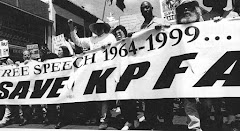
For some people elections are the heart of what has been achieved by the Save Pacifica movement – more than a hundred elected local board members for the five sister stations, chosen by Pacifica members through a complex form of proportion voting. Each listener-member, volunteer and staff member can support multiple candidates by ranking their choices. A computer program calculates the results, making it possible for various constituencies to be represented.

But the process takes months, what with determining eligibility, nominations, public forums and public service announcements designed to level the playing field, the mailing of more than 80,000 ballots and booklets with candidate appeals, and the tabulation and certification of each station’s results. According to the new bylaws, at least 10 percent of members must vote in each local election for the outcome to be valid, and it has been getting more difficult each year to legitimately achieve quorum.

Within a month I would have to select a National Election Supervisor to manage the entire process (In April 2006 I picked Les Radke, over the objections of some), someone who understood this unusual approach to elections and had enough patience to handle the inevitable complaints. That overseer would in turn recruit Local Election Supervisors for each station. It might also be necessary to contract with an outside firm specializing in this type of computer-based voting. The whole shebang would cost more than $200,000 (slightly less in 2006) and require the cooperation of managers and staff at every station. The latter certainly wasn’t assured. For many staff members the elections were a time-consuming nuisance and ended up producing boards that demanded far too much involvement in day-to-day decisions for their taste.

That evening I was the main speaker at a community meeting. After explaining how it happened that a Vermont editor had become the CEO of a radio network, I took questions for about two hours. People seemed surprised that I had a decent grasp of the myriad challenges. After that I drove downtown for a late-night talk with Dave Adelson, the new chair of the national board.

Dave was neurophysiologist, former chair of the KPFK board, and, during the Save Pacifica movement, lead plaintiff in a key lawsuit. He had supported Eva Georgia’s candidacy for ED, as he explained it mainly because she was tough and wouldn’t “take shit” from people. On the other hand, he advised me not to act too fast but rather to watch the dynamics before making any strong moves. His analysis centered on the notion that Pacifica had been “privatized” by people who thought of airtime as their personal real estate. The idea that the network was supposed to foster a civic community had been lost along the way. It would be difficult to change that, he believed. But he had a big idea.

Dave’s idea involved the growth of digital media and the Internet. Increasing numbers of people, especially the young, were already getting their media via devices like iPods. They didn’t see the point of making an appointment to hear a show when they could download it at their convenience. If Pacifica provided major online platforms for content – and encouraged people to use them as a viable alternative to terrestrial radio – it could foster a new form of civic media. Over time it wouldn’t matter as much who had the 8 a.m. time slot. An unlimited number of shows could be distributed. Listeners could even become their own program directors, assisted by Pacifica in setting up virtual channels.

But making all content, including existing shows, available online meant that questions of ownership and copyright had to be resolved. The stations owned any shows produced by staff members, and the CPB provided a blanket agreement that allowed non-commercial stations to air commercially-owned music. But most Pacifica shows weren’t produced by staff; they were created and hosted by individual volunteers and collectives. And music distributed digitally wasn’t covered by the CPB’s deal with the recording industry. As soon as possible Pacifica needed to work out an arrangement with its volunteers, resolving the ownership issue and winning support for licensing agreements that would allow the network to distribute hundreds of programs to a vast new and much younger audience.

It was a lot to absorb, and I didn’t completely get it the first time he tried to explain. Dave had a scientist’s fascination with subtle details and tended to rhapsodize about his vision of the future. But it was clear that he had a plan and had taken on a leadership role within the board to make something very specific happen. He too wanted to know if he could count on my support.

Part Twelve of Pacifica Radio: A Listening Tour

Next: Following the Money

Wednesday, July 2, 2008

Pacifica's Archives: A Preservation Oasis

Pacificans often call it The Archives or just PRA, an astonishing resource, virtually the only audio collection of its kind, more than 50,000 recordings that chronicle the social, cultural and political movements of the second half of the 20th century.

The McCarthy hearings, the Civil Rights Movement, and the Vietnam War; the voices of Dorothy Dandridge, Allen Ginsberg, Malcolm X, Margaret Mead, Alan Watts, Rachel Carson, Bertolt Brecht, Che Guevara, and countless others; rare musical performances from Coltrane to Dylan; documentaries, debates, poetry, drama, and historic moments – it’s all there in a climate-controlled Los Angeles vault.

After more than two decades on the air, Pacifica decided to begin formal preservation efforts in 1972. The idea was to save, transfer and distribute key broadcasts to schools, libraries, other radio stations, and to individuals who wanted to own a small piece of history. The decision was made to keep the library at KPFK in Los Angeles. In 1986, the National Federation of Community Broadcasters added its own archives to the collection, and by the end of the decade about 7,000 unique recordings had been restored. By the 1990s, however, the project had become enormous and the Board wasn’t devoting sufficient funds to keep rare material from deteriorating. Preservation is a costly, labor-intensive process and some tapes are so brittle that they disintegrate when handled.

The determination of PRA Director Brian DeShazor, along with the realization that both irreplaceable history and a potential income stream were being neglected, produced a change of priorities. The archives staff grew, grants were obtained, and the Board decided to devote at least two percent of the annual budget to preservation. Today many historians and scholars consider the Pacifica Radio Archives one of the most important audio collections in the world. With a line item budget of its own and status as a formal department, PRA is sometimes described as Pacifica's "sixth station."

Brian greeted me on the second floor of the KPFK building in North Hollywood the day after my first visit to the station. A precise, fair-skinned man with a deep passion for historic preservation, he was eager to explain the importance and urgency of PRA’s work. Even though Pacifica’s annual budget included more than $500,000 a year for preservation, it wasn’t enough, he said. In truth, it would take millions to rescue the thousands of tapes still sitting on long rows in the vault. Many hadn’t even been reviewed yet. And PRA’s job went far beyond that.

Once an audio jewel is identified, it must be digitally transferred and then duplicated. The archives also handle production of CDs sold as premiums during station fund drives, provide producers with access to relevant excerpts for their shows, give program directors material to enhance coverage of major events like Black History Month, make the collection – including more recent shows – available to affiliate stations for broadcast, and work with outside organizations that have nowhere else to turn for specific rare recordings.

PRA also has to raise a major portion of its budget, mainly by organizing an annual fundraising marathon broadcast on the sister stations. To supplement this income, it licenses material to publishers and the film industry, creates premium packages on specific themes, and encourages individual listeners to “adopt” tapes, which basically means underwriting the cost of restoration.

The Board didn’t seem sufficiently committed to what was, after all, a time-sensitive project, Brian felt. And station managers balked at giving up even one day of local programming for PRA’s annual on-air drive. This was the soul of Pacifica, its legacy on tape, he insisted, yet many “profoundly irreplaceable sonic documents” might still be lost unless preservation became a much higher priority. Like almost everyone I was meeting, he felt that he (and the archives) was unappreciated, and gently probed to see how committed I was to supporting the work.

Meeting with the seven person staff I was struck by the calm, upbeat atmosphere. In contrast to staff I’d encountered at some stations these people seemed to truly enjoy their jobs. Reinforcing that perception, there was little turnover or discussion of internal politics. On the other hand, they sounded detached, as if PRA was a separate organization, more like an audio library or museum than part of a national broadcasting operation.

How did they get along with the KPFK staff just downstairs? I asked. Brian flashed an ironic smile and said that contact with minimal. In fact, Eva Georgia, the station’s General Manager, rarely visited the second floor.

That was disappointing – but not a surprise. Each unit or station operated without much interest in what the others were doing. If anything, they viewed other parts of the organization as competitors for limited resources. Words like “fiefdoms” and “balkanization” were used frequently to describe the dynamic. Everyone wanted respect, but most people stressed the unresponsiveness and limitations of others rather than how they might collaborate.

Part Eleven of Pacifica Radio: A Listening Tour

Next: Electronic Democracy & Civic Media

Tuesday, July 1, 2008

Pacifica Live: Sawaya Goes On The Record

In a live “coast to coast” report to Pacifica Radio listeners on June 27, 2008, Nicole Sawaya, Executive Director since March, said that the biggest challenge facing the 59-year-old progressive media organization is deciding whether it is five stations or a network. Admitting that Pacifica currently faces “hard times,” marked by flat income and shrinking audiences, the self-proclaimed “reluctant ED” – an apt, familiar description, by the way – argued that the solution is to act like a network, embrace the digital future, and “create programming that makes Pacifica essential.”

The broadcast was unusual, the first time a Pacifica top manager has been able to address a national audience live – through all five sister stations – in many years. With station managers empowered to make programming decisions locally, simultaneous broadcast by Pacifica’s owned stations in New York, Los Angeles, Houston, Berkeley, and Washington, DC has been rare in recent years. The one-hour show, which included calls from listeners, gave Sawaya the chance to candidly discuss the organization’s accomplishments, potential, and difficulties. Although avoiding some hot topics – a 25 percent cut in funding for Free Speech Radio News (FSRN) and a financial crunch so serious that money for a national board meeting is hard to find, for example – she did acknowledge at one point that letters have gone out about possible staff cuts.

Looking at Pacifica as an ecosystem, she remarked that it’s “not sustainable,” but promised that “no asset will be sold.” The pledge is significant, since the rumor that the National Board was considering the sale of a station helped fuel large protests in the late 1990s. Although Pacifica is “not a movement,” she argued, it is “a public trust and should not be leveraged.”

On the other hand, Sawaya said, “I prefer a network” to a “low bar of entry.” Since Pacifica’s reorganization in 2002, it has become “so flat it’s concave,” she continued, and this has raised the question of “where does leadership belong?” Later, she joked that “in the lexicon of Pacifica, management is a dirty word.”

Despite financial pressures, Sawaya is determined to produce more national broadcasts. During the report, she pointed to coverage of Gay Pride events, hearings on torture covered via KPFA by Larry Bensky, and the recent Winter Soldiers hearings, which were ignored by most commercial media. Later in the summer, she noted, Pacifica will provide its own national coverage of the Democratic, Republican and Green Party conventions.

Looking further into the future, she spoke of a “generational hand off” linked to the shift toward digital distribution and the need to “connect the country together” through new programs such as an “environmental watch” show. In recent years, she noted, “our discourse has declined.” But she feels that the blogosphere provides a new model and pointed to Pacifica founder Lew Hill’s on-air roundtable discussions, noting that they didn’t become “a food fight” or “dumbed down.”

Her conclusion is that the organization needs to be “more inclusive, and not afraid.” However, she added, “I don’t have a vision. I’m just a worker trying to knit together the best programs.”

Sawaya fielded more than a dozen calls during the broadcast, with questions and comments on transparency, moving WBAI from its expensive Wall Street location, editorial priorities, tenure limits for producers, international coverage, and whether she feels emotional and embattled. Though she shrugged off the latter concern, saying “I’m just wired that way,” she admitted that the financial problems are serious and she’s anxious to provide “economies,” efficiency, and better service.

In response to the question about New York station WBAI’s location and budget troubles, she noted that moving the station, as well as WPFW – whose lease in Washington, DC runs out soon – raises the question of whether stations should focus on “bricks and mortar” or “scale it down.”

Sawaya – who served as flagship station KPFA’s General Manager briefly in the late 1990s before being abruptly dismissed – returned as Pacifica’s top executive last September. The vote was unanimous, but she was the only candidate interviewed in person. Although given a five-year contract, she unexpectedly resigned in early December – to widespread surprise and disappointment. In the three months that followed, however, she negotiated privately with the board and agreed to return in early March. The details of the negotiations are confidential, but one of her first public struggles was to assert more oversight of finances, including over Chief Financial Officer Lonnie Hicks and his staff. After a series of meetings the board basically backed her position.

That success was followed closely by the public admission that Pacifica is being forced to cut back on spending. As Sawaya searched for a way to pay for national programming, FSRN received word that funding for its daily half-hour international newscast would be cut by more than $13,500 a month – effective immediately. According to an FSRN press release, “The reduction represents about a 25% cut in income for the grassroots news collective. Since FSRN is barred from on-air fundraising, it must seek to offset the cut with income from affiliates, foundations and individuals.” As of late June, an on-line petition to the Pacifica National Board had been signed by almost 400 people. It says:

“Free Speech Radio News has long been a vital part of the global media justice movement that highlights the voices of marginalized communities most affected by social and economic policy changes. I understand that Pacifica is facing a budget crisis, but FSRN is indispensable to Pacifica's mission and I encourage sustained funding to ensure FSRN's survival.”

In June, the board also got word from CFO Hicks that “it will be tough” to come up with enough money for a meeting of the National Board in July and August, even if the usual spending is cut by more than 50 percent. “All stations have failed to meet drive goals,” Hicks stated, “some of the worst I’ve seen.” Pointing to mounting expenses and unexpected legal costs, he concluded, “We are working from payroll to payroll. Our reserves have been used up over the last couple of years.”

A Board committee was established to consider options, and subsequently recommended that the meeting be held anyway. The Board itself chose July 25-27 (an effort to rescind that decision failed) and instructed the committee and management to select one of three Washington, DC locations. The choices include Howard University or Gallaudet University (a school for the deaf and hard of hearing), both in Washington, or the National Labor College in nearby Silver Spring, Maryland.

At the end of the broadcast, Sawaya remained optimistic, pointing to the potential of launching “multiple streams” through the Internet and high definition radio (already in use at Houston station KPFT). When the last caller argued that Pacifica isn’t typical and operates in an “interactive” rather than a “one way” manner, she heartily agreed. “It’s a two-way street,” she replied.