Showing posts with label Autobiography. Show all posts

Wednesday, July 3, 2013

Restless Times, Big Love and Nagging Questions

This is the fourteenth chapter of a series excerpted from “Maverick Chronicles,” a memoir-in-progress. Previous stories can be found at VTDigger. By Greg Guma

Visiting Nicaragua as part of a peace delegation in 1983 was an inspiring experience. But I also noticed that the Sandinista road had some potholes. In bookstores, for instance, I saw only Marxist literature and imports from the Soviet Union. The country’s literacy crusade had made a huge difference, but right-wing propaganda was being replaced by ham-handed left-wing indoctrination.
     
Paulo Freire teaches
As a student of Paolo Freire, the Brazilian educator whose approach stressed the development of critical consciousness, I concluded that Nicaragua’s revolutionaries were passing up a chance to transform society. "We are unfinished beings in an unfinished reality,” Freire had explained in class. “We become educated every day. But education doesn't have to do with the quantity of information you eat. You are educated to the extent that you are engaged in creating knowledge."
     But how is knowledge created? I had asked.
     “Knowledge is a mixture of thought and action which becomes like a ball in permanent motion,” he said. “It moves in spirals until the 'teachment' comes forth and knowledge appears."
     The process sounded a bit like giving birth, a painful but liberating experience. Knowing demands reflection, action, curiosity, patience, hope to create and taking risks, Freire explained. But in most schools, the acts of knowing and creating new knowledge are divided, so places of education have essentially become shopping centers that sell existing knowledge.
     "In Latin America fatalism is expressed in reliance on God,” he said. “In North America it is the power of the establishment and technology that replaces God. It is as though history is already finished and not being created and growing."
     When I shared my impressions of Nicaragua during a speaking tour, some people in audiences nevertheless objected to my questions about the Sandinistas’ decision to suppress dissent or censor books and newspapers. They have no choice, folks said, pointing to US attempts to overthrown the new regime. They were right. The Reagan administration was funding a violent insurgency and other forms of destabilization. But the Sandinistas weren’t perfect, and support for them need not exclude a bit of constructive criticism.
      Self-criticism was supposedly an aspect of the Left’s approach to process. When it came to “our side,” however, any break from “unity” could be grounds for a charge of disloyalty, perhaps even “collaboration” with the enemy.
     Frustrated with such reactions, I stopped speaking about politics in public for a while and returned to the book business to launch Maverick Bookstore and Gallery in Burlington’s Old North End. The name felt appropriate, philosophically and because the Lloyds, my son’s family on Robin’s side, were related to the Maverick clan in Texas.
     Samuel Maverick was a big Texas personality and the origin of the word’s modern usage. The official story is that he won a ranch in a card game and afterward declined to brand his steers. Unbranded steers became known around San Antonio as mavericks.
     The TV show Maverick was pure fiction, but there was a large maverick family. Robin’s grandfather married Lola Maverick. He became famous briefly as a so-called “Communist millionaire;” she helped organize the Ford Peace Ship before World War I and co-founded the Women’s International League for Peace and Freedom. Some of their children were activists as well, including Robin’s dad Bill. So, when I thought about an independent enterprise, not to mention my journalism and peace work, the name felt apt.
     Running a local business replaced political arguments with community service, brought in a modest income, and provided the opportunity to create an outlet for new community projects. But I was still restless, and spent considerable time over the next several years in Europe, seeing as much of the world as I could afford.
     At the end of the 1980s I tried to reconnect with Vermont as coordinator of the Burlington Peace and Justice Center and commissioner on the local Library Board. I even made a second run for the City Council, again getting 42 percent of the vote. In that race the local GOP Chair called me a “serious professional revolutionary anarchist,” an attack I turned into a campaign button. But despite some modest successes – forging a connection between the peace and environmental movements, publishing a book about Vermont, bringing the local library under direct city control – I felt disconnected, out of synch with the increasingly gentrified Burlington scene.
     
One of our Mexican campsites
Fortunately, I was deeply in love at the time. If we are lucky, at some point we experience a great love, one that stirs the soul and rocks the world. Mine was a Danish guitarist who visited Burlington with an international work camp when I was in my mid-30s and she was 20. For the next six years we pursued a trans-continental affair, wintering in my camper on the Mexican coast, mushroom hunting on a remote Danish island, trying to live together in Denmark and Vermont, breaking up and re-uniting and breaking up again. Finally, in 1990, we gave up struggling and married. A year later we picked up stakes and moved to southern California.
     Before arriving we were both offered jobs, she as a music therapist at a state hospital, me as manager of a bookstore in Santa Monica. Gail Stevenson, a successful therapist with celebrity clients and a Frazier Crane-like husband who offered advice on the radio, was about to open a trendy “eco-feminist” bookstore across from the Santa Monica Museum. She’d heard about my Vermont business and hoped to create something similar, a bookstore that was also a center for community activity. She already had a name – Revolution.
     The location was prime, the patrons affluent, sometimes famous, the space large and airy. But Gail was more concerned about what it looked like than how well it functioned as a business. The interior was designed by an architect partial to deconstructionist style, so books were piled on rough crates and lodged on stark metal shelves that made effective display difficult. Six months after the opening, an event heralded by a front page piece in the style section of the Los Angeles Times, the renovations still weren’t complete.
     No matter how much money we made it wasn’t enough. The main reason was Gail’s inability to stop spending on anything but books. The kid’s section had to be a posh playground with toys and designer pillows, the coffee bar had to feature only the best espresso machine and pastries. There were always more ads to place for events, and new ideas for an even better image. Meanwhile, I struggled to make payroll for a large seven-days-a-week staff and keep up with monster bills from our wholesalers.
     When I mentioned the problems to Gail, pleading with her to get a grip on the spending, her gaze would drift away, as if distracted by an invisible marvel somewhere in the distance. When I finished talking she’d turn back and say something like, “We need better biscottis.” It was maddening.
     Eventually, I demanded some changes. Making a comprehensive list of what was essential to get the operation into the black, I presented my case. The next day she introduced my replacement.
     Two weeks later I was unemployed. Three weeks after that I received a call from a member of the bookstore staff. On Gail’s 46th birthday, the staffer recounted, she had purchased a gun, learned how to use it at a shooting range, then driven to her Westwood office and killed herself. She was beautiful, blonde and wealthy, with a young son, an admired spouse and A-list friends. None of it turned out to enough.
    I stayed in L.A. for another year, but after the Revolution disaster I just couldn’t connect with the city’s ephemeral, often narcissistic culture. Three of my screenplays made the rounds – an historical epic on the Haymarket bombing, a film noir take on the CIA’s notorious MK-Ultra mind control program and a contemporary thriller about religious fundamentalists who carry out assassinations for a covert right wing group – but none of them survived the Hollywood meat grinder. After a few years neither did my marriage, although my love never faded and the memories remain.  
     Back in Vermont, the editorship of Toward Freedom opened up at the right moment, so I returned East and tried to recover. Still, the restlessness would not go away.
     In 1995, when an ex-girlfriend got in touch and I learned that she was moving to New Mexico for health reasons, I decided to give the west another try. Fortunately, the Internet had gone public by then, so it was possible to edit Toward Freedom long distance, even increase its immediacy and writer network. Dave Dellinger, who was co-chairing the board with Robin Lloyd, was skeptical but willing to give the idea a chance.
     A few months after arriving I was both editing TF and running yet another progressive non-profit, the Albuquerque Border City Project, an immigrant rights organization that provided legal services. As it happened, the US was just entering one of its periodic bouts with anti-immigrant fever.
     While living in L.A., I had watched the Border Patrol play a key role in the riots of 1992, deployed in Latino communities and arresting more than 1,000 people. Afterward, the INS had begun work with the Pentagon’s Center for Low-Intensity Conflict. The line between civilian and military operations was largely being erased. Human Rights Watch accused the US Border Patrol of routinely abusing people, citing a pattern of beatings, shootings, rapes, and deaths. In response, INS detainees in a private jail rioted in June 1995 after being tortured by guards.
     In many ways Los Angeles embodied the American Dream. The confluence of climate, capital and demographics had made California one of the world’s largest economies, an “international” state that was also the image capital of the world. But it was also rapidly becoming a "third world" state. As David Rieff noted in Los Angeles: Capital of the Third World, the rest of the country – and perhaps the world – might well follow the L.A. model. Rieff considered it, at the very least, a national archetype. The US was no longer an extension of Europe, he argued, becoming instead "an increasingly nonwhite country adrift, however majestically and powerfully, in an increasingly nonwhite world."
     While I worked in Albuquerque, the border became a battlefield, and government strategies for combating undocumented immigration re-militarized the region. The recently-passed North American Free Trade Agreement (NAFTA) meshed neatly with more obvious aspects of low-intensity conflict (LIC) doctrine. The definition of immigration and drug trafficking as “national security” issues brought state-of-the-art military approaches into domestic affairs. Just as the projection of a “communist menace” was a smokescreen for post-war expansionism, a “Brown wave,” the “Drug War” and terrorism were being used as pretexts for military-industrial penetration.
     In New Mexico I immersed myself in immigration law and regional race politics, developing a coalition of sympathetic groups to fight back against the most draconian aspects of a new immigration reform law. We staged public rallies in Old Town, and brought Latino and Asian spokesmen to Santa Fe to testify at legislative hearings. Sensing potential, the progressive power structure welcomed such initiatives and offered me a spot on the State Human Rights Commission.
     I remained an outsider, however, one who didn’t fully understand the nature of the local culture or embrace some of its assumptions. The cause was just. But the small, progressive enclave I’d entered was isolated from a larger and essentially conservative community. Neither felt like a place where I could comfortably put down roots.
    What was I, an activist or a writer? A foot soldier in the long progressive march – a movement about which I was having some doubts – or a social critic and observer, always questioning conventional wisdom? Was it possible to be both? Wherever I went such questions followed.
     Maybe my standards were too rigid, or my expectations too high, I thought. Maybe a more practical, less perfectionist approach to life and work would serve me – and whatever came next – a bit better. After years of self-imposed exile it was time to go home and find out.

Maverick Chronicles will continue ...

Thursday, June 13, 2013

Tipping Point: Burlington's Progressive Revolution

This is the eleventh chapter of a series excerpted from “Maverick Chronicles,” a memoir-in-progress. Previous stories can be found at VTDigger. By Greg Guma

“I think I’d make a good candidate,” said Bernie Sanders. We were sitting across a small table in the Fresh Ground Coffee House, the same place the FBI had labeled a “known contact point” for extremists a few years earlier. As far as I knew no spooks were listening.
     
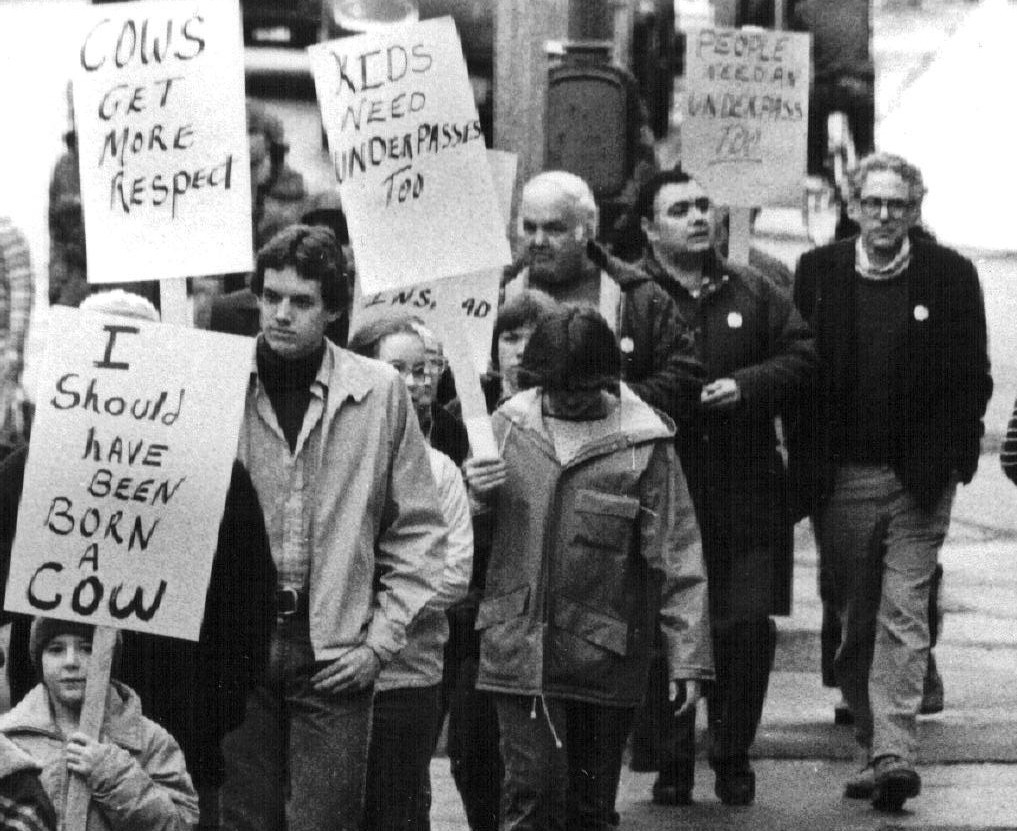
Bernie Sanders (right), protested
outside City Hall in the 70s
In October 1980, most people were focused on the presidential race between Jimmy Carter and Ronald Reagan. But a few of us were looking beyond the two-party system. Sanders supported Socialist Workers Party candidate Andrew Pulley, on the Vermont ballot that year along with four other “minor” party hopefuls. I backed Barry Commoner, who had formed the Citizens Party a year earlier. The reason for the meeting wasn’t national politics, however. Both of us were thinking about the race for mayor the following March.
     As editor of The Vermont Vanguard Press I had crossed the line from observer to participant. Earlier in the year I’d attended the founding of the new party’s Vermont chapter and pushed for a race against incumbent congressman James Jeffords (who left the Republican Party two decades later). The Democrats had opted not to put up a candidate. The Citizens Party’s choice was Robin Lloyd, a peace activist and advocate for a nuclear weapons freeze since the birth of our son Jesse in 1978. Further complicating the picture, I was chairing the Burlington City Committee of the party, and let it be known that if Robin did well locally, I might build on the momentum by running for mayor.
     As it turned out, Robin won about 13 percent of the statewide vote, an impressive number for a first-time candidate in the race only six weeks against a popular incumbent. But another important number was 25, the percentage of the vote she won in Burlington. To those paying close attention, this suggested that a candidate not in one of the major parties could potentially mount a local challenge. When we met neither Bernie nor I knew how well Robin would do. But we both sensed the potential.
     The truth is that it was not a negotiation. As Bernie made plain, he planned to run no matter what anyone else did. Since leaving the Liberty Union Party in 1977 and declaring it a failure he had been working as a filmstrip producer and building a political base in the city’s New North End. Joining forces with tenants at a public housing project, he formed an advocacy group, then a campaign exploratory committee that included local activists and UVM faculty. He planned to run as an independent, he said, and create a loose coalition.
     Some people had doubts about his move. Even Bernie wondered whether he could focus on local issues instead of blasting millionaires. “National and state issues are more my thing,” he acknowledged But the word was out. According to the Burlington Free Press, two “left-leaning activists” were “jockeying over who will carry the progressive banner next year.” 
     Sanders said he wanted to lead a coalition of poor people, blue-collar workers and university students. “The goal must be to take political power away from the handful of millionaires (he’d managed to get them in the mix) who currently control it through Mayor Paquette, and place that power in the hands of the working people of the city,” he announced.
     My approach was more local and granular. Building on the issues I’d been pursuing as Vanguard Press editor for several years, I talked about building low and moderate income housing, establishing neighborhood councils, diversifying the economy, stopping the Southern Connector highway, and “linking development to human needs.” Allies urged me to run despite Bernie’s announcement, and suggested forthcoming support from some Democrats since I “sounded more moderate.”
     Although Sanders’ rhetoric did make it appear that he was “further to the left,” when push came to shove he turned out to be pragmatic about policy choices, and quite comfortable with the unilateral exercise of power. Still, his approach was appealing to broad constituencies, even some conservatives; local issues were less important to him, and in truth he knew little about them. On the other hand, he was a natural campaigner who could connect with the public.
     If both of us ran, neither was likely to win. If one stepped aside, however, my earlier prediction about overturning the local political establishment might come true.
     A few days after the November elections, I phoned in my decision to the Free Press. “I don’t really want to be in the position of dividing progressives looking for an alternative to Paquette,” I explained.
     Dropping out of the race was a tough choice, and I wasn’t completely comfortable with Sanders heading the ticket of a movement I had spent much effort and many years helping to build. But faced with the opportunity to plunge seriously into electoral politics, I decided to pass. Two years later I rejected the Citizens Party nomination to run for Vermont governor, along with backing from a faction in the national Party who wanted to replace Barry Commoner as chair.
author as candidate, '81
     The way I saw it at the time, Bernie was an instinctive politician and I was not. He enjoyed campaigning and knew how to give the same speech, over and over, while connecting viscerally with his audience. He also knew how to wage ideological war and manipulate the media, without scruples or dependence on facts to make his case. On the other hand, he wanted to lead this emerging movement without submitting to the dictates of any leadership. And he conveniently separated a professed dedication to democracy from his personal practice, which soon led to autocratic actions and shutting down the opinions of allies with the temerity to disagree. 

     As one supporter confided, “He’s a jerk. But he’s our jerk.”
     In January 1981, Gordon Paquette was nominated for a fifth term as Burlington Mayor. After the Democratic caucus Richard Bove, owner of a popular local Italian restaurant who was defeated in the caucus, bolted the party to run as an independent. Republican leaders decided not to oppose Paquette and instead banked on his re-election.
     Rather than sit out the campaign I ran as a Citizens Party candidate for the City Council against Richard Wadham Jr., preppy chair of the Republican City Committee. The Citizens Party fielded candidates in two other wards. Our opponents tried to ignore us, assuming that a small group of activists had no chance of upsetting the status quo. They seriously underestimated the growing influence of neighborhood groups, housing reformers and redevelopment opponents, young people and the disgruntled elderly. They also ignored the possibility that some of Paquette’s past supporters might choose to send him a message.
     
Sanders savors victory, March 3, 1981
On March 3, 1981, with a few thousand dollars, a handful of volunteers and a vague reform agenda, Bernie Sanders won the race by ten votes. Burlington had a radical mayor, a self-described democratic socialist who was determined to change the course of Vermont history.
  
     I lost my council race with 42 percent of the vote, but another Citizens Party candidate, Terry Bouricius, became the first member of the party elected anywhere in the country. In an odd twist of fate, he won in Ward Two, the same neighborhood that had given Mayor Paquette his first term on the City Council 23 years before.

Over the next decade there were remarkable advances in the Queen City, as well as several missteps. Some early progressive initiatives actually challenged the basic logic of capitalism, but others simply provided benefits while leaving the system unchanged. A few contradicted the public rhetoric, however, raising doubts about the priorities of the new movement and creating divisions that endured.
     Beginning in 1983, for example, protests at the local General Electric armaments plant led to painful arguments: activists wanted a city commitment to peace conversion, Sanders and other progressives preferred to turn the heat on Congress. It was basically a dispute over tactics, but the implications went deeper. By opposing the GE protests and having the protesters arrested, Bernie appeared to protect the corporation and the military-industrial complex behind it. His position also contradicted strong local pronouncements on intervention in Central America. At the very least, Sanders’ commitment to an industrially-based socialism was colliding with the community-based peace movement's commitment to ending foreign intervention and violence. The casualties were some mutual trust – and the workers who later lost their jobs as demand for GE’s Gatling guns waned.
     The working relationship between Sanders’ City Hall and the peace movement usually went more smoothly. And the results were indisputably significant. Burlington developed, and, to a limited extent, implemented aspects of a foreign policy. A series of citywide votes established the framework – cooperation and exchanges with the Soviet Union, opposition to intervention, people-to-people programs and exchanges. Designed to change consciousness and challenge knee-jerk anti-Communism, they did exactly that.
     Between 1981 and 1987, Burlington voted to cut aid to El Salvador, oppose crisis relocation planning for nuclear war, freeze nuclear weapons production, transfer military funds to civilian programs, condemn Nicaraguan Contra aid, and divest from companies doing business with apartheid South Africa. Supporting the efforts of the independent peace movement, Sanders was a consistent voice for a new foreign policy.
     Did all the resolutions, statements, and even diplomatic links with Nicaragua pose a threat to capitalist interests? Hardly. But they contributed to a change in basic attitudes, and meshed well with the efforts of others activists around the state. By the end of the 1980s, most Vermont politicians supported disarmament and a non-interventionist foreign policy. Peace and, to a limited extent, social justice became mainstream positions. 
Main St, City Hall and the Waterfront
     The thrust of reform during the early years of Burlington’s progressive realignment was primarily economic, driven by the mayor's reform-oriented, “sewer socialist” approach. It wasn’t that other issues were ignored; the administration's record on youth programs, tenants' right, and women's issues was impressive. Rather it was a matter of priorities and focus. Issues affecting women and gays did take a back seat sometimes, or were handled indirectly as matters of economic justice.
  
     After 1981 Burlington became a more dynamic, open community. During this same time, the unemployment rate was virtually the lowest in the nation. The cultural forces set loose, and nourished by local government, made the urban core more magnetic than ever.  But there were clouds on the horizon, some new, others gathering force after years of neglect. For this New England city, the price of success included things like traffic jams and high rents, toxic dumps and a landfill crunch, gentrification, the feminization of poverty and a rush to redevelopment.

Next: Berlin in the Cold War

Monday, June 3, 2013

Maverick Chronicles: Cracks in the Iceberg

This is the tenth chapter of a series excerpted from “Maverick Chronicles,” a memoir-in-progress. Previous stories can be found at VTDigger.

By Greg Guma

Before Burlington’s progressive revolution in 1981, the Vermont Vanguard Press was the Champlain Valley's strongest voice for change to emerge in years, hosting a hungry crew of young journalists, activists and thinkers who frequently shook up the status quo. Although an alternative newspaper certainly didn’t qualify as a political movement, the dividing line was less than obvious.
     Editorial board meetings often became encounter groups where ideology clashed with the desire for respectability and the need for advertisers. It was certainly a voice of opposition, bringing problems like Burlington’s housing crisis, homelessness, environmental threats, the nuclear arms race, the perils of urban growth and the decaying dynasty inside city hall into the mainstream of public consciousness.     
Mayor Paquette
     Mayor Gordon Paquette recognized the threat, and, after the newspaper published an article criticizing his decision to ban rock music in local venues, he decided to counter-attack. Paquette sued the paper and its editors for libel. The case centered on the allegation that he was drunk on the night when he attended a Supertramp concert in Memorial Auditorium and found some concertgoers too rowdy for his taste.
     After we published the story, Paquette tried to force a retraction and get the names of our anonymous sources. When we refused he sued, which led to even more bad press. Convinced that the paper – and its senior editor specifically – was out to get him, the goal was to make the price so high that the Vanguard would be forced to back off. But we didn’t, and in early 1981, on the verge of a remarkable mayoral election, discovery and depositions were pending. 
     Shortly after that vote the case was quietly dropped.
     Concerned about the power and danger of covert operations and perception management, I had turned my focus to the intelligence community and threats to civil liberties, publishing investigative pieces and speaking at conferences and protests. After the post-Watergate revelations of the mid-1970s Congress moved briefly toward defining a set of standards. By the time the Foreign Intelligence Surveillance Act (FISA) was passed in 1978, however, the mood was already shifting back toward broadening the powers of the FBI and CIA.
     Fearing that Supreme Court decisions would be even more damaging to individual rights than congressional actions many civil libertarians supported FISA, which set up a “secret court” to handle wiretap warrants. Emboldened by this legislative victory, the FBI and CIA next sought to legitimize the type of covert activities that had provoked protest only a few years before.
     Most of Congress was already eager to liberate the intelligence agencies, which claimed that their covert programs had been hamstrung by Watergate era rules and congressional oversight. Thus, politicians looked away when the CIA or FBI didn't completely notify Congress about their operations. A chance to blow the whistle finally emerged in early 1980, just days before the launch of the US Census.
     Sometimes it takes only a single document – and good timing – to shake things up. In this case it was an FBI report about the surveillance of a nurse practitioner named Jed Lowy. Like many people, Lowy just happened to be in the “wrong place” at the wrong time. In his case, the place was a so-called Vermont “commune” the bureau considered a gathering spot for “extremists.” The difference was that Lowy obtained his FBI file via the Freedom of Information Act and shared it.
     One entry in the file revealed that the bureau was trying to identify the driver of a Blue 1970 Volkswagen, which had “previously been observed at New Left locations in Vermont.” The Albany FBI office contacted its Newark, New Jersey counterpart and discovered that the car belonged to a 53-year-old man, Lowy’s father. A search was initiated to see who might be driving it.
     The article I wrote for the Vanguard, published on April 4, 1980, charged the bureau with misusing the US Census. The evidence was a document that said the following: “A (deleted) to (deleted) the (deleted) of a spot check for the 1970 census resulted in a (deleted) with the (deleted) from whom the following was obtained.”
     Not much to go on. But in a letter to Lowy the Bureau explained that the deleted portions referred to other people whose privacy rights were being protected and the investigative techniques that had been used. Once they had Lowy’s name, they had zeroed in on him through the New Jersey Department of Motor Vehicles and continued investigating for another six months. Despite the absence of any evidence they kept at it because of an alleged association with the Fresh Ground Coffee House, “a known contact point for extremist(sic) and associated with the Red Mountain Green Commune.”
     When I contacted the FBI, an agent in Washington, DC office issued the standard denial: “The FBI does not utilize census information. Period.” Once I read portions of the memo, however, he decided to get back to me. In a follow up call, the new line was that he wasn’t “at liberty to discuss documents that the FBI has.” He didn’t repeat the denial. We had struck a nerve.
     The story created an immediate sensation, shooting across the country within hours. Vermont’s congressional delegation said the repercussions could be serious and promised to investigate. By the weekend, our scoop was a national sensation and Lowy was being interviewed on the CBS Evening News. A week after the initial story, the FBI acknowledged that, although census information hadn’t been used, an agent had indeed posed as a census worker.
     The technique, a bureau spokesman told the New York Times, was known as “pretext interviews,” in which agents assume false identities. But he added that new FBI guidelines said agents shouldn’t pose as representatives of other Federal agencies without the consent of that agency. That, of course, raised the question of what the Census Bureau actually knew. Unfortunately, the investigation never got that far.
     Instead, the FBI released a less deleted version of the memo. What it revealed was that a “pretext call” – the first deleted phrase – to the Lowy home had “resulted in a conversation with the maid…” In other words, an FBI agent had posed as a census worker to find out more about a 30-year-old health worker who had merely visited a “commune.” FBI Director William Webster protested that the technique was legal – but added that all field offices had been told not to do it.
     Attorney General Ben Civiletti was a more candid. In a letter to US Senator Patrick Leahy, he said the FBI knew “it is wrong for an FBI agent to pose as a representative of the Bureau of the Census for any reason,” and had so informed its special agents. Webster subsequently put the revised policy on paper: the pretext of being a census worker shouldn’t be used, or even requested.
     What we never learned was whether it was an isolated occurrence or a standard procedure. Nevertheless, a small crack had been made in the covert iceberg. An alternative newspaper had broken through the “Washington consensus” to challenge the intelligence community. It wouldn’t be the last time.

Next: The Tipping Point

Wednesday, April 24, 2013

Remembering Vaughn’s World

The Life and Death of Deadbone’s Dark Wizard
By Greg Guma

When Vaughn Bode died in 1975 his most memorable eulogy appeared in National Lampoon, which speculated in jest that he might have been murdered by Paul Krassner, a Bode acquaintance and notorious renegade journalist. It was a fitting tribute for an artist whose life and work often rode the line between satire, genius and obsession.
     Bode had become famous for comics in the East Village Other, his Cheech Wizard strip and the weirdly erotic Deadbone series that appeared in Cavalier, the first full-color comic strip in a national magazine. But by then he was also a world-class manic depressive with paranoid tendencies, buffeted by primal fears and suicidal thoughts. 
     And not all of it was in his mind. The IRS was out to get him.
     We met ten years earlier at Syracuse University, when he returned to school after release from the army. At the time he admitted to getting out on Section 8, a psychological discharge, but did not mention that he’d been locked up after a suicide attempt. He was 23 at the time, married with a young son, and struggling to balance school with supporting a family by creating ads and illustrations for local businesses. One campaign included a comic book about the exploits of Mower Man.
     On campus he emerged with a strip called The Man, wryly humorous stories about a cave man struggling to survive with his only friend, a stick. In a 1966 collection of those strips poet Greg Kuzma commented that Vaughn’s work was like an epic panorama: “a cast of thousands of unique characters lies behind his pen waiting to be born.”
     Shortly after The Man we began collaborating on a publication, Vintage, an attempt to re-imagine the idea of a campus magazine. With a small budget provided by Syracuse University we produced several issues over the next two years, each one different in content and form.     
    For Vaughn it provided a platform to tell stories his own way, to explore his demons and introduce an alternative universe in which he would spend much of his remaining life. In the first issue he published seven illustrated vignettes called “Excerpts from the Saurkraut Papers,” brief stories about the absurd hypocrisy of war. In “Survivor,” for example, a German hides from the Russians under a pile of bodies only to discover that he’s not the only one. As more time passes more Germans pipe up. “About two hours later,” Vaughn concludes, “the pile of dead Germans stood up and walked back to camp.”
     These early experiments were restrained in comparison to what came next. Although Vaughn had not yet experimented with drugs and wasn’t much aware of the emerging underground comics scene he had a whole world in his head that was destined to emerge. To provide a better venue we decided to publish the next issue of Vintage as a series of stand-alone sections, all enclosed in a stylish slim box. The package included two Vaughn Bode comics, and a third by his protégé Larry Todd
     The more memorable comic was Cheech Wizard, which introduced one of the characters that made him famous. Cheech, who talks trash from under an oversized hat, is taken into custody by cops under the control of Morton Frog, a boss who wants to reveal his identity. But as Cheech explains in the final frame, after his captors go into shock, “Their primitive minds couldn’t accept the truth.” 
   Who was Cheech? Neither he nor Vaughn ever said.    
     The second comic book, The Machines, is a grim dystopian tale about a Terminator world of thinking machines. Set in 2005, it’s a war story with three main characters, a lone human living underground, a “Baby Battery” machine fighting on the surface and “Mother Complex.” When Baby is hit Mother goes ballistic before being overwhelmed by other machines. There’s no silver lining and little humor.
     As Vaughn’s universe expanded the magazine attempted to keep up. The last issue of Vintage, released in late 1967, was a large-format publication. We promoted it with the catch phrase “It’s bigger than Life,” since it was literally larger than the popular publication. The cover was an elaborate full-color illustration by Vaughn that introduced the Deadbone world of lizards and cherubs. Inside, along with contributions by Allen Ginsberg, Marshall McLuhan and folksinger Tom Paxton, plus features on contraception and a motorcycle gang, was the first installment of The Junkwaffel Papers, ostensibly “wireless communications between the Planet Plumpstickel 5 and Vaughn Bode’’s head.”   
      The format allowed Vaughn to create a short graphic novel with four book pages on each larger page of the magazine, each bordered with the image of a heavily-armed woman warrior. The story’s premise is that Vaughn, an illustrated character in his tale, is struck by lightning and begins receiving outer space transmissions. Eventually he learns that he’s been set up to provide the opening for a regime change on lizard planet.
     “When they try to jam your mind out of existence,” he is told, “they will be feeding out 86 percent of their total energy capacities. A nation-wide blackout will exist while they execute you. That’s when we strike!”
Self-portrait, 1967
     Fortunately for the world of comic art, he survived the plot and was invited to lizard world for an extended visit. But the story did suggest that Vaughn was dealing with deep inner conflicts, and perhaps even saw himself as a victim. Meanwhile, back on Earth, he separated from his wife Barbara and moved to New York in 1968 to begin work with The East Village Other and found The Gothic Blimp, a weekly comic paper. That year he also won a Hugo Award for his science fiction illustrations.
     By 1970 Vaughn Bode was a comic art superstar, his work able to cross from the underground to commercial venues. He’d created about 200 different cartoon series with more than 1500 characters. During a visit in 1969 he shared some of the detailed dossiers and designs he was developing for each character and location. A natural performer, he also began appearing in a series of Cartoon Concerts, which combined slides of his art with voicing of characters. His Cavalier strips were collected for a 1971 book, Deadbone Erotica.
Deadbone landscape
     During the next few years he had considerable fun hanging out with Jerry Garcia and The Grateful Dead, which helped catapult him into the drug scene. He also collaborated with writer Dean Koontz and began developing motion picture ideas with Ralph Bakshi. But an attempt to establish himself as a church failed to dissuade the IRS. According to someone close to him during this time, Vaughn again began to view suicide as a serious option.
     For several years he followed Guru Maharaji, the teenage spiritual leader of the Divine Light Mission. At the same time he was experimenting with meditative auto-asphyxiation. Although primarily known as a sexual practice, oxygen deprivation is sometimes associated with deep meditative states.
     On July 18, 1975, according to the official version of the story, Vaughn was meditating with a leather collar around his neck. A San Francisco Chronicle editor described it as a bizarre hanging accident. But National Lampoon wasn’t satisfied with that tepid explanation. “Bode was a convert to Zen Zen, a highly advanced mystical discipline which teaches that satori can be reached merely by drinking a quart of Jim Beam and urinating in a light socket,” the Magazine joked. I believe he would have loved the attention and have gotten the joke.
   Lampoon even published a poem about his passing, “Vaughn But Not Forgotten.” It begins with the line “Somewhere there’s a four-color heaven,” and then describes an afterlife filled with artists and their creations. It ends with this:
And Jesus was waiting for Bode
And Cheech up in heaven that day.

If you believe in forever
Then life ain’t just a four frame gag.
If there’s a comic strip heaven,
You know they’ve got a heck of a gang.
    
     Seeing photos of Vaughn during his last years, it’s hard not to compare them with some illustrations in his comics. He'd transformed himself physically into a character from his imagined world – a buff, long-haired cartoon hero in a tough and sexual alien environment. From the distance of decades it seems as if he never truly returned from lizard planet.

Wednesday, March 20, 2013

When Grads Come Back


(Or, how I spent my high school reunion)

By Greg Guma

In our hearts, sometimes we were the Jets, a teenage posse strutting down Bell Boulevard in Bayside, rapping lines from the opening song in West Side Story. We were also members of our own fraternity, Gamma Beta Sigma – otherwise known as GBS or the Guinea Ballbusters Society.
     Not that we were very tough. Our crib was a basement rec room, and Mrs. George Bernard Shaw – another GBS – was our mascot.

Holy Cross High
     To be honest, we were “normal,” relatively innocent kids who went to confession on Saturday night (before going out to “party”), early Baby Boomers, mostly Italian, and all student “knights” at Holy Cross High School in New York City during the early 1960s. My core group, my compadres – the guys I trusted, the ones who watched my back and kept me in line – were Paul, Jack, John, and Jim.
     I hadn’t seen most of them for decades, in most cases since graduating over 40 years ago. But they agreed to turn out for a high school reunion. Celebrating a half-century of educating “articulate Catholic youth,” the school was hosting dinner and dancing for grads from the early and later years on two consecutive nights in the school gym.

Revisiting the old days isn’t for everyone. For some, even thinking about it – no less actually contacting people who knew us when – can be painful and disconcerting. That may be why some prefer to put the past in a box and tuck it away, focusing on who we want to be rather than the way we were. At least that’s how I felt about it for many years.
     Attending a Catholic school wasn’t my idea. In September 1960, most of my friends were returning for ninth grade at one of New York’s better public junior highs. But I was off to spend four years “with my own kind,” as my parents put it. I’m still not sure what they meant, but it didn’t sound promising.
     As I soon learned, the Brothers of the Holy Cross put a heavy emphasis on faith, obedience, and orthodox piety. Gone were supportive teachers who nurtured my creative side. A beautiful closet socialist who used to sit on my desk, exposing me to political thought and encouraging my urge to write, was replaced by a freshman English teacher/football coach who opened his first class with the warning, “You're going to learn how to read, or you're going to learn how to bleed."  In the days of corporal punishment, it wasn't just a rhyme.
     Holy Cross upperclassmen had been in this thing together for years. Even most of the freshmen knew each other from attending parochial elementary schools around Queens County. I had no idea what it was about, and for a long time (until I found my crew) I felt like an outsider, a public school immigrant who didn’t know the score.
     Nevertheless, when a flyer arrived for the school reunion I was curious. Time had healed enough wounds, and it might be worth the seven-hour drive from Lake Champlain to Long Island to find out what had become of my high school compatriots.
     From the outside, Holy Cross looked the same – a grim stone building in a middle class neighborhood, decorated with an austere crucifix and the school’s name. Going inside early in the morning used to feel like entering a prison. 
     This time it was like time travel.

I arrived with Jack, my best friend from those days, wing man extraordinary, biting humorist, and primary co-conspirator in so many teenage adventures. Becoming a media educator on Long Island, he had handled labor relations for the teachers’ association and mentored students at the community radio station. It was hard to suppress a bit of envy, since he was on the verge of retiring from his full-time job.
     Inside, we linked up with Paul and John. Both had brought their wives.
Joan and Paul at the reunion
     Paul and Joan met while they were still in high school, and married once Joan finished nursing school. After playing in a rock band and a few years doing hair – his story about handling wigs for half-naked models was priceless – Paul settled into the insurance business. He’d put on a few pounds – truth be told, we all had – and yet was still the same slick dude, stylishly casual, a gold cross and an anchor (he enjoys sailing) hanging from his neck.
     During high school, a necklace played a role in one adventure that proved Paul was ready to go to the mat for our friendship. I had been meeting secretly with my girl friend – our parents disapproved of “going steady” – and we surreptitiously talked on the phone in the middle of the night.
     One night, my father burst in, Mom behind him holding the necklace she had discovered in my room. (Was nothing sacred?) The inscription told the tale: For my love. 
     “Who’s on the phone? Dad demanded as I hung up.
     “Paul,” I lied.
     “And what’s this?” Mom followed up, brandishing the evidence.
     “I'm holding it for him” was all I could muster. They immediately called his house.
     Awakened by his parents, Paul backed me up the best he could while half asleep. Our parents knew it was baloney, but there was no way to break us. We’d all seen The Great Escape, and understood what it meant to be part of the team.

“Joan’s still waiting for her necklace,” Paul joked 42 years later.
     We were strolling down the hall to our old in-school getaway, a tiny room from which our group had run the school’s public address system. For us – and our captive student audience – it was WHCH, a “radio” station that we used to offer news, the latest music, and the occasional crazy skit.  “Ah, the ‘don’t bother me, I’m busy’ room,” Paul recalled.
     Although the members of my group had varied interests in high school, we often joined the same clubs; athletics, forensics (various forms of public speaking), the Spanish Club, school paper, Great Books Club, and more.
     John and I also were part of the cheerleading squad (no girls attended Holy Cross, and someone had to orchestrate the cheering). Thinking back, we laughed about the trouble we sometimes had explaining why boys were cheerleaders. Still, he was surprised to learn why I actually joined – to irritate my over-protective parents, who worried that I might get injured doing flips or fall off the pyramid.
     Like Paul, John had become an insurance executive. His comfortable home on the New Jersey coast had cute nautical touches, and he was still the same straight-shooting, earnest guy. I dropped in several years ago, and our spirited political conversation went late into the night.
     Down in the gym, we grabbed a table and looked for faces we could recognize. Sometimes it wasn’t easy. But I had no trouble picking out Artie, the person who had served as our year’s Mr. Wonderful. That’s the guy who is not only smart, but also has real athletic ability, and, to make matters worse, is an all-around nice human being. In this case, he had been class president and vice president over three years, excelled at football and academics, served on the student council, and edited our yearbook.
Artie remembered the show
     Artie was in management with New York’s Group Health, Inc., remained a strong presence, and attended as many reunions as he could.
     “I often wondered what happened to you,” he said, smiling. “Remember WHCH? I loved hearing you guys.”
     Jack and I were surprised that anyone was actually listening.
      Later, I asked Artie how he felt about being that special figure in our class, or whether he was even aware of the role he had played.
     Artie nodded and explained “I guess more people remember my name,” he said. “That’s why I try to keep in touch, bring people back. Every time we see a few new people. I feel it’s kind of a responsibility.” He also hadn’t changed.

Before dinner arrived, Jim joined us. Now the reunion was complete. Although Jim wasn’t “officially” part of GBS – he couldn’t be bothered with our absurd initiation rites – we were debate team partners for most of high school, spending countless hours developing arguments and taking on opponents from other schools. You had to be ready to take either side, but we specialized in “going negative.”
     I found the skills I developed more useful than most of my classes. Jim agreed. Chief of the children’s ward at a New York psychiatric hospital, he noted that understanding and responding to arguments was a major help in his work as a mental health manager. Our salutatorian (second in the class), he remained sharp, serious, and sensitive.
     For the next few hours, we reminisced and shared bits of our stories (all of us had children and most had been through at least one divorce). About the only topic that didn’t get covered was religion. When former Catholic school kids gather, it may be one of the only social taboos left.
     At one point, I considered walking up to my freshman English teacher, the one who connected reading with bleeding, and reminding him that I hadn’t plagiarized that book report on Howard Fast’s Spartacus. For some reason, I just identified with the story of a slave revolt. He was there as a special guest and finally looked approachable. But I let it pass. He wasn’t likely to remember and it no longer made a difference.
     Anyway, there were more helpful teachers. Although many were young, a few downright incompetent or even sadistic, and most Holy Cross brothers with limited experience and marginal social skills, some could make learning relevant.
Jack: Brainy BFF
     Jack and I agree that our junior year English teacher was perhaps the best. He had a knack for getting us excited about literature and ideas. My exposure to major intellectual currents through writing papers for him about Jack London, Stephen Crane, Ernest Hemingway, John Dos Passos, the early 20th century muckrakers, and the luminaries of the “lost generation” truly set the context for my career as a journalist, editor, and teller of stories with some social relevance.
     That one class made the travails of my high school years worth enduring. 

As the party broke up, Jack, Paul and I extended our reunion with drinks at a nearby bar. We talked about Madeline, the object of all our desires, and other young women we had dated. Although no one got much sex in those days, we agreed that they were among our most romantic and exciting. It was all about anticipation, the mystery of what might happen next – the process of being young and horny.
     But that was then, when we were Holy Cross knights and the “sap was running” – as our principal would put it. We had phony IDs, raging hormones, and more attitude than we could handle. Now we had business cards, responsibilities, and great memories that hadn’t faded with time.  All things considered a worthwhile trip. 

Four Knights: Greg, Jack, Paul and John
Originally appeared in Vermont Guardian, 2005

Tuesday, March 22, 2011

The Next Phase & The Vermont Way

Alternative means having a choice. In the media, it’s often the choice to look for answers outside traditional institutions and systems. As many of us know, it doesn’t get any easier in an era of wall-to-wall news distractions, corporate concentration, mounting calamity and perpetual spin. But we do want we can.

What I am doing is continue as a maverick, writing, publishing and working with friends and allies on issues that matter. Response to my work over the past few years has been exciting, even the occasional criticisms. Maverick Media was launched in March 2008 after I returned from Berkeley and Pacifica Radio. Since then articles have appeared on dozens of websites, often spawning healthy dialogue, and in print publications around the world. I’ve appeared regularly on the radio and dug into issues like immigration hysteria, Obama myths and realities, cyber war, Al Jazeera and Lockheed Martin in Burlington, the prospects for progressive politics, Pacifica Radio, and, of course, perception management.

Since returning to Vermont last summer I’ve been focusing mainly on state and local politics, military and environmental issues, and lessons of the past. Next year, The Vermont Way, a popular history of Vermont I have been developing for many years, will be released. Between now and then I’ll distribute a series of short thematic essays to newspapers and websites on some of the turning points in state history – from its birth as an Independent Republic to legalizing same sex marriage – as well as some of the people who have played pivotal roles.

I have also noticed that some of my earlier books were becoming basically unavailable or hard to find, and so I’ve been working with Amazon and other publishers to make them more available, in print and digital form. One result is that Maverick Media is also becoming an online storefront for previous and new title sales, along with other collectible media, in association with Amazon. That makes it easy to order Vermont’s Untold History, a collectible 1976 people’s history published by Public Occurrence and The Frayed Page Collective, as well as Uneasy Empire, released by Toward Freedom in 2002, and my novel Spirits of Desire.

In April we’ll add The People’s Republic: Vermont and the Sanders Revolution, which was first published in 1989. All copies ordered via Maverick Media are new and signed.

The Vermont Way will be published in 2012. It is intended to be an engaging, provocative and accessible study of Vermont’s political, economic and cultural evolution and influence. It tells the state’s unique story from the time before European settlers to the present day, with the emphasis on movements and memorable people. In some cases it re-interprets well-known events and trends; at other points it presents fresh information based on original scholarship, interviews and observations. It is a popular history and an exploration of the qualities, contradictions and traditions that have shaped Vermont’s path.

Readers and reviewers are currently being asked for feedback and reviews prior to publication. If you know organizations, bookstores or other venues where a talk about Vermont would be welcome, let me know.

Meanwhile, Vermont’s progressive movement had a birthday on March 3, just a day before I turned 64. Here’s a short essay, as it appeared on the state party’s website:

Vermont’s Progressive Era Turns 30
In April a series of excerpts from The Vermont Way begins with The Path to Marriage Equality. Then...

May: Voting equality (one man-one vote) and the Hoff Effect
June: When the first Mormon ran for president
July: How Vermont went Republican
August: A progressive censors Red Emma
September: Vermonters go to the White House
October: From boom to bust in company towns
November: Burlington's public power story
December: The parkway that never was


The Maverick Storefront
Please let friends know how they can order these books. Just click on the title:

Spirits of Desire

A romantic mystery of the paranormal, set in Vermont during the spiritualist craze of the 1870s, that explores the hidden powers of nature and the human mind.

Like E. L. Doctorow's novel Ragtime, Spirits of Desire is a story that plays out against a tapestry of social, intellectual, religious, political and scientific forces.... Because this is a novel -- and a good one- - I don't want to give away too much. Suffice it to say that Mr. Guma has done a fine job of bringing these characters and their fascinating epoch to life. -- Joseph Citro, Vermont Public Radio

Vermont’s Untold History

A groundbreaking radical history, including Labor and Capital in the Green Mountains by Robert Mueller and Greg Guma; Beyond Midwifery and Motherhood by Jo Schneiderman; and Labor in Barre by Roby Colodny. Illustrated with an index. The 1976 edition released by Public Occurrence and The Frayed Page.

Reign of Error

Illustrator Dan Florentino explores the hot issues – everything from drugs, crime, privacy, fundamentalism and climate change to media madness and the global power plays that drive us crazy. Featuring more than 100 illustrations and the insights of 47 authors. A graphic guide for anyone who cares about the state and fate of the earth. And it’s easy on the eyes.

Uneasy Empire

A manifesto that exposes the hidden agendas behind desperate domestic and international policies, and their devastating impacts on much of he world. Published by Toward Freedom in November 2002, it explains how an international establishment has used fear of socialism, communism and, more recently, terrorism to justify repression and a massive military establishment. It also examines the goals and strategies of the de facto world government that currently dominates countless economies. Pointing past nationalism and corporate empire, Uneasy Empire combines a radical critique with hopeful solutions and a vision of democratic globalism.

Available Soon
The People’s Republic: Vermont and the Sanders Revolution

The first comprehensive analysis of Bernie Sanders’ mayoral years in Burlington and the progressive movement in Vermont during the 1970s and 1980s. Published by New England Press in 1989.

A fast-moving description that illustrates one of the great efforts at innovative government of the past fifty years… -- Pierre Clavel, Cornell University

A treasure house of first-hand information and perceptive, if often controversial analysis of great value to anyone concerned to explore realistically the possibilities for combining third-party electoral politics with other methods of working for justice, peace, environmental sanity and genuine democracy. – David Dellinger, author/activist

If you are at all interested in Vermont and Burlington, and public policy, get this book. – Phil Hoff, former Vermont Governor

Other Recent Stuff
Up in Arms (research for a Seven Days feature)

Doomsday Obsessions: Imagining the End (from the blog)
Selected Web Articles

On the Radio: Pacifica & Progressive Politics

That’s it for now. Keep in touch and stay a Maverick.

Greg


Subscribe to Maverick Media to receive articles and updates